


Discovering that your wife is in multiple relationships or an extra-marital affair is an emotionally shattering experience. Beyond the mental trauma, it raises urgent questions about your legal standing, your rights, and the future of your marriage.
While the legal landscape regarding marital infidelity in India has shifted significantly over the years, aggrieved husbands still have robust civil and matrimonial remedies available under modern Indian law.
In this article, we discuss the modern legal status of infidelity, the essential legal remedies available to husbands, and how to protect your financial and parental rights.
Is Having an Affair a Crime under Modern Indian Law?
Historically, old laws like Section 497 of the Indian Penal Code (IPC) allowed a husband to criminally prosecute his wife’s male partner. However, in a landmark ruling (Joseph Shine v. Union of India), the Supreme Court completely decriminalized adultery, declaring the old penal provision unconstitutional.
Under the current legal framework, including the Bharatiya Nyaya Sanhita (BNS) infidelity is not a criminal offense. This means you cannot have your wife or her partner jailed simply for having an affair.
Important Note: While cheating is no longer a crime that results in imprisonment, it remains an absolute and strong civil ground for matrimonial relief, asset protection, and divorce.
Main Legal Options Available for Husbands
If you have definitive proof that your wife is in multiple relationships, the Indian family court system provides specific remedies to protect your emotional, financial, and parental interests.
Filing for a Contested Divorce
Under Section 13(1)(i) of the Hindu Marriage Act, 1955 (and corresponding provisions in the Special Marriage Act or other personal laws), any voluntary sexual intercourse outside of marriage is a valid ground for a contested divorce.
- You can file for a dissolution of marriage by presenting clear evidence of your wife’s unfaithfulness.
- The third party involved (the paramour) can be named as a co-respondent in the divorce petition to strengthen your case.

Stopping Maintenance Payments under Section 144 of BNSS
One of the most critical financial protections for a husband lies within India’s newly updated maintenance laws. Under Section 144(4) of the Bharatiya Nagarik Suraksha Sanhita (BNSS) (which replaced the old Section 125 of the CrPC), a wife is not entitled to receive maintenance if she is “living in adultery.”
- The Legal Standard Indian courts emphasize that “living in adultery” means a continuous, habitual, and ongoing illicit relationship, rather than a single, one-time mistake.
- If a sustained pattern of infidelity is proven via circumstantial or direct evidence, the court can reject her claim for both temporary (interim) and final maintenance.
Fighting for Child Custody
While courts treat child custody independently of matrimonial disputes, a wife’s involvement in multiple relationships can heavily influence the outcome.
- The primary guiding principle for Indian family courts is always the welfare and best interest of the child.
- If you can prove that your wife’s lifestyle, neglect, or multiple relationships create an unstable, unsafe, or morally compromised environment for your children, the court may heavily favor giving custody to the father.
What Evidence Do You Need in Court?
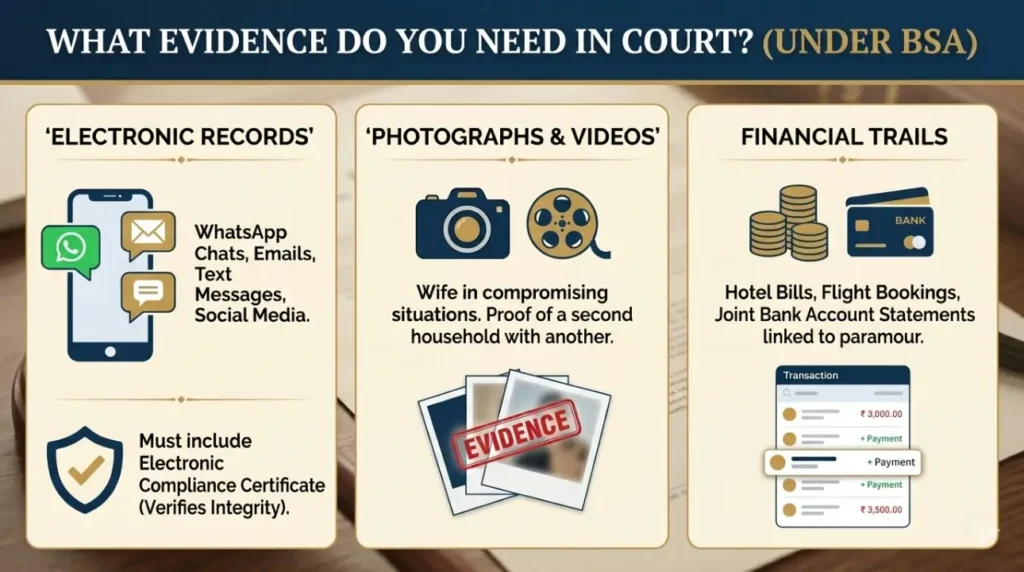
Because the standard of proof in these civil matrimonial cases relies on the preponderance of probabilities (showing that it is highly likely that cheating occurred), having undeniable evidence is crucial. Under the Bharatiya Sakshya Adhiniyam (BSA) (which replaced the Indian Evidence Act), digital and circumstantial evidence plays a massive role:
- Electronic Records WhatsApp chats, emails, text messages, and social media interactions are fully admissible. However, they must be accompanied by the required electronic compliance certificates to ensure they haven’t been tampered with.
- Photographs and Videos Visual proof showing your wife in compromising situations or establishing a second household with another person.
- Financial Trails Hotel bills, flight bookings, or joint bank account statements linked directly to the paramour.
Need Guidance on Your Divorce Proceedings Involving Infidelity
Navigating the emotional and procedural complexities of marital infidelity and family law in India requires clear, strategic guidance. Trying to act impulsively or misinterpreting the standards of proof required to establish a spouse’s multiple relationships can weaken your case, costing you valuable time, financial security, and peace of mind.
If you are looking to understand your options, evaluate your eligibility to contest a divorce, protect your assets, deny unfair maintenance claims, or settle matrimonial matters smoothly, the experienced legal team at G.S. Bagga & Associates is here to assist you. With extensive experience across Indian family courts, we ensure your legal transition is handled with the utmost confidentiality, speed, and dignity.