


Navigating marriage laws can feel incredibly overwhelming, especially for Sikh families in India trying to understand where they stand legally. While a Sikh wedding has its own beautiful, separate legal recognition, ending that marriage involves a completely different set of rules.
We often meet clients who are deeply confused about whether the Anand Marriage Act covers legal separation. In this guide, we cuts through the complex legal jargon to explain the limits of the Anand Act, how the Hindu Marriage Act fills the gap, and what the actual step by step journey looks like in a family court.
Understand the Anand Marriage (Amendment) Act, 2012
Back in 1909, the Anand Marriage Act was first passed to give proper legal backing to Anand Karaj, which translates to a “blissful event”. But for over a century, the law had a massive, frustrating flaw. It didn’t actually give couples a way to register their marriage with the government.
Because of this, Sikh couples had no choice but to get their marriage certificates under the Hindu Marriage Act. This caused a real identity crisis for families moving or traveling abroad, where their official paperwork didn’t reflect who they actually were.
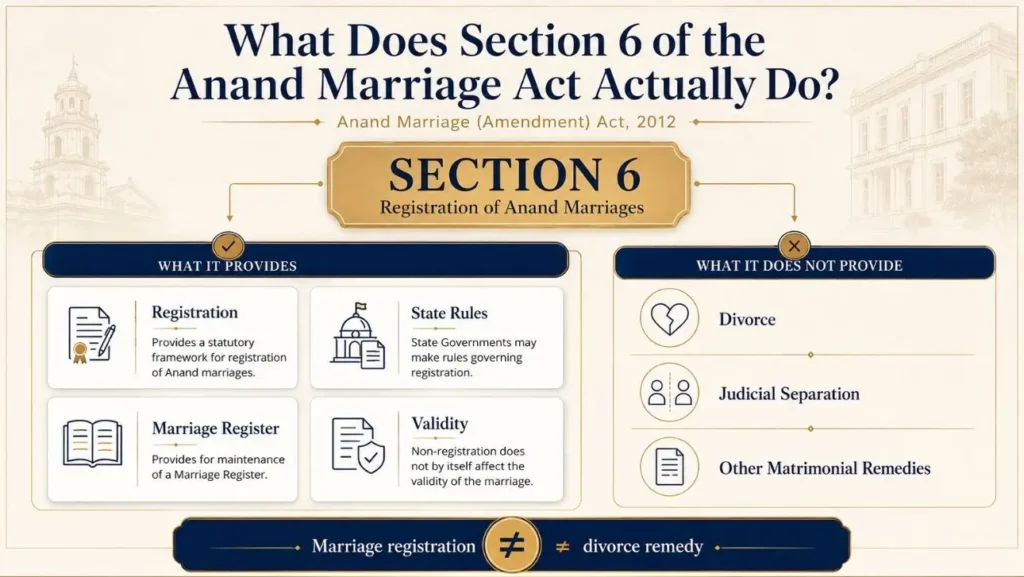
To address this issue, Parliament enacted the Anand Marriage (Amendment) Bill 2012. The amendment introduced Section 6, providing a statutory framework for the registration of Anand marriages and empowering State Governments to make rules governing the registration process.
The 2012 amendment primarily addressed the registration of Anand marriages. It did not introduce provisions dealing with divorce, judicial separation, maintenance or other matrimonial remedies. Those issues therefore have to be considered under the other matrimonial laws applicable to the parties.
Why Sikh Ideology and Rehat Maryada Do Not Feature Divorce
To truly understand why this law leaves out divorce, we have to look at the deeply spiritual heart of the faith. In Sikhism, a wedding isn’t a casual civil contract or something you can easily dissolve. It is seen as a profound, sacred bond where two souls become one light, a concept known as “Ek Joti Due Murati”.
The Sikh Rehat Maryada, which is the community’s official code of conduct, describes how an Anand Karaj must take place directly in front of the Sri Guru Granth Sahib Ji. Because Anand Karaj represents a lifelong spiritual partnership, Sikh religious principles place strong emphasis on commitment and reconciliation.
However, these religious principles should be distinguished from India’s matrimonial laws, which determine the legal process and remedies available when a marriage breaks down.
Does the Anand Marriage Act Provide for Divorce?
If we look at the strict legal reality, the answer is a definitive no. The Anand Marriage Act doesn’t have a single line about divorce, separation, or financial maintenance. This legal gap has caused painful debates across generations because, despite what religious ideals teach us, painful marital breakdowns are a real human reality in every single community.
What Does Section 6 of the Anand Marriage Act Actually Provide?
Section 6, inserted by the 2012 amendment, provides for the registration of Anand marriages. It requires the State Government to make rules for registration and provides for the maintenance of a Marriage Register. Importantly, Section 6 also states that failure to register an Anand marriage does not, by itself, affect the validity of the marriage.
While this certificate is incredibly helpful for getting visas, handling inheritance, or opening bank accounts, it gives judges zero power to end a marriage or sort out disputes when things go wrong.
Why Do Sikh Couples Rely on the Hindu Marriage Act for Divorce?
Since the Anand Act offers no solutions for a broken marriage, couples are forced to use the broader civil laws of India. According to Section 2 of the Hindu Marriage Act (HMA), 1955, the legal term “Hindu” is written to include Sikhs, Jains, and Buddhists for all family court matters. That is why the HMA has become the default legal tool that family courts use to help Sikh partners find a path forward.
How Sikh Divorces are Governed Under the Hindu Marriage Act
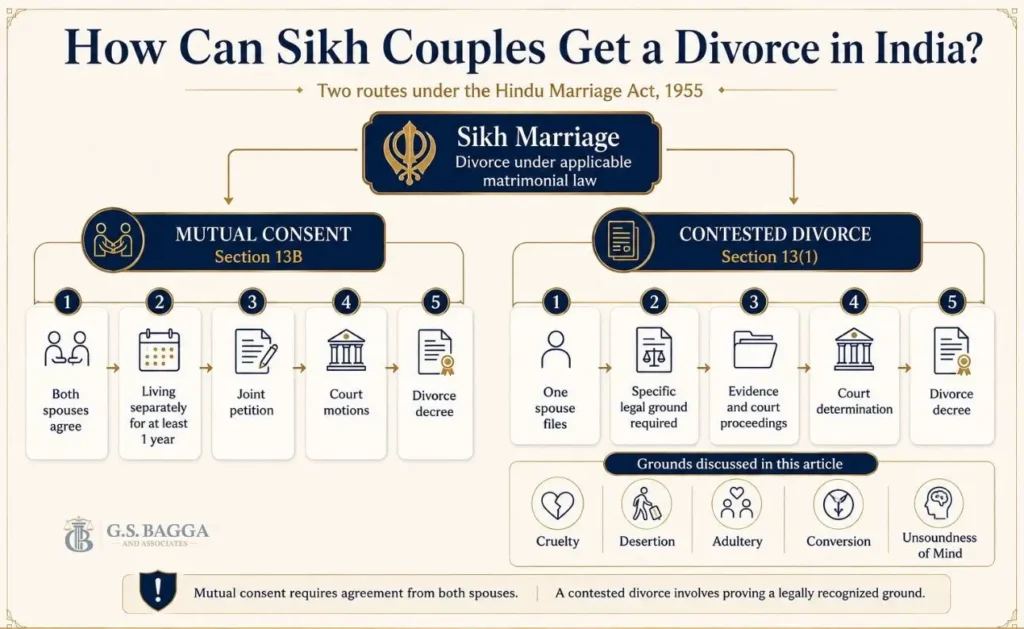
When a marriage is no longer salvageable, Sikh individuals have to navigate the family court system using the specific routes laid out in the Hindu Marriage Act, 1955. The law basically gives you two very different paths depending on your situation:
Requirements for Mutual Consent Divorce
This falls under Section 13B of the HMA, and it is by far the least painful way to close a chapter. Both partners come to court together and file a joint petition, proving three main things:
- They haven’t lived together under the same roof for at least a full year.
- They have tried their absolute best but simply cannot reconcile or live as a couple again.
- They have both freely agreed that dissolving the marriage is the right choice.
Legally Recognized Grounds for a Contested Divorce
When only one partner wants out, the situation becomes a contested battle under Section 13(1). The person filing has to prove a specific fault in court. The law recognizes a few heavy grounds, including:
- Cruelty: Facing physical abuse or severe mental torment from your spouse.
- Desertion: Being completely abandoned without a valid reason for two years straight.
- Adultery: Your partner willingly choosing to have an intimate relationship outside the marriage.
- Conversion: Your spouse giving up their faith to convert to a different religion.
- Unsoundness of Mind: A severe, incurable mental illness that makes living together impossible.
How Long Does the Process Take?
The time you will spend in court depends almost entirely on how cooperative both sides are:
- Mutual Consent: Usually takes anywhere from 6 to 15 months. After you file the first time, the court gives you a mandatory “cooling off” period to think things over. If you still feel the same way after those months pass, you file a second motion to finalize the divorce.
- Contested Divorce: This path is a marathon. It can drag on for 2 to 5 years, sometimes even longer, because you have to go through intense trial procedures, argue over who gets what assets, and handle bitter child custody battles.

Judicial Separation vs. Divorce for Sikh Couples
| Legal Feature | Judicial Separation (Section 10 HMA) | Divorce (Section 13 HMA) |
| Marital Status | You stay legally married in the eyes of the law. | The marriage is completely and permanently dissolved. |
| Cohabitation | You get legal permission to live apart and do your own thing. | All your marital rights and duties come to an end. |
| Remarriage | Neither of you can legally marry someone else. | You are both completely free to start a new marriage. |
| Reconciliation | The court can cancel this order easily if you decide to get back together. | It is final. To get back together, you would have to remarry. |
Where Can a Sikh Couple Legally File a Divorce Petition?
You cannot just walk into any random court to file your paperwork. According to Section 19 of the HMA, you have to approach the specific Family Court that has jurisdiction over where:
- The actual Anand Karaj took place.
- The respondent (the partner who isn’t filing the case) is living right now.
- You both last lived together as a married couple in your final matrimonial home.
- The wife is currently living, if she is the one taking the initiative to file the case.
Documents Required to File a Sikh Divorce Petition
To make sure the court clerk actually accepts your petition without tossing it back for fixes, you will need to gather a solid pile of paperwork:
- Proof of Marriage: Your Anand Karaj Marriage Certificate issued under Section 6, or your original wedding invitations and clear photos of the ceremony.
- Identity and Address Proof: Standard KYC documents like your Aadhaar Card, Passport, or Voter ID.
- Proof of Separation: Anything showing you have lived apart for over a year, like a separate rent agreement or formal notices.
- Financial Records: Your Income Tax Returns for the last 3 years, recent salary slips, and a breakdown of your assets so the judge can calculate fair maintenance or alimony.
- Photos: Passport size photos of both partners alongside a couple of your shared wedding pictures.
Frequently Asked Questions (FAQs)
Can Sikhs get divorced without using the Hindu Marriage Act?
For the vast majority, no. If you had a traditional Anand Karaj, the Hindu Marriage Act of 1955 is the only legal tool available to end it. The rare exception is if you bypass religion entirely from day one and register your wedding under the Special Marriage Act, 1954, which is a purely secular law code. If you did that, you would divorce under that secular law instead.
Is an Anand Karaj marriage legally valid without registration?
Yes, it is absolutely valid. Section 6(3) of the updated law makes it incredibly clear that forgetting or choosing not to register your marriage doesn’t take away the legal validity of a properly performed Anand Karaj. That said, our legal team always advises getting it registered anyway because life gets messy without that official paper when you need a passport or want to inherit property.
Can a Sikh couple get a divorce by mutual consent?
Yes, they absolutely can. A Sikh couple can smoothly use Section 13B of the Hindu Marriage Act, 1955 to end things amicably. You just have to meet the basic legal requirements: live apart for at least twelve months and both tell the judge that you want to move on separately.
Conclusion
When you look at the whole picture, the Anand Marriage Act does a wonderful job of protecting the beautiful identity of Sikh weddings, but it completely steps away when a marriage breaks down. To get a legally binding divorce, a legal separation, or alimony, Sikh couples have to look outside their specific act and use the Hindu Marriage Act of 1955 instead.
Going through a divorce is a deeply emotional journey that involves tricky paperwork and massive life changes. If you are feeling lost or need clear, empathetic guidance on your options, reach out to our team today for a completely private conversation.