

Remarriage after divorce is quite common in Indian families now, but it often brings a painful doubt in the minds of parents: if I marry again, will I lose my child? This fear is especially strong in cases of girl child custody after divorce in India, where families worry about safety, culture, and social judgment. Many parents are also unsure how courts look at child custody after divorce in India once there is a second marriage involved.
Legally, Indian courts have repeatedly said that remarriage alone is not a valid reason to give or take custody from any parent. The real question judges ask is simple: what is best for the child’s welfare in real life, not in theory. In this article, we discuss how child custody after remarriage is actually decided in Indian courts and what really matters for your child.
Child Custody Applies After Remarriage in India
Why Second Marriages Raise Custody Questions
When one or both parents remarry after a divorce, the child’s world changes in many ways: a new home, a new “uncle” or “aunty,” sometimes step‑siblings, a different school, or even a new city. Emotionally, children may feel confusion or loyalty conflicts, especially if they sense tension between the new spouse and the other biological parent.
Because of this, both sides often fear that the other parent will use the remarriage to reopen child custody after divorce in India. Parents worry that the court will favour the “single” parent over the “remarried” one, or that a mother’s second marriage will be used to attack girl child custody after divorce in India. Older social norms still influence people’s thinking, even though the courts have moved forward.
How Indian Courts Look at Custody When a Parent Remarries
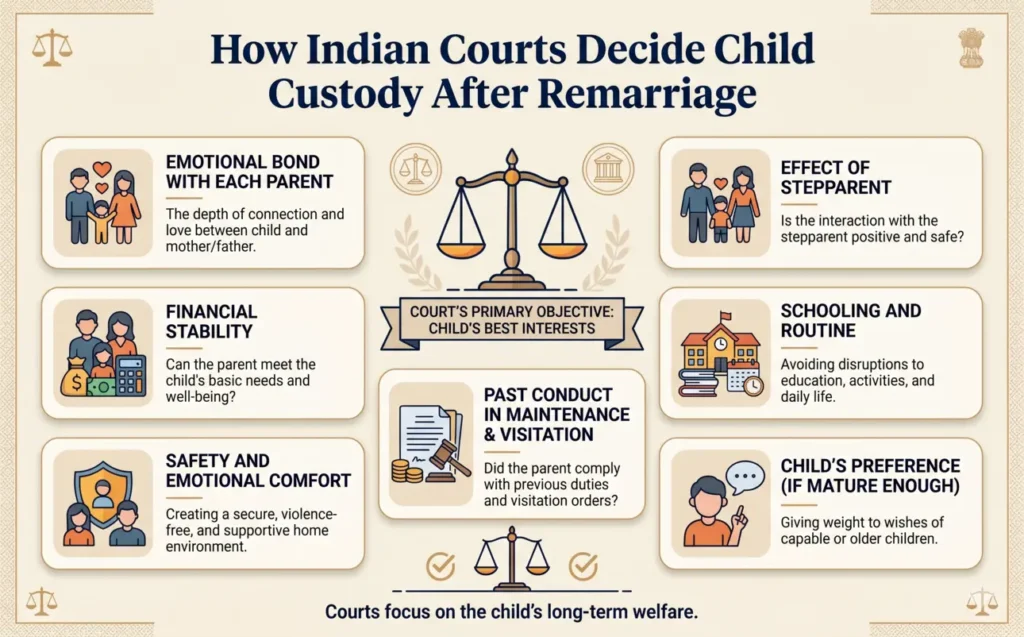
Indian courts do not treat remarriage as a punishment or a prize. They treat it as one circumstance among many that affect the child’s life. Judges focus on facts such as who is actually caring for the child every day, how stable and peaceful the home environment is, whether the child is safe, loved, and emotionally secure, and how the new stepparent behaves with the child and with the other biological parent.
So, child custody after remarriage is not decided by a fixed rule. It is an extension of the same welfare‑based approach that already governs child custody after divorce in India, applied to a new family structure.
Legal Foundations for Child Custody After Remarriage
Key Indian Laws Governing Custody and Guardianship
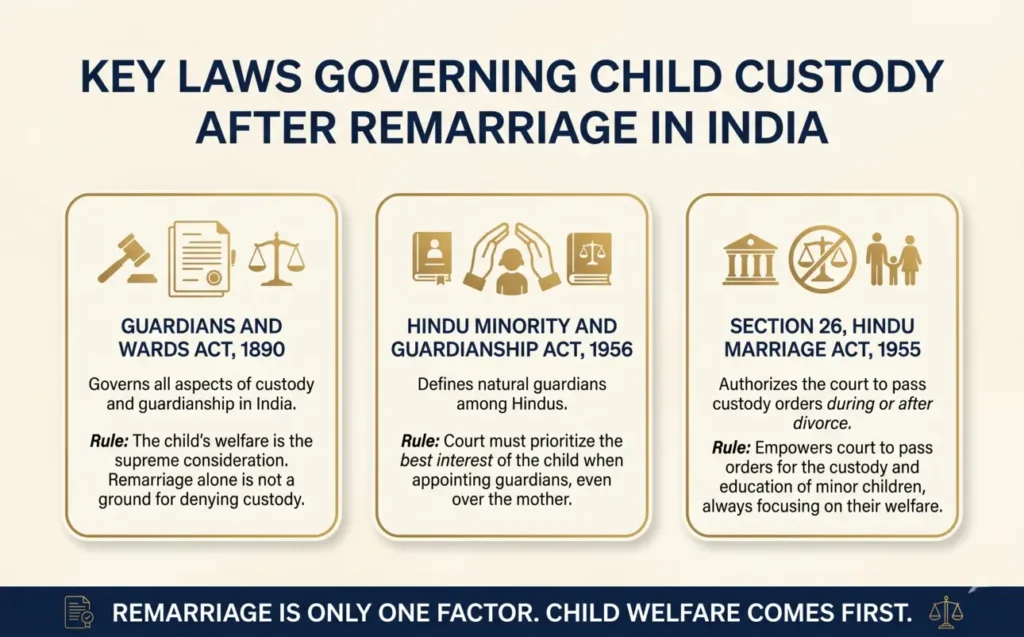
Child custody after divorce in India, including after remarriage, is primarily guided by these laws:
- Guardians and Wards Act, 1890 (GWA): the central secular statute for guardianship and custody, which says that the welfare of the minor is the first and paramount consideration.
- Hindu Minority and Guardianship Act, 1956 (HMGA): for Hindus, this law defines natural guardians but is also subject to the welfare principle.
Section 26 of the Hindu Marriage Act, 1955 allows courts to pass orders for custody, maintenance, and education of children during and after divorce proceedings. Courts consistently stress that no personal law rule or old “father first, mother second” idea can override the welfare standard.
Welfare of the Child as the Paramount Test in Remarriage Cases
Across decades, courts in India have said that the welfare of the child is paramount in custody matters, not the technical “right” of the father or mother. This principle governs:
- Child custody after divorce in India
- Girl child custody after divorce in India
- Child custody after remarriage of either parent
Courts have held that a father’s remarriage cannot be treated as a ground, by itself, to deny him custody if he has been fulfilling his commitments and looking after the child. Similarly, the Supreme Court has ruled that a mother’s remarriage cannot be taken as a ground to refuse custody where the child’s welfare is better served by staying with her. Remarriage is tested only through one lens: how it affects the child’s welfare.
Remarriage of a Custodial Parent in India
How a Custodial Parent’s Second Marriage Can Change the Child’s Life
When the custodial parent (the parent with whom the child primarily lives) remarries, the child must adapt to a new family situation. As your original text puts it, the child may have to adjust to “a new home, family or even a new city,” and everything depends on the “unique situation building up in the meanwhile.” A stepparent can bring financial strength, emotional harmony, and overall stability when the marriage is healthy and supportive.
Courts look at how this second marriage has actually changed the child’s daily life. Are meals, homework, sleep, and health care running smoothly? Does the child show comfort and affection in the new home? Or does the child show fear, withdrawal, or strong resistance to the stepparent? These practical signs matter more than labels or assumptions.
Situations Where Remarriage Supports Continuation of Custody
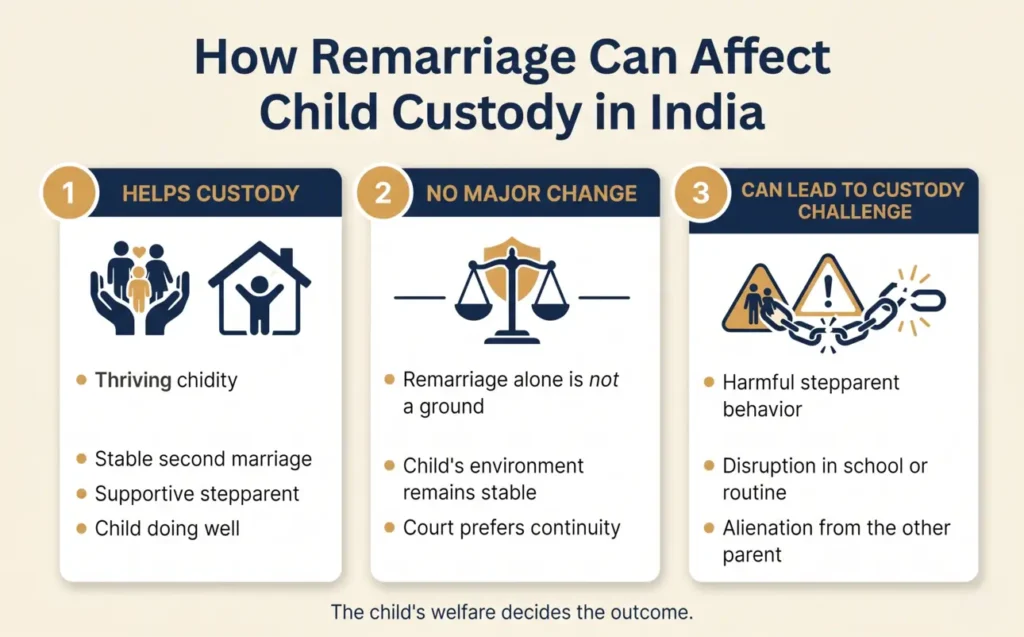
A custodial parent’s remarriage can strengthen the existing custody arrangement when it improves the child’s overall situation. For example:
- Better living conditions and financial security for the child.
- Less conflict at home compared to the pre‑divorce period.
- A positive, respectful bond between child and stepparent.
When the child is settled, performing well in school, and emotionally at ease, courts are usually reluctant to disturb custody just because the parent has decided to “go ahead in life” and remarry. In such situations, child custody after remarriage often continues with the existing custodial parent.
Situations Where Remarriage May Lead to Custody Being Challenged
The non‑custodial parent may seek modification if the remarriage harms the child’s welfare. Some examples include:
- The stepparent is hostile, abusive, or routinely humiliates the child.
- The child’s schooling and routine are disrupted without proper planning.
- The custodial parent uses the new spouse to alienate the child from the other parent.
Courts do not change child custody after divorce in India on suspicion alone. They look for credible evidence and patterns. Where remarriage has clearly created a harmful or unstable environment, judges may revise custody or enhance contact with the other parent to protect the child.
Treatment of Custodial Mother’s Remarriage and Young Children
In the past, a mother’s second marriage was sometimes treated as a moral fault. Modern decisions have moved away from this thinking. Many authorities note that children under five years are ordinarily expected to remain with the mother unless serious reasons show that doing so would harm the child.
This presumption is strong in early childhood due to the child’s tender age and need for care. The Supreme Court has clearly held that a mother’s remarriage does not automatically rob her of her parental right to custody.
For girl child custody after divorce in India, courts are particularly sensitive to safety and emotional comfort, but they do not punish a mother simply because she chooses to remarry. The focus stays on whether the new home remains a safe, nurturing environment.
Remarriage of the Non-Custodial Parent in India
Can a Non-Custodial Parent Seek Custody After Remarriage?
This question usually comes from genuine anxiety about losing contact with the child. Non‑custodial parents often ask whether remarriage gives them a “fresh chance” at custody. Legally, a non‑custodial parent can always approach the court if there is a significant change in circumstances, including a new marriage.
But the second marriage itself does not give an automatic right to shift child custody after divorce in India. Courts ask whether this parent has been paying maintenance on time, using visitation rights regularly, and building a stable, positive relationship with the child. If the answer is largely “no,” then the new marriage on paper does not help very much.
When a Stable Second Marriage Strengthens a Custody Modification Request
A stable second marriage can support a request for modification when the new household genuinely offers a better environment for the child:
- The new spouse is supportive and willing to share caregiving.
- The remarried household provides better educational and emotional support.
- The parent has a consistent history of involvement and responsibility.
In such cases, the second marriage is part of a bigger story of steady, responsible parenting, and it can become a positive factor in child custody after remarriage disputes.
Limits of Relying on Remarriage Alone to Change Custody
Even when a non‑custodial parent has a very stable second marriage, courts are cautious about uprooting a child from a settled arrangement. Judges often consider steps like extended visitation, overnight access, or holiday contact before thinking about a complete change of custody.
If the child is thriving with the custodial parent, a higher income or more comfortable lifestyle for the other parent is usually not enough. This protective approach applies to both boy and girl child custody after divorce in India, and it helps ensure that the child is not treated as a bargaining chip in ongoing disputes.
How Indian Courts Evaluate Remarriage in Custody Disputes
Impact of New Spouse (Stepparent) on the Child’s Welfare
The stepparent’s role is central when judges evaluate child custody after remarriage. Courts examine the emotional bond between the child and the stepparent, and whether the stepparent encourages a healthy relationship with the other biological parent.
They also look for any signs of psychological, verbal, or physical abuse. A caring stepparent can act as an additional support in the child’s life, while a hostile or abusive stepparent can justify revisiting custody or restricting access.
Financial, Emotional, and Environmental Changes After Remarriage
Judges look at the combined impact of financial, emotional, and environmental changes after remarriage. They consider whether the household can comfortably meet the child’s education and health needs, whether the atmosphere at home is calm and predictable or full of conflict, and whether the neighbourhood and extended family network are supportive.
In girl child custody after divorce in India, particular weight is often given to privacy, safety, and the presence of trustworthy caregivers, while still applying a gender‑neutral welfare standard.
Past Conduct in Maintenance and Visitation Orders
Courts place strong emphasis on past conduct. A parent who has ignored maintenance obligations or repeatedly failed to use visitation rights is viewed with caution when seeking custody based on a new marriage.
By contrast, a parent who has consistently honoured court orders, maintained contact, and prioritised the child’s needs is more likely to be taken seriously when asking for changes after remarriage.
Child’s Preference in Custody After a Parent’s Remarriage
When Indian Courts Ask the Child About Living With a Remarried Parent?
Courts in India begin giving significant weight to a child’s views when the child is old enough to form an intelligent preference, often around nine years of age and above. In child custody after remarriage cases, judges may speak with the child privately, away from both parents, to get an honest sense of how the child feels.
The child may say they feel more comfortable in the remarried parent’s home or that they are afraid or unhappy with a particular stepparent. These views are important but are always cross‑checked against the real conditions on the ground.
Balancing the Child’s Wishes With Concerns About the New Household
A child’s wishes are influential, but they are not the final word. Judges balance the sincerity and maturity of the child’s preference, objective signs of safety and stability in each home, and any hints of coaching or pressure from either parent.
If the child’s choice matches a stable, nurturing environment, courts are more likely to follow it. If the choice clearly goes against the child’s long‑term welfare, courts may choose a different arrangement in the child’s best interests.
Joint and Shared Custody After Remarriage
Use of Joint or Shared Custody When One Parent Remarries
Joint custody and shared parenting models are slowly gaining ground in Indian family law. Law Commission recommendations and recent judgments recognise that children benefit when both parents remain actively involved in their upbringing, even after divorce.
In child custody after remarriage, courts may keep primary physical custody with one parent but allow both parents to share legal custody. That means both parents have a say in major decisions about education, health care, and religious or cultural upbringing. If a remarried parent and the other parent can communicate in a civil, child‑focused way, shared models can work well.
Shared Parenting Models With Two Remarried Households
When both parents have remarried, shared parenting can become more complex but also more supportive, as the child may receive care from two extended families. Courts may design detailed parenting plans that cover weekly schedules, holidays, festivals, and rules for communication and school events.
For both boy and girl child custody after divorce in India, such shared arrangements can reduce the sense that divorce and remarriage mean losing one parent forever.
Practical Guidance for Parents on Child Custody After Remarriage
Steps to Protect the Child’s Best Interests Before and After Remarriage
Parents planning remarriage should protect the child’s emotional and practical stability. It is helpful to introduce the new partner slowly, explain upcoming changes in age‑appropriate language, and keep important routines like schooling and health care as steady as possible.
Even if communication with the ex‑spouse is difficult, it should remain focused on the child, not old marital disputes. Parents should avoid using the child as a messenger or weapon in fights over property, maintenance, or access.
Courts notice when a child is used this way, and it can count against that parent in future child custody after remarriage hearings.
When to Approach an Indian Family Court for Modification of Custody
Returning to court may be necessary when life after remarriage looks very different from what was expected. This can include clear emotional or physical risk to the child, ongoing denial of court‑ordered visitation, or major financial and living changes that seriously affect the child’s welfare.
In such cases, it is important to consult a family law advocate who regularly handles sensitive matters like girl child custody after divorce in India and has practical experience dealing with complex child custody after remarriage disputes, so that your case strategy stays fully aligned with current Indian custody law and court practice.
Final Thoughts on Child Custody After Remarriage
Remarriage has become a normal part of post‑divorce life, but it does not automatically change custody. Courts in India consistently look beyond labels and focus on the child’s real welfare and long‑term stability. In disputes involving child custody after divorce in India, judges examine who can provide a safer and more emotionally secure environment.
When remarriage improves the home situation, child custody after remarriage may continue with the same parent without disturbance. Where a second marriage creates conflict or neglect, the court can modify orders to protect the child. This approach also guides girl child custody after divorce in India, where safety, dignity, and emotional comfort are carefully evaluated.