

Getting a divorce in India involves a structured legal process requiring patience and careful legal planning. Inter religion couples often face confusion about which family laws apply to their divorce. Many couples worry that different religious beliefs might create complicated legal blockages during court proceedings.
Fortunately the Indian judicial system provides a clear secular pathway to resolve these marriage disputes. In this comprehensive guide, we explain the step by step procedure for dissolving an interfaith marriage smoothly. Understanding your legal options will help you navigate this transition with clarity and confidence.
Both partners can protect their personal rights without changing their original faiths or religious identities. Knowing the correct legal rules saves significant time and reduces unnecessary stress for both families.
The Special Marriage Act 1954 for Inter Religion Divorce
If an inter religion couple has registered their marriage without changing faith then this Act applies. Because the marriage comes under this secular Act the legal dissolution happens under the same law. Neither husband nor wife needs to convert to another religion for filing a separation petition.
The family court will only look at the secular legal rules of this specific Act. Under this law you can apply for divorce through mutual consent or a contested route. This means your personal religious rules will not affect the court proceedings.
Where to File the Inter Religion Divorce Case
You can file your legal application where the marriage was originally registered or solemnized. You can also file where the husband and wife last lived together under one roof. Another option is the place where the respondent is currently staying within India.
The wife can also file from the city where she is currently residing. If you married by traditional religious rituals and changed religion, then your personal religious laws will govern the divorce. Marriages under the Hindu Marriage Act or Muslim personal law (Sharia-based personal law) must follow their own rules.
Note: Divorce for such marriages is governed by Section 27 (contested divorce) and Section 28 (mutual consent divorce) of the Special Marriage Act, 1954
How to Get Mutual Consent Divorce under Section 28
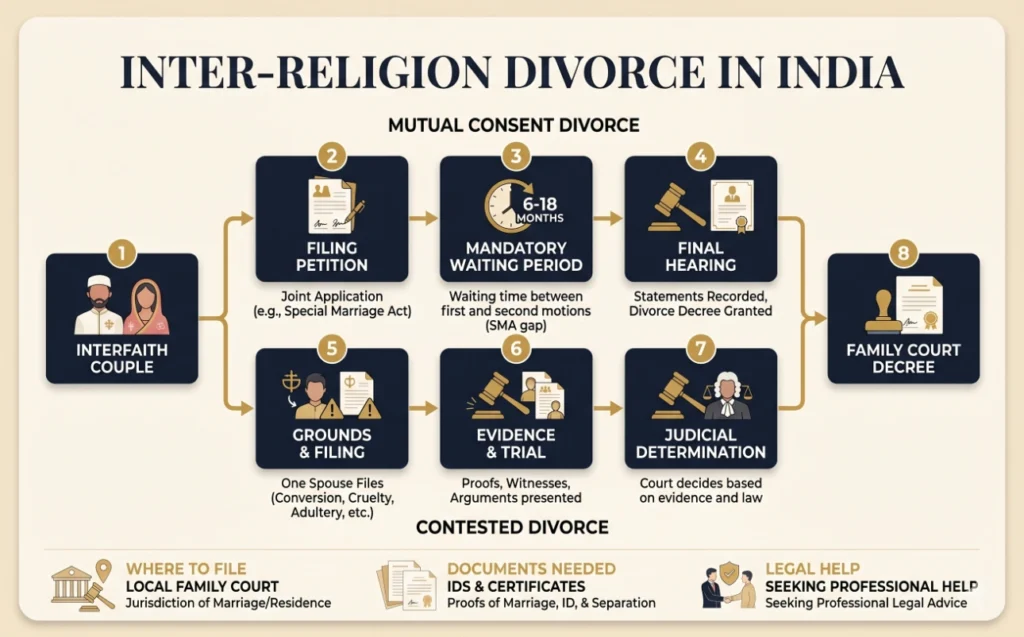
If both husband and wife agree to part ways peacefully this is the best option. It saves a lot of money, time, and personal respect for both families in India. The timeline for a mutual consent divorce usually ranges from six to eighteen months total.
Basic Requirements for Mutual Divorce under Section 28
Both parties must live separately for at least one year before presenting the petition. You have to satisfy the judge that you cannot live together as husband and wife. There must be clear agreement regarding ending marriage settling alimony and handling child custody. Both partners must give their free consent without any force or pressure from anyone.
Shorter Waiting Time Rules for Mutual Divorce
Normally the court gives a mandatory six month cooling period to rethink your decision. But the landmark judgment of Amardeep Singh v Harveen Kaur 2017 changed this strict rule. The Supreme Court ruled that judges can now waive off this six month waiting period.
This waiver is given if there is absolutely no chance of saving the marriage union. The Supreme Court clarified that this six month period is directory and not mandatory, so the judge can waive it in appropriate cases.
How to File a Contested Divorce under Section 27
If your spouse does not agree to mutual divorce, you must file a contested divorce case. Here you have to prove solid legal grounds in front of the family judge. A contested divorce in India often takes longer and can last from two to five years or more.
Legal Grounds for Contested Inter Religion Divorce
- Cruelty: You can file for divorce if your spouse treats you with physical or mental cruelty, such as abuse, constant insults, or humiliating behaviour.
- Desertion: You can apply for divorce if your partner has deserted you for a continuous period of at least two years without a valid reason and with no intention to return.
- Adultery: Adultery is a ground if your spouse has had voluntary sexual relations with someone outside the marriage during the subsistence of your marriage.
- Imprisonment: You can file if your spouse is undergoing a jail sentence of seven years or more, based on a valid conviction by a competent court.
- Mental illness: Severe mental illness that makes it impossible or unsafe to live together as husband and wife is also a valid legal ground.
- Incurable venereal disease: Suffering from an incurable venereal disease, which poses a serious health risk to the other spouse, is another recognised ground for divorce.
- Burden of proof: In a contested case, you must present proper evidence and supporting documents or witnesses to prove these grounds before the family court.
Alimony and Child Custody Rules for Inter Religion Marriage
Under the Special Marriage Act courts decide alimony based on income and property of spouses. The financial status of both husband and wife is evaluated to determine fair maintenance amounts. Child custody decisions depend strictly on the welfare and best interests of the minor child. The court can grant joint custody or visitation rights depending on the family circumstances.
Documents Required for Inter Religion Divorce Cases
You need to submit specific papers to the family court when filing your petition. The key documents include the official marriage registration certificate under the Special Marriage Act. Address proofs of both husband and wife along with passport photographs are strictly mandatory. Evidence of separate living for one year and income tax statements must be attached.
Frequently Asked Questions
Can Hindu and Muslim couple divorce in India?
Yes an interfaith couple can file for divorce in India under secular laws easily. The Special Marriage Act governs their legal dissolution without requiring any religious conversion. Both partners can approach the family court directly for relief.
What documents are needed for inter religion divorce?
You need the marriage registration certificate address proofs passport photographs and family income statements. Evidence proving separate living for at least one continuous year is also mandatory. Mutual consent petitions also require signed agreements regarding alimony terms.
How long does an inter religion divorce take?
A mutual consent divorce under secular law takes around six to eighteen months. A contested case takes longer ranging from two to more than five years. The exact duration depends on court backlogs and cooperation between both parties.
Which law applies if we did not register under Special Marriage Act?
If you married through traditional religious rituals your personal laws will govern the divorce. Matrimonial acts like the Hindu Marriage Act or Muslim personal law applies instead. Secular law benefits require proper registration under the Special Marriage Act.
Conclusion
Ending an inter religion marriage does not mean fighting a bitter battle over your faiths. The Special Marriage Act gives a completely secular and straightforward legal process for Indian couples. Knowing your exact legal rights can make this difficult journey much easier for you. Taking the right legal step at the correct time ensures a peaceful future for everyone.
You should take proper guidance from an expert family lawyer for sorting your case. Experienced professionals at the Law Office of G.S. Bagga & Associates can protect your legal rights. They will help clear your alimony property division and child custody without extra stress.