

Marriages in India are deeply cultural and emotional milestones, uniting not just two individuals but two families. However, when a marriage breaks down irretrievably, parting ways legally and cleanly becomes necessary to protect your future.
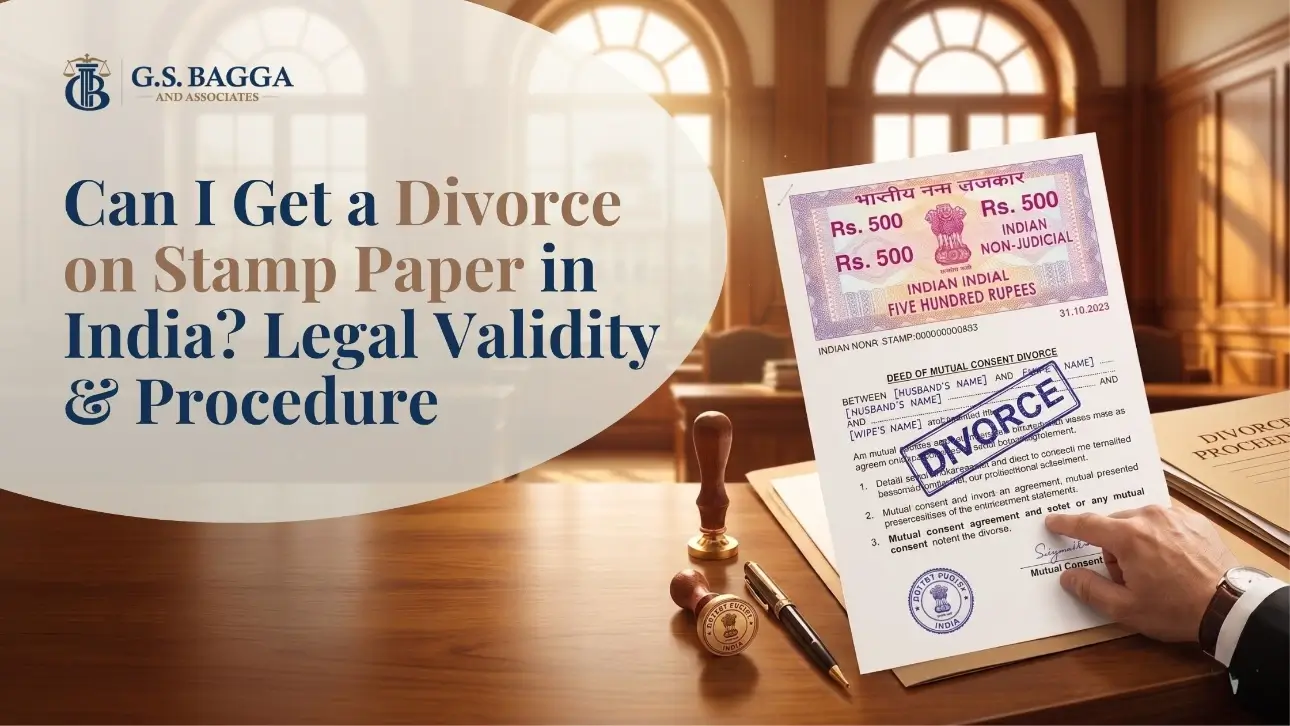
A very common misconception across the country is that a couple can dissolve their marriage quickly and quietly by simply signing a mutual agreement on a divorce stamp paper and getting it notarized.
But is a divorce on stamp paper legally valid? can you legally apply for divorce via Stamp paper? Let’s look directly at what Indian family law or divorce law says about this practice.
Can You Get a Divorce on a 100 Rs Stamp Paper?
To put it simply: Absolutely not. A very common myth across India is that a mutual agreement or a divorce on 100 rs stamp paper or ₹500 stamp paper is a quick, hassle-free shortcut to legal separation. However, the legal reality is starkly different:
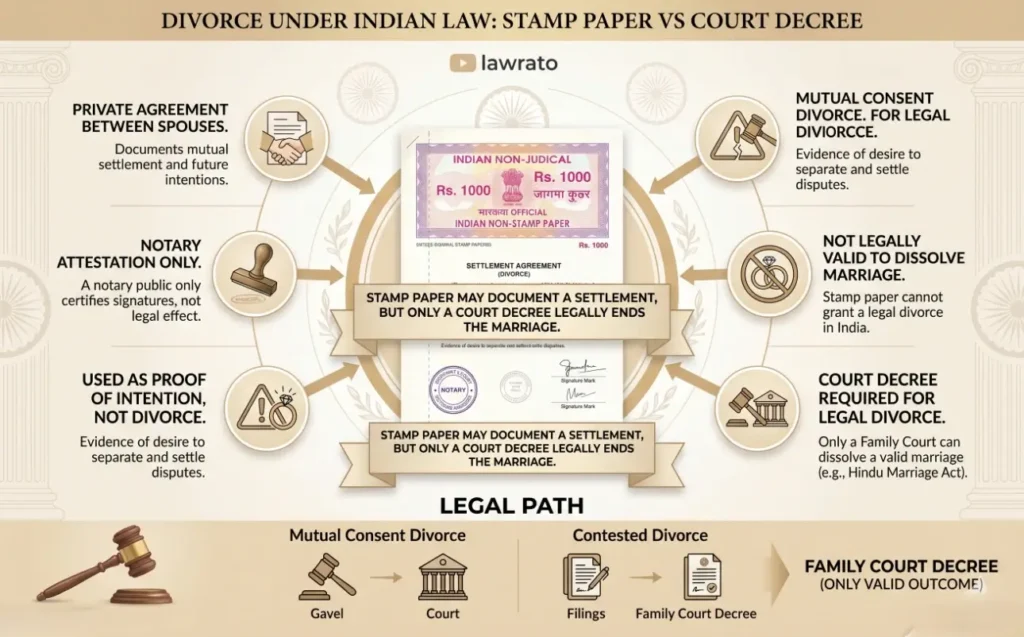
- Notaries Aren’t Judges: A notary public has the authority to verify signatures and attest documents, but they possess absolutely no judicial power to dissolve a marriage.
- Exclusive Court Jurisdiction: Under Indian personal laws, a marriage can only be legally terminated through a proper trial or mutual petition processed inside a competent Family Court.
An out-of-court agreement executed on a divorce stamp paper is completely void in the eyes of the law. This means both partners remain legally bound to each other, leaving them exposed to severe legal and financial complications.
Serious Legal Risks of a “Notary Divorce”
Relying on a piece of paper to end your marriage instead of a court decree can land you in severe legal trouble:
- Charges of Bigamy: Because a divorce on stamp paper is legally invalid, your first marriage remains fully alive. If you remarry based on a notary document, your spouse can prosecute you for bigamy under Indian law, which carries a penalty of up to 7 years in prison.
- No Enforceable Rights to Alimony: If your partner stops paying the maintenance or alimony agreed upon in the private contract, you cannot approach a court to enforce it because the foundational document itself is illegal.
- Child Custody Vulnerability: Legal custody and guardianship of children cannot be permanently settled through a private notary agreement. Only a Family Court can pass a binding order that protects the child’s future.
The Single Exception: A customary divorce outside of court is only recognized if a specific, long-standing custom is legally proven to exist within your specific community or tribe (such as under Section 29(2) of the Hindu Marriage Act, 1955). However, proving such a custom in a court of law is incredibly difficult, heavily contested, and rarely succeeds without extensive litigation.
How to Legally File for Divorce in India?
To obtain a legally binding separation, you must follow the formal divorce procedures established under Indian personal laws, such as the Hindu Marriage Act, 1955, or the Special Marriage Act, 1954. There are two primary routes you can take:
1. Divorce by Mutual Consent (The Preferred Route)
If both husband and wife mutually agree that they cannot live together anymore, they can file for a mutual divorce. This is the fastest, most dignified, and least expensive way to separate.
- Key Requirement: Both partners must have been living separately for at least one continuous year before filing the petition.
- Settlement Terms: Issues regarding alimony, child custody, and division of joint assets must be mutually decided and drafted into the petition beforehand.
2. Contested Divorce
If one partner wants a divorce but the other does not agree, or if they cannot agree on settlement terms, a contested divorce must be filed.
- Legal Grounds Required: You must prove specific legal grounds in court to get a contested divorce. These grounds include cruelty (mental or physical), adultery, desertion (for more than 2 years), conversion, or mental illness.
Quick Comparison Between Mutual Consent vs. Contested Divorce
To obtain a legally binding separation, you must follow the formal procedures established under Indian personal laws, such as the Hindu Marriage Act, 1955, or the Special Marriage Act, 1954.
| Feature | Mutual Consent Divorce | Contested Divorce |
| Agreement | Both spouses agree to separate willingly. | One spouse files; the other opposes or disagrees on terms. |
| Time Frame | Usually resolved within 6 to 18 months. | Can take 2 to 5+ years depending on complexities. |
| Cooling-off Period | 6 months (can be waived by the judge under specific conditions). | Not applicable. |
| Stress & Cost | Relatively low stress and highly cost-effective. | Highly stressful, emotional, and expensive. |

What Are The Documents To Be Submitted While Applying For Divorce?
If you are planning to file for a legal separation, ensure you have the following documents ready for your legal counsel:
- Marriage Certificate (or wedding invitation card and wedding photographs if unregistered).
- Address Proof of both husband and wife (Aadhaar Card, Passport, or Voter ID).
- Passport-size photographs of both parties.
- Proof of separate living for at least 1 year (for mutual divorce cases).
- Financial Documents: Income Tax Returns (ITRs) for the last 3 years, salary slips, and professional details (crucial for deciding alimony).
- Asset Details: Documentation of jointly owned properties, bank accounts, and gold/jewelry items.
Step-by-Step Legal Procedure in Indian Family Courts
For Mutual Divorce
- Filing a Joint Petition: Moving a joint application in the local Family Court.
- First Motion: Both parties appear, give their statements under oath, and the court records the first motion.
- Cooling-off Period: A mandatory waiting period of 6 months is given to allow a final chance for reconciliation (this can sometimes be waived via an application if the marriage is completely dead).
- Second Motion: If the couple hasn’t reconciled within 6 to 18 months of the first motion, they appear for the second motion.
- Decree of Divorce: The judge passes the final order dissolving the marriage legally.
For Contested Divorce
- Filing the Petition: One spouse files the petition detailing the specific legal grounds for the divorce.
- Summons: The court issues a formal notice to the other spouse to appear and submit a reply.
- Reconciliation/Mediation: The court mandates a session to check if the couple can save the marriage through mediation.
- Evidence & Arguments: Both sides present their evidence, and witnesses are cross-examined by the respective family lawyers.
- Final Judgment: The judge delivers the final verdict and issues a formal divorce decree.
Frequently Asked Questions (FAQs)
Q1. What should I do if I already signed a divorce stamp paper?
You must consult a family lawyer immediately. Since that document has no legal standing, you are still technically and legally married. You will need to file a formal petition in the Family Court to make your separation valid.
Q2. Can a mutual divorce petition be filed within the first year of marriage?
No. Under Section 13B of the Hindu Marriage Act, you cannot file for a mutual consent divorce unless you have been married for at least one year and have lived separately during that time.
Q3. Can a notary public ever grant a divorce decree?
No. A notary public is only authorized to authenticate signatures, administer oaths, and swear affidavits. They belong to the executive branch, not the judiciary, and have absolutely no power to dissolve a marriage.
Need Legal Assistance?
Navigating matrimonial disputes can be emotionally draining and legally complex. Taking shortcuts like an out-of-court divorce stamp paper will only lead to long-term legal complications and financial vulnerability.
If you are dealing with marital issues, separation, or child custody disputes, the experienced legal team at G.S. Bagga & Associates is here to guide you. With over 20 years of combined legal expertise across Indian family courts, we ensure your rights are fully protected through a proper, lawful process.
Contact G.S. Bagga & Associates today for a confidential, professional consultation.