

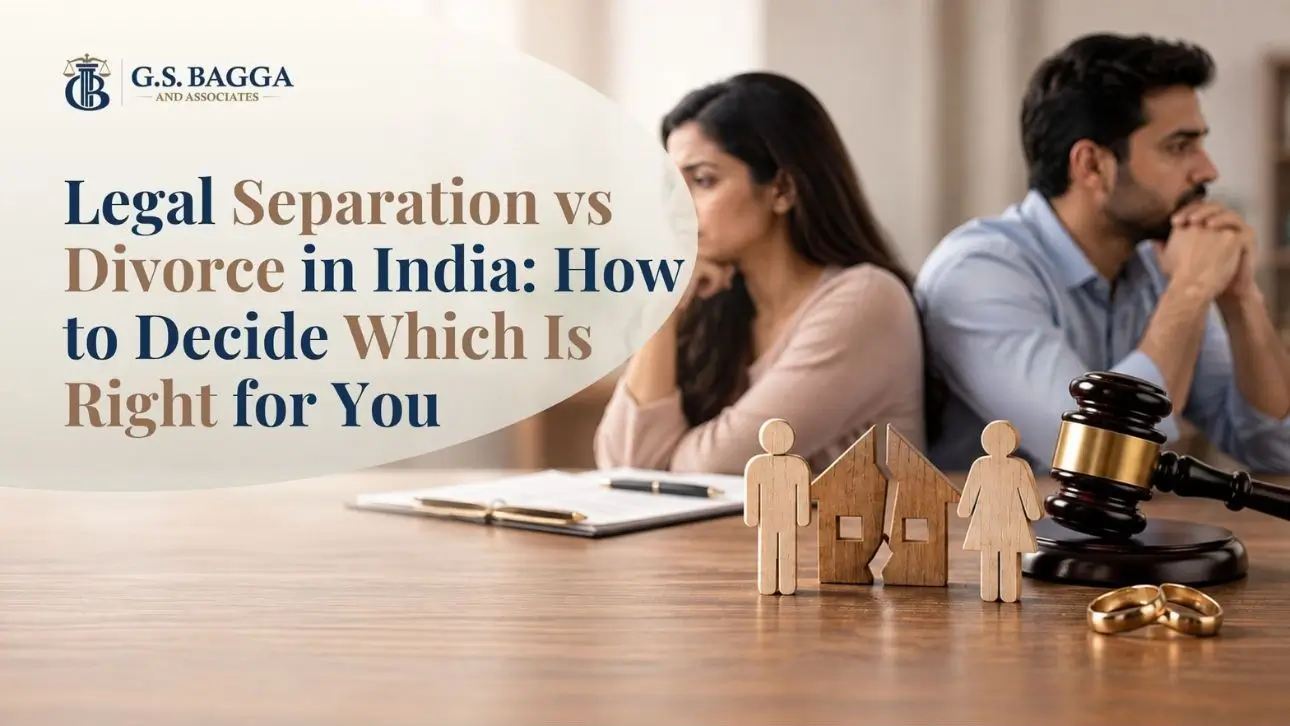
When marital distress becomes overwhelming, facing difficulties does not mean immediate divorce is your only path forward. In Indian family law, navigating marital conflict often involves choosing between two distinct legal remedies, judicial separation and divorce.
The core distinction between legal separation vs divorce lies in the continuity of marital status: judicial separation permits spouses to live apart legally while keeping the marriage intact, whereas divorce legally dissolves the marital union.
Understanding this separation vs divorce distinction is vital for protecting your immediate well-being, parental rights, and personal stability. In this guide, we examine statutory procedures, financial support, custody considerations, and practical decision criteria to help you determine which legal avenue fits your circumstances.
What Is Judicial Separation Under Indian Law?
What judicial separation means
Judicial separation is a formal statutory remedy granted by a Family Court that legally suspends the mutual obligation of marital cohabitation without ending the marriage itself. It serves as an intermediate legal status for spouses facing serious marital breakdown who are not ready for irrevocable dissolution.
How judicial separation works
A spouse initiates proceedings by filing a petition in Family Court under relevant statutes—such as Section 10 of the Hindu Marriage Act, 1955, or Section 23 of the Special Marriage Act, 1954. Once the court issues a decree of judicial separation, neither spouse is legally obligated to live with the other.
The marriage continues legally; neither party is unmarried or free to remarry. The effect of judicial separation on inheritance rights depends on the applicable succession law and the circumstances of the case, and spouses retain the possibility of reconciliation if they later choose to resume their marital relationship.
Is judicial separation the same as simply living separately?
No, judicial separation is not the same as informal physical separation. Informal physical separation or signing a private separation agreement carries no formal statutory recognition under most Indian matrimonial laws.
]Such private arrangements do not alter statutory marital obligations, leaving spouses vulnerable to legal petitions for restitution of conjugal rights or claims of desertion. Only a court-decreed judicial separation provides recognized legal protection.
What Is Divorce in India and What Does It Mean Legally?
Divorce is the formal, legal dissolution of a marriage under Indian law. A final decree of divorce formally terminates the matrimonial bond, altering reciprocal spousal rights and obligations.
What happens when a divorce is granted
Divorce ends the parties’ legal status as spouses. Both individuals revert to single legal status and regain the legal capacity to remarry once statutory appeal requirements are satisfied. The effect on inheritance, nominations and other benefits depends on the applicable law and circumstances.
However, certain legal obligations and court-ordered ties often continue beyond dissolution, specifically regarding compliance with maintenance or permanent alimony orders, property-related determinations, and ongoing child custody and support arrangements.
Mutual consent and contested divorce
Indian matrimonial statutes provide two primary avenues for obtaining divorce. Spouses may file for mutual consent divorce under applicable personal statutes (such as Section 13B of the Hindu Marriage Act) by jointly settling terms regarding maintenance and custody, or pursue a contested divorce where one spouse establishes statutory grounds such as cruelty, desertion, or adultery.
Legal Separation vs Divorce and the Key Differences
Understanding the difference between legal separation and divorce is vital when assessing marital remedies under Indian law. The primary difference between separation and divorce centers on legal finality, marital status, and future personal freedom.
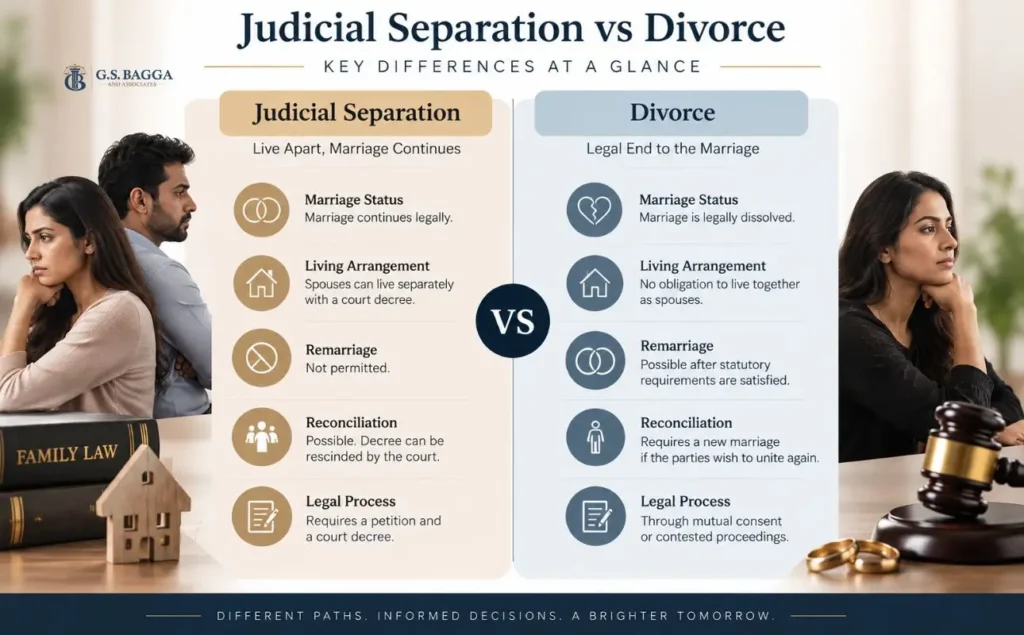
Marriage status and right to remarry
Under judicial separation, the marriage continues legally on public records. Judicial separation does not dissolve the existing marriage, so a person cannot remarry merely because a decree of judicial separation has been granted.
A second marriage while the first marriage is subsisting can have serious legal consequences under applicable law. In contrast, a divorce decree dissolves the marital contract, allowing both parties to remarry once statutory conditions and appeal timelines are met.
Living arrangements and legal finality
A judicial separation decree provides a court-recognised basis for spouses to live separately. Divorce, meanwhile, ends the marital relationship altogether. While judicial separation serves as an intermediate remedy that relieves cohabitation duties without ending the marriage, divorce achieves complete legal finality by ending the union.
Reconciliation and court involvement
Reconciliation remains straightforward under judicial separation vs divorce because the marriage endures. Either spouse can apply to the court to rescind the decree of judicial separation, and the court may do so if it considers it just and reasonable.
Once divorce is final, reconciling requires solemnizing an entirely new marriage under applicable law. Because they produce distinct consequences, judicial separation and divorce require separate court petitions and cannot be treated interchangeably.
Comparison: Judicial Separation vs Divorce
| Issue | Judicial Separation | Divorce |
| Marriage | Continues legally | Legally dissolved |
| Living Together | Spouses may live separately | No marital cohabitation obligation |
| Remarriage | Not permitted merely because of separation | Possible after legal requirements are satisfied |
| Reconciliation | Court may rescind decree if just and reasonable | Requires remarriage if parties want to unite again |
| Legal Status | Spouses remain legally married | Parties cease to be spouses |

How Judicial Separation and Divorce Affect Your Marriage
What changes after judicial separation?
Judicial separation alters the everyday reality of your marriage by legally releasing both partners from the duty to cohabit. However, it does not mean all marital obligations disappear.
The spouses remain legally married after judicial separation, but the effect on pension, insurance, nominations, inheritance and financial obligations depends on the applicable law, scheme and circumstances.
What changes after divorce?
After divorce, the parties are no longer legally married to each other. However, court-ordered maintenance, property issues and parental responsibilities may continue after the divorce.
Each party becomes an independent individual under the law, capable of making personal, financial, and estate decisions without spousal consent.
Why the distinction matters
Readers frequently ask: “Am I still legally married after separation?” The direct answer is yes. Judicial separation provides a legal basis to live apart while preserving the legal marriage, whereas divorce dissolves the marital relationship entirely.
Maintenance, Alimony and Property Rights After Separation or Divorce
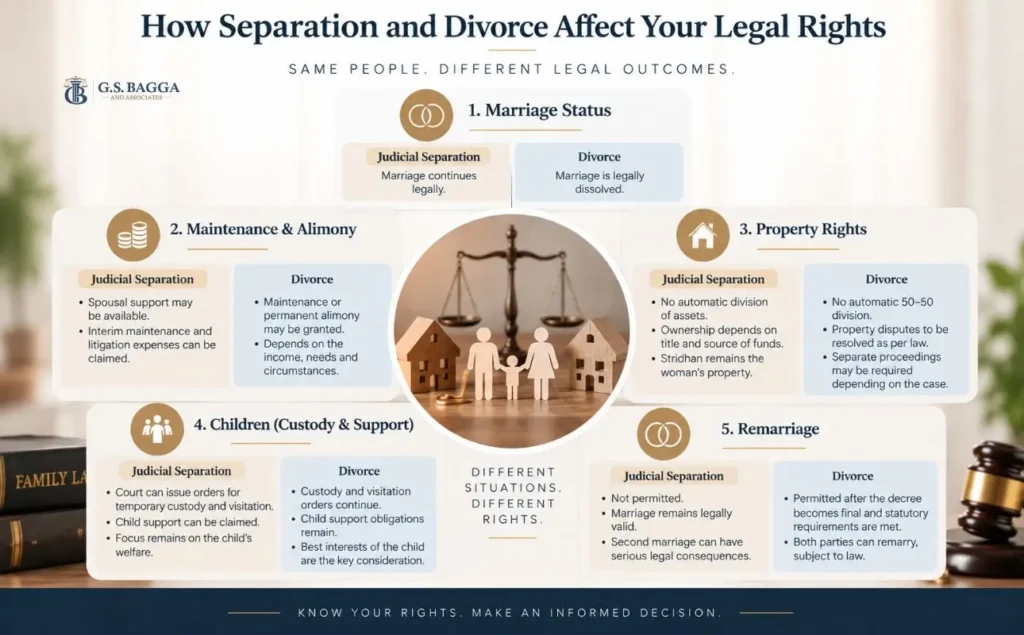
Maintenance during judicial separation
Judicial separation does not eliminate spousal support rights. Under personal matrimonial statutes (such as Sections 24 and 25 of the Hindu Marriage Act) and secular provisions under Section 144 of the Bharatiya Nagarik Suraksha Sanhita, 2023 (formerly Section 125 of the CrPC), a financially dependent spouse can seek interim maintenance and litigation expenses while living apart.
Maintenance and alimony after divorce
Depending on the applicable law and circumstances, a spouse may seek maintenance or permanent alimony during or after divorce proceedings. These claims are evaluated by the court to provide financial support, either as a lump-sum arrangement or recurring periodic payments, based on statutory factors.
How Separation or Divorce Can Affect Property Rights
Property ownership generally depends on the title, source of funds, applicable law and the facts of the case. Judicial separation or divorce does not automatically result in an equal division of all assets. Stridhan is generally treated as the woman’s own property.
Disputes concerning possession or return of stridhan may require appropriate legal proceedings depending on the circumstances. Jointly held assets must be resolved amicably or through independent civil partition proceedings.
Why financial circumstances matter
Courts do not apply fixed percentages when determining financial relief. Judges evaluate reasonable living requirements, income capacity, personal assets, pre-existing obligations, custody of dependent children, and overall economic dependency.
Child Custody and Support During Separation and After Divorce
Child custody during judicial separation
Living separately through judicial separation requires practical arrangements for children. The Family Court can issue appropriate directions regarding temporary physical care, parental responsibility, and visitation schedules to ensure stability while parents reside in separate homes.
Child custody after divorce
Divorce legally dissolves the marriage, but it does not end parental responsibilities. Family Courts may make appropriate orders concerning custody, care, visitation and access based on the welfare and best interests of the child, tailored to the facts of each family.
What courts consider
Custody is never determined as a parental reward or punishment. Under Indian jurisprudence, the welfare and best interests of the minor child remain the paramount consideration. Courts examine the child’s moral safety, educational continuity, emotional bonding, healthcare needs, and overall living environment.
Child Support and Parental Responsibilities
Courts may order financial support for children based on their needs, the parents’ financial circumstances and the applicable law. Parental maintenance duties exist to ensure sufficient provision for school fees, medical expenses, and general living standards.
Can You Reconcile After Judicial Separation?
Why judicial separation can leave the door open to reconciliation
Because judicial separation preserves the legal marriage, it provides valuable breathing room for couples seeking to resolve marital discord. If spouses decide to resume cohabitation, either spouse can apply to the court to rescind the decree of judicial separation, and the court may do so if it considers it just and reasonable.
What if reconciliation does not happen?
A decree of judicial separation does not automatically convert into a divorce. If the period of separation fails to resolve differences, the marriage continues until affirmative legal steps are taken.
When divorce may become relevant
Under the Hindu Marriage Act, for example, failure to resume cohabitation for one year or more after a decree of judicial separation can become a statutory ground for seeking divorce.
Can You Remarry After Judicial Separation or Divorce?
Remarriage after judicial separation
You cannot remarry after obtaining a decree of judicial separation. Because judicial separation does not dissolve the marital bond, your legal marital status remains intact. A second marriage while the first marriage is subsisting can have serious legal consequences under applicable law.
Remarriage after divorce
Remarriage generally becomes permissible only after a divorce decree has been granted and the statutory time frame for filing an appeal has expired without an appeal being filed, or any appeal filed has been dismissed. These requirements help ensure that the divorce decree has become legally effective before either party remarries.
How to Decide Between Legal Separation and Divorce in India
Choosing between judicial separation and divorce requires carefully evaluating your emotional circumstances, family realities, and civil objectives.
Infographic 3 — Should You Consider Judicial Separation or Divorce?
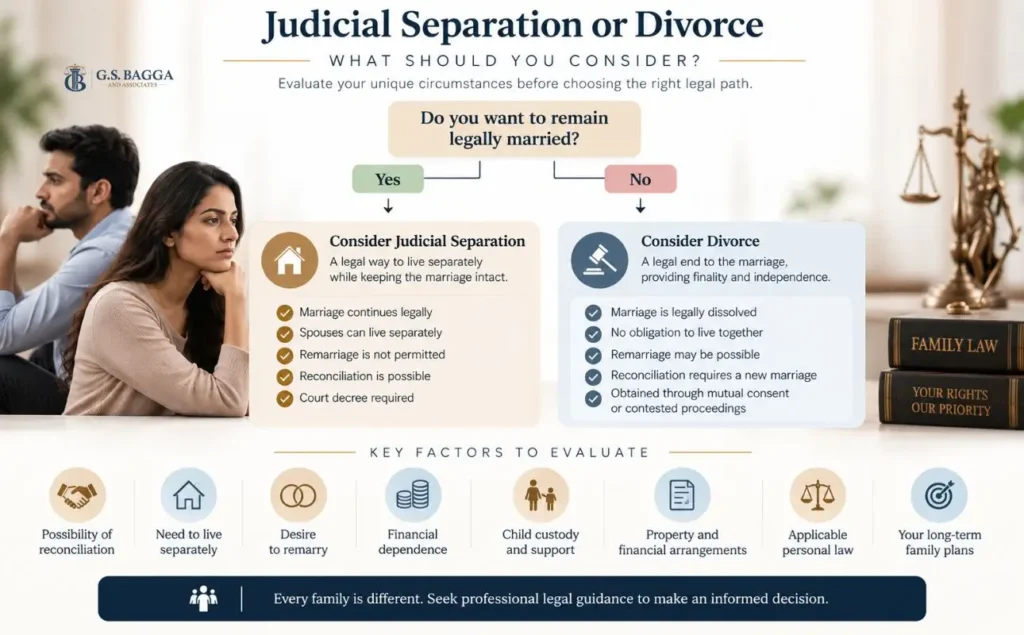
Consider whether you want to preserve the marriage
Ask yourself whether reconciliation remains a genuine possibility. If you need structured space, time, or marital counseling while keeping the legal marriage intact, judicial separation provides formal legal protection without permanent dissolution.
Consider whether you need legal separation
Judicial separation may be appropriate if personal, cultural, or religious convictions discourage divorce, or if you need an immediate, court-recognized basis to live separately without facing allegations of abandonment.
Consider the seriousness of the marital dispute
Weigh critical factors such as the degree of emotional breakdown, ongoing cruelty, personal safety concerns, and the stability of your children. Severe, irremediable abuse or desertion often points toward seeking a permanent legal dissolution rather than interim relief.
Consider Your Long-Term Plans
Clarify your personal goals: Do you intend to remarry, lead a completely independent financial life, and conclude mutual marital liabilities? If final legal independence is necessary, divorce is generally the appropriate remedy.
When professional legal guidance is important
Because matrimonial remedies and procedural requirements vary significantly across personal laws, consulting an experienced family law advocate helps ensure your rights are properly safeguarded.
Conclusion: Choosing the Right Legal Path
Navigating marital difficulty requires recognizing that judicial separation and divorce are distinct legal remedies designed for different stages of marital crisis. While judicial separation allows spouses to live separately without dissolving the marriage, divorce brings permanent legal finality to the relationship.
Your financial security, child custody considerations, and personal goals must guide your decision. Because there is no single solution that fits every situation, seeking guidance from a qualified family law advocate can help you evaluate the applicable law, assess your options, and make an informed choice for your future.
Legal note: The rules governing judicial separation and divorce depend on the law applicable to the marriage, such as the Hindu Marriage Act, Special Marriage Act, or other applicable personal laws. The legal consequences can also vary according to the facts and circumstances of each case.