



When a husband leaves the matrimonial home, stops calling, or suddenly stops supporting the household, a wife can be left wondering what to do next. The emotional pain is often followed by practical worries about rent, food, children, and daily expenses. But living separately does not automatically mean legal desertion.
Indian matrimonial law looks at why the husband left, whether he intended to end married life, and whether the wife wanted the separation. Depending on the facts and the law governing the marriage, a deserted wife may seek maintenance, separate residence, restitution of conjugal rights, or divorce. Here is what the law generally provides.
What Is Desertion in Matrimonial Law
In simple terms, desertion means one spouse abandoning the other without reasonable cause, without the other spouse’s consent, or against that spouse’s wishes. Under the Hindu Marriage Act, 1955, the definition also includes wilful neglect.
So, a husband staying away from home for a few weeks does not automatically mean he has deserted his wife. The court looks at the bigger picture. Did he actually withdraw from marital life? Did he intend to stay away? Was there a genuine reason for the separation?
For example, if a husband leaves home, takes up a separate residence, stops communicating with his wife, refuses to return, and shows no intention of continuing married life, these facts may support a claim of desertion. The final decision, however, depends on the evidence before the court.
Actual Desertion and Constructive Desertion
Actual desertion is the more straightforward situation. The husband physically leaves the matrimonial home and withdraws from marital cohabitation without reasonable cause.
Constructive desertion is less obvious. Here, the spouse who is legally treated as the deserter may not be the person who physically left the home. For instance, if a husband’s serious conduct makes it unreasonable or unsafe for his wife to continue living with him, she may leave the matrimonial home without necessarily being the deserter.
This is why simply asking, “Who left the house?” may not answer the legal question. The circumstances that led to the separation also matter.
What Are the Four Essential Elements of Desertion
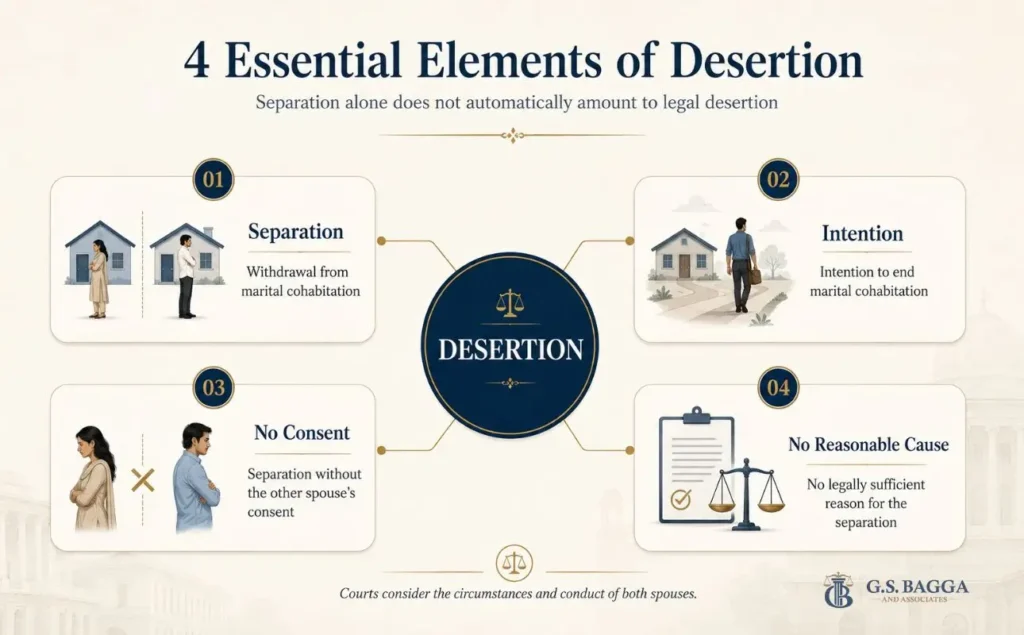
A desertion claim is not decided simply because one spouse says, “My husband left me.” The court generally examines four connected factors: separation, intention to end marital cohabitation, absence of consent, and absence of reasonable cause.
Factum of Separation and Physical Separation
There must generally be a real withdrawal from marital cohabitation. This may happen when a husband moves to another home and starts living separately from his wife.
But physical distance alone is not enough. A husband may be working in Mumbai while his wife lives in Kolkata, or he may be posted abroad for work. If he continues to maintain contact, supports his family, visits when possible, and intends to continue the marriage, those facts may point away from desertion. The court therefore looks beyond the address of each spouse.
Intention to End Marital Cohabitation
The next question is what the husband intended when he separated. Did he simply need time away, or did he intend to end marital cohabitation?
This intention is often inferred from conduct. Messages refusing to return, repeated rejection of reconciliation attempts, cutting off communication, or maintaining a separate life for a prolonged period may become relevant.
A husband who tells his wife that he has no intention of returning and then continues living separately may provide strong evidence of his intention. On the other hand, temporary separation followed by genuine efforts to resume married life may tell a different story.
Absence of Consent
The separation must be without the wife’s consent or against her wishes when she claims that her husband deserted her.
This does not mean that she must have physically stopped him from leaving. Her conduct after the separation can also be relevant. Messages asking him to come home, requests to resume cohabitation, family mediation, or other attempts to repair the marriage may help show that she did not agree to the abandonment.
Absence of Reasonable Cause
A husband cannot necessarily be called a deserter simply because he left the matrimonial home. The reason for leaving matters.
For example, if he left because of serious threats, violence, or another genuine circumstance created by his wife or her family, the court may consider whether there was a reasonable cause for the separation.
Likewise, a wife who leaves because of cruelty or serious safety concerns should not automatically be labelled as the spouse who deserted the marriage. The facts surrounding the separation need to be examined carefully.
Is Mere Separation Considered Desertion
No. Mere separation is not automatically legal desertion.
Consider a husband who works in Dubai. He lives away from his wife but speaks with her regularly, sends money home, visits India when his work permits, and continues to plan his family’s future. Although the couple is physically separated, those circumstances may not show an intention to abandon the marriage.
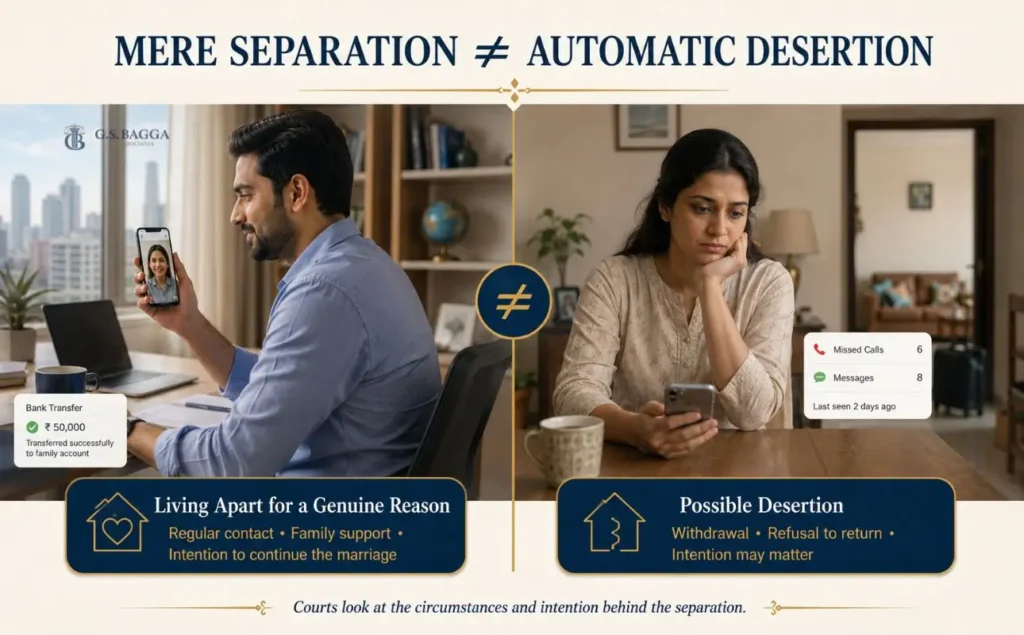
The position can be very different if the husband moves out, stops all meaningful contact, refuses to support his wife, rejects attempts to bring him home, and clearly intends to live separately on a permanent basis.
The difference lies in the circumstances and intention behind the separation, not simply in the fact that the spouses have different addresses.
How to File for Divorce on the Ground of Desertion
For a marriage governed by the Hindu Marriage Act, 1955, desertion is a statutory ground for divorce. Section 13(1)(ib) allows either spouse to seek divorce where the other spouse has deserted the petitioner for the required continuous period immediately before the divorce petition is filed.
A wife seeking divorce will need to present her case before the court having jurisdiction over the matrimonial dispute. Her petition should explain when the separation began, the circumstances in which her husband left, his conduct afterward, and why she believes the separation amounts to desertion.
The exact procedure depends on the facts of the case and the law applicable to the marriage.

The Two-Year Continuous Desertion Requirement
Under Section 13(1)(ib) of the Hindu Marriage Act, desertion must continue for at least two years immediately before the divorce petition is presented.
This is an important requirement. A short separation, even if emotionally difficult, does not by itself satisfy this particular ground for divorce.
The two-year rule discussed here applies to divorce under the Hindu Marriage Act. It should not be treated as a universal rule for every marriage or every personal law in India.
Proving Desertion Before the Family Court
The spouse alleging desertion has to establish the relevant facts through evidence. Courts generally consider the entire course of conduct rather than focusing on one argument or one message.
The court may look at communications between the spouses, proof of separate residence, financial records, attempts at reconciliation, statements from people familiar with the situation, and other evidence showing what happened and why.
This is also why keeping important messages, financial records, and correspondence can be useful when a matrimonial dispute has already begun.
Financial and Legal Remedies for a Deserted Wife
Divorce is not the only option available to a wife whose husband has left her. Sometimes the immediate concern is not ending the marriage but having enough money to manage the household. In other cases, the wife may want her husband to return.
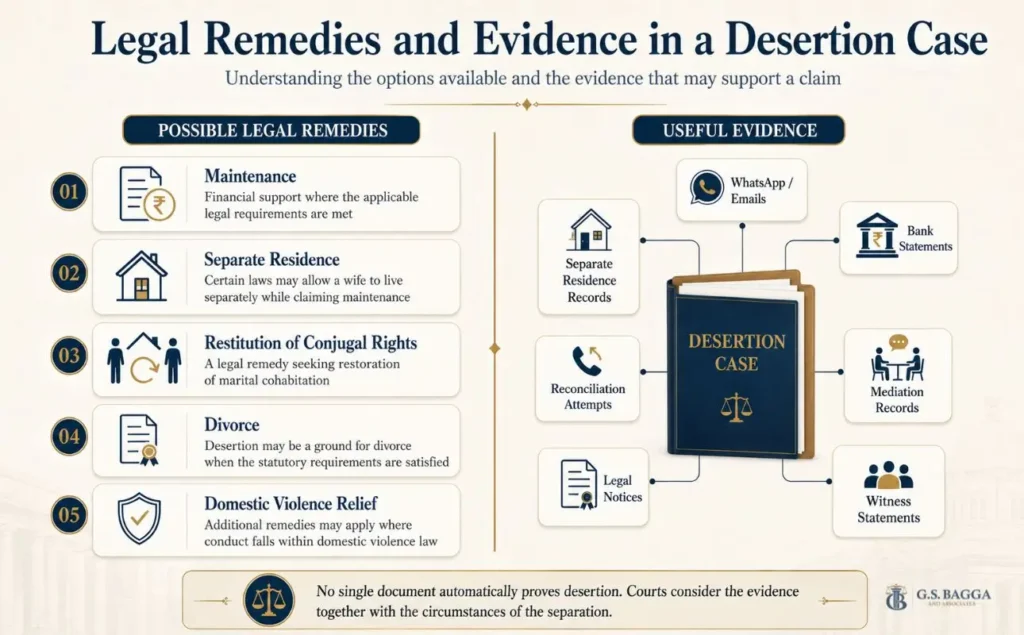
Depending on the circumstances and applicable law, remedies may include maintenance, separate residence, restitution of conjugal rights, and relief under domestic violence law.
Claiming Maintenance From Your Husband
Section 144 of the Bharatiya Nagarik Suraksha Sanhita, 2023 provides a maintenance remedy where a person with sufficient means neglects or refuses to maintain his wife who is unable to maintain herself. It can also provide for interim maintenance and expenses of proceedings in appropriate cases.
This means a wife does not necessarily have to wait for a divorce before seeking financial support. The amount depends on the circumstances, including the parties’ financial position and the wife’s needs.
Seeking Separate Residence and Maintenance
For a Hindu wife, Section 18 of the Hindu Adoptions and Maintenance Act, 1956 provides for maintenance during her lifetime, subject to the conditions of the Act. It specifically recognises desertion by the husband, without reasonable cause and without her consent or against her wishes, as a circumstance in which she may live separately without losing her maintenance claim.
This can be particularly relevant where a wife does not want to end the marriage immediately but believes she cannot reasonably continue living with her husband.
Asking the Court to Restore Marital Cohabitation
Not every wife wants a divorce. Some may still want their husband to return and the marriage to continue.
Under Section 9 of the Hindu Marriage Act, a spouse can petition for restitution of conjugal rights when the other spouse has withdrawn from their society without reasonable excuse.
This remedy is therefore different from divorce. It addresses withdrawal from marital cohabitation and may be considered by someone who wants to restore the marital relationship.
Seeking Protection and Financial Relief From Domestic Violence
Desertion and domestic violence are not automatically the same thing. However, if abandonment is accompanied by conduct covered by the Protection of Women from Domestic Violence Act, 2005, a woman may have additional remedies.
Depending on the circumstances, these can include protection, residence-related relief, and monetary relief. The facts matter, particularly where the wife has also faced physical, verbal, emotional, or economic abuse.
What Evidence Do You Need to Prove Desertion
Evidence can make a significant difference in a desertion case. Useful material may include:
- Proof of the husband’s separate residence, such as rent agreements, utility bills, or address records.
- WhatsApp messages, emails, letters, or other communications showing his refusal to return or resume married life.
- Bank statements and other financial records showing changes in household support.
- Messages or correspondence showing attempts to reconcile.
- Mediation records or communications involving family members who tried to resolve the dispute.
- Witness statements from relatives, neighbours, or other people familiar with the separation.
- Legal notices asking the husband to return or resume cohabitation.
- Other documents that help explain when the separation began and what happened afterward.
No single document automatically proves desertion. The court looks at the evidence together and decides whether the legal requirements have been established.
Frequently Asked Questions About Desertion of Wife
Can a Wife File for Divorce if Her Husband Abandons Her?
Yes, desertion can be a ground for divorce under the Hindu Marriage Act when its legal requirements are satisfied. The requirements may differ under other matrimonial laws.
How Long Does a Husband Have to Desert His Wife Before Divorce?
For divorce under the Hindu Marriage Act, desertion must continue for at least two years immediately before the divorce petition is presented.
Is Leaving the Matrimonial Home Enough to Prove Desertion?
No. Leaving the home is only one part of the picture. The court also considers the intention behind the separation, the wife’s consent, and whether there was a reasonable cause for living apart.
Can a Deserted Wife Claim Maintenance From Her Husband?
A wife may be able to claim maintenance under applicable law. Section 144 of the BNSS provides a maintenance remedy where its requirements are met, while Section 18 of HAMA gives specific rights to a Hindu wife in qualifying circumstances.
What Evidence Can a Wife Use to Prove Desertion?
Messages, emails, proof of separate residence, bank records, witness statements, reconciliation attempts, legal notices, and other relevant documents may help establish the circumstances surrounding the separation.
What Can a Wife Do if Her Husband Refuses to Return?
Depending on the circumstances, she may consider maintenance, restitution of conjugal rights, divorce on the ground of desertion, or other remedies available under the law applicable to her marriage. A lawyer can assess the facts and suggest the most suitable course of action.