

Adoption creates a legally recognized parent-child relationship, whereas divorce addresses the legal separation of spouses. Consequently, the dissolution of a marriage does not automatically resolve legal and practical questions concerning an adopted child.
In Indian family law, the legal consequences of divorce may differ depending on whether the adoption has already been completed or remains pending. While a completed adoption establishes permanent parental obligations, a pending adoption may be affected by changes in applicant eligibility.
Addressing divorce and adoption in India requires examining how courts evaluate child custody, continuing parental responsibilities, and financial maintenance obligations. In this article, we explain how divorce can affect adoption proceedings, custody determinations, and the statutory rights of an adopted child in India.
What Happens to an Adopted Child After Divorce?
A divorce between adoptive parents does not alter the legal status of an adopted child after divorce. Under the applicable legal framework, a validly completed adoption establishes a legal parent-child relationship between the child and adoptive parents.
Once an adoption order takes legal effect, the child holds the legal status of a child born to the adoptive family. In matters concerning a divorce after adoption in India, a valid adoption creates a legal parent-child relationship, and custody and parental-responsibility questions are considered in accordance with the applicable family-law framework.
While adoption and divorce are governed by distinct legal frameworks, a divorce necessarily alters living arrangements and day-to-day care. However, questions concerning physical custody, parenting time, and financial maintenance are determined independently, with the child’s welfare serving as the paramount legal consideration.
Rights and Responsibilities of Adoptive Parents After Divorce
Divorce alters the marital relationship between spouses, but it does not extinguish statutory parental obligations toward an adopted child. Both adoptive parents ordinarily retain continuing legal obligations under the applicable adoption statutes and general family law principles.
Following a marital breakdown, the statutory rights of adoptive parents after divorce and the corresponding responsibilities of adoptive parents generally encompass:
- Providing day-to-day care, shelter, and physical protection under stable living arrangements.
- Ensuring continuous access to formal education, healthcare, and necessary medical treatment.
- Safeguarding established adopted child rights after divorce, including appropriate living standards and developmental opportunities.
- Participating in significant legal decisions concerning the child’s schooling, healthcare interventions, and general welfare.
- Contributing financially to the child’s upbringing in proportion to each parent’s respective financial capacity.
Divorce or a change in physical custody does not by itself end the parental responsibilities arising from the parent-child relationship.
Who Gets Custody of an Adopted Child After Divorce?
A court does not determine the custody of adopted child after divorce based on the fact of adoption or marital fault. Instead, family courts adjudicate custody disputes under the Guardians and Wards Act, 1890, and relevant personal laws, guided primarily by the child’s welfare.
When determining adopted child custody after divorce, the legal evaluation for child custody after divorce in India focuses on identifying which arrangement best supports the child’s physical, educational, and emotional development.
The fact that the child is adopted does not, by itself, determine which parent should receive custody. The court considers the child’s welfare and the circumstances relevant to the custody dispute when awarding custody of adopted child.
Can Adoptive Parents Have Joint Custody?
Family courts may grant joint legal custody or shared parenting arrangements when parents demonstrate the capacity to cooperate constructively. In these arrangements, both adoptive parents share decision-making authority regarding education, medical care, and general upbringing, while establishing a structured schedule for physical parenting time.
Can One Adoptive Parent Get Sole Custody?
When parental conflict, geographic distance, or safety concerns make shared parenting impracticable, a court may award sole physical custody to one adoptive parent. The other parent may be granted visitation, communication, or other parenting arrangements, depending on the child’s welfare and circumstances.

What Factors Do Courts Consider in Child Custody?
When evaluating custody and parenting arrangements, and depending on the applicable law and circumstances, courts may consider factors such as:
- The child’s age, developmental needs, health, and other individual circumstances.
- The emotional bond and attachment established between the child and each adoptive parent.
- Continuity in schooling, community ties, and established domestic routines.
- The financial capability, home environment, and physical capacity of each parent.
- The child’s preference, provided the child has attained sufficient maturity to express an informed view.
- Protection from domestic conflict, neglect, or hazardous household conditions.
What Happens to Child Support After Divorce?
Divorce does not terminate an adoptive parent’s obligation to contribute financially to their child’s upbringing. An adopted child remains entitled to appropriate financial support from the parents under the applicable legal framework. The amount of child support after divorce in India will depend on the child’s reasonable needs, the parents’ financial circumstances, and the law applicable to the case.
Depending on the circumstances and applicable law, claims for the maintenance of adopted child may be sought under provisions such as Section 144 of the Bharatiya Nagarik Suraksha Sanhita, 2023, Section 20 of the Hindu Adoptions and Maintenance Act, 1956, or other relevant matrimonial and family statutes.
A parent without physical custody retains an ongoing financial responsibility for adopted child expenses. These expenses generally encompass school fees, medical care, housing, food, and clothing, assessed in proportion to each parent’s resources and standard of living.
Can Divorce Cancel a Completed Adoption in India?
“Can divorce cancel adoption in India?” is a common concern among adoptive parents facing marital breakdown. A decree of divorce does not, by itself, cancel or revoke a validly completed adoption.
Under Section 15 of the Hindu Adoptions and Maintenance Act, 1956, a validly made adoption cannot be cancelled by the adoptive parents, nor can the adopted child renounce that status. Similarly, under Section 63 of the Juvenile Justice (Care and Protection of Children) Act, 2015, an adoption order establishes a legal parent-child relationship as if the child had been born to the adoptive parents.
While questions of custody and maintenance arise, a completed adoption and divorce remain distinct legal matters. Therefore, a divorce between adoptive parents is not, by itself, a ground for cancelling a valid adoption. Any challenge concerning the validity of an adoption would depend on the governing law and the facts of the particular case, such as established procedural invalidity or fraud during the original proceedings.
What Happens If Parents Divorce During the Adoption Process?
Navigating a divorce during adoption process differs significantly from dealing with an adoption that has already been legally completed. Under the Adoption Regulations, 2022, framed under the Juvenile Justice Act, joint adoption by a married couple requires the consent of both spouses and generally requires at least two years of a stable marital relationship.
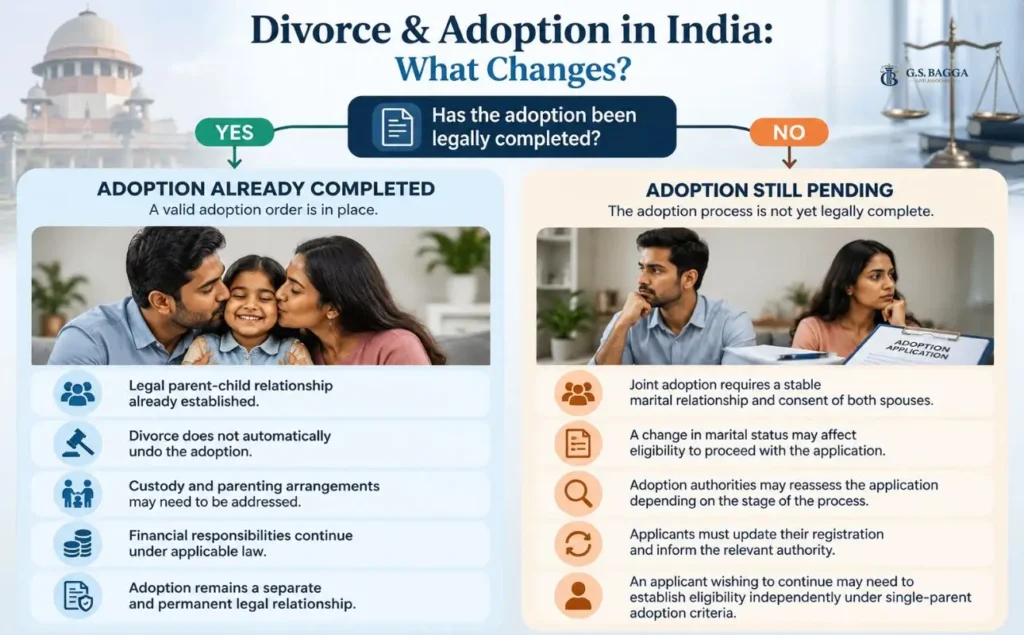
If the marital status of prospective adoptive parents changes while an adoption application is pending, the applicants should promptly inform the relevant adoption authority. The legal and administrative consequences of a divorce while adoption is pending depend on the procedural stage of the application and the governing regulations:
- Before referral: The change in marital status may affect the applicants’ eligibility to proceed jointly under CARA guidelines.
- After referral or during pre-adoption care: The adoption authorities may need to reassess the proposed placement and the applicants’ continuing eligibility to prevent placement disruption.
- Before an adoption order is issued: The applicants must continue to satisfy the applicable eligibility and consent requirements under the governing adoption framework.
If an applicant wishes to continue the adoption process after divorce, they may need to update their registration and establish eligibility independently under single-parent adoption criteria.
Can a Divorced Person Adopt a Child in India?
A divorced individual can legally apply to adopt a child in India, provided they satisfy the applicable eligibility requirements under the Adoption Regulations, 2022 established for single prospective adoptive parents. Whether a divorced person can proceed with an adoption depends on the governing legal framework and case-specific assessment.
Under Regulation 5 of the Adoption Regulations, administered by the Central Adoption Resource Authority (CARA), prospective adoptive parents may adopt irrespective of marital status. For single parent adoption India, specific conditions apply:
- A single or divorced female prospective adoptive parent is eligible to adopt a child of any gender.
- A single or divorced male prospective adoptive parent is eligible to adopt only a male child.
These rules establish the eligibility framework applicable to single prospective adoptive parents, alongside criteria governing age, physical fitness, and financial stability.
What Happens to the Child’s Legal Rights After Adoptive Parents Divorce?
The legal dissolution of an adoptive marriage does not diminish the independent statutory rights of the child. The legal rights of adopted child after divorce remain protected under Indian family law.
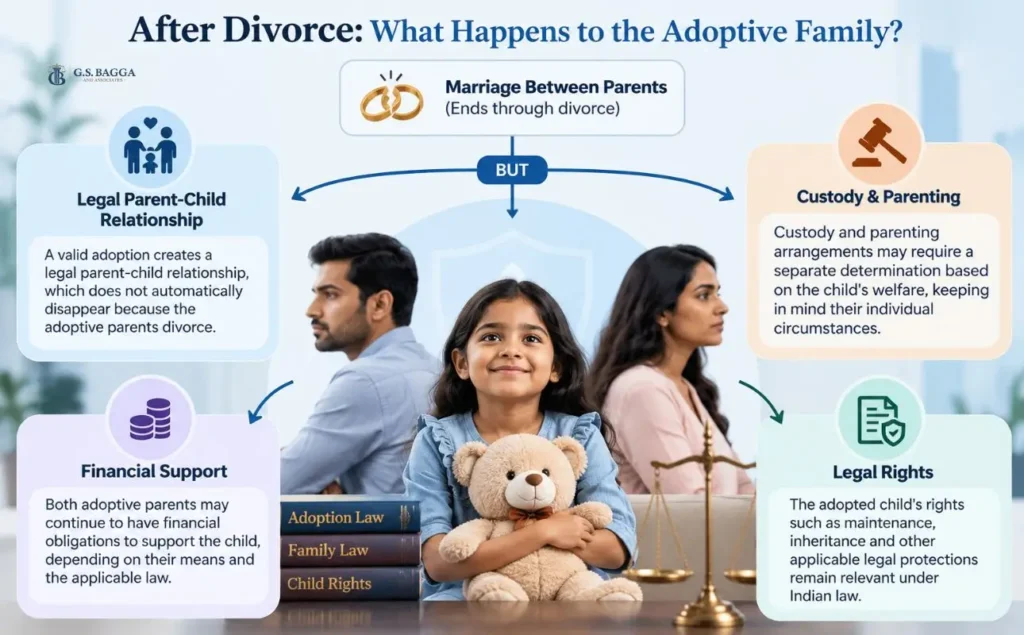
Key statutory safeguards upholding the rights of adopted child after divorce include:
- The right to maintenance, sustenance, and developmental care from both adoptive parents under applicable personal and civil statutes.
- Applicable inheritance and succession rights arising from the adoption, subject to the governing personal law and the nature of the property involved.
- Protection against arbitrary denial of parental responsibility or financial abandonment arising from adult marital disputes.
These protections ensure that adult marital disputes do not compromise an adopted child’s rights or their established legal standing.
When Should You Consult a Family Law Attorney?
Because adoption and custody matters involve intersecting statutory frameworks and fact-specific inquiries, professional guidance can clarify legal rights and responsibilities. Consulting a qualified family lawyer for adoption and divorce is particularly advisable when:
- Divorce occurs while an adoption application is pending before CARA or the competent adoption authority.
- Parents face contested custody disputes or disagreements regarding parenting time and relocation.
- Disputes arise regarding child maintenance calculations, enforcement proceedings, or education and healthcare expenses.
- Questions arise concerning the validity or legal consequences of an adoption order.
Consulting an experienced adoption lawyer in India or a child custody lawyer can help parties understand the applicable procedures, navigate dispute resolution, and protect the child’s interests.
Frequently Asked Questions About Divorce and Adoption
Does Divorce Cancel an Adoption in India?
No. Divorce dissolves the marriage between spouses, not a validly completed adoption. Under Indian law, a completed adoption establishes an enduring legal parent-child relationship. While divorce may necessitate separate legal proceedings for custody, visitation, and financial maintenance, it does not revoke the adoption order itself.
Who Gets Custody of an Adopted Child After Divorce?
Custody is determined based on the paramount welfare of the child under the Guardians and Wards Act, 1890, and relevant personal laws. Family courts evaluate caregiving capacity, educational continuity, emotional attachment, and living stability, rather than relying merely on the fact of adoption.
What Happens If Parents Divorce During the Adoption Process?
Prospective parents must notify adoption authorities promptly. Because joint eligibility requires mutual consent and a stable marital relationship, marital dissolution during a pending application leads to procedural reassessment. An applicant wishing to continue may need to establish eligibility independently under single-parent guidelines.
Can a Divorced Person Adopt a Child in India?
Yes. Under the Adoption Regulations, 2022, administered by CARA, divorced individuals may adopt as single prospective parents. Eligibility criteria differ by gender: a divorced female is eligible to adopt a child of any gender, whereas a divorced male may adopt only a male child.
Conclusion
Divorce and adoption are legally distinct matters under Indian family law. A validly completed adoption establishes an enduring legal parent-child relationship that is not dissolved by the termination of the adoptive parents’ marriage. Conversely, marital breakdown during a pending adoption may affect the applicants’ eligibility and the course of the proceedings under the applicable adoption framework.
While divorce frequently requires separate legal proceedings to resolve child custody, visitation schedules, and financial maintenance, these outcomes depend on the specific facts and governing statutes. Addressing divorce and adoption in India requires attention to the applicable statutory procedures and the child’s paramount welfare.
Disclaimer: This article is intended for general informational and educational purposes only and does not constitute formal legal advice. The applicable law and outcome may vary depending on the facts, governing statutes, and individual circumstances of each case. Consult a qualified family-law practitioner for specific legal guidance.