



Adultery can deeply affect a marriage and often becomes a difficult issue when a couple decides to separate. In India, however, the legal position is quite clear. Adultery is no longer a criminal offence, but it can still be used as a ground for divorce under the matrimonial law applicable to the marriage.
This difference is important. A spouse cannot be criminally prosecuted simply for having an extra-marital relationship, but the same conduct can still become relevant in a divorce case. It may also come up while dealing with maintenance, alimony or child custody, depending on the facts.
In this article, we explain how adultery affects divorce proceedings, how it can be proved, and what role digital evidence can play.
Is Adultery a Ground for Divorce in India?
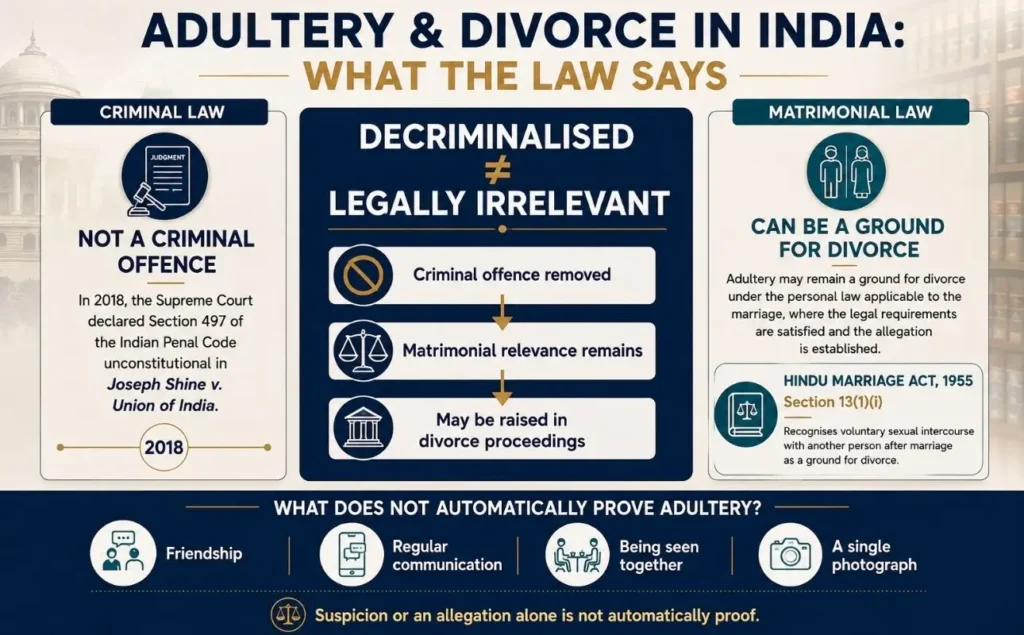
Yes, adultery can still be a ground for divorce in India under the personal law applicable to the marriage. For example, Section 13(1)(i) of the Hindu Marriage Act, 1955, allows either spouse to seek divorce where the other spouse has, after the marriage, had voluntary sexual intercourse with another person.
The decriminalisation of adultery did not remove it from matrimonial law. A husband or wife can still rely on adultery while seeking a contested divorce, provided the legal requirements are satisfied and the allegation is established before the court.
However, friendship, regular communication or being seen with another person does not automatically amount to adultery. Even an allegation of an extra-marital affair is not enough by itself. The court considers the evidence and surrounding circumstances before reaching a conclusion.
Adultery as a Civil Ground After Decriminalisation
What Did the Joseph Shine Judgment Change?
Before 2018, Section 497 of the Indian Penal Code treated adultery as a criminal offence in certain circumstances. In Joseph Shine v. Union of India, the Supreme Court declared the provision unconstitutional. This removed the possibility of criminal prosecution for adultery.
The judgment did not make adultery completely irrelevant in law. It removed adultery as a criminal offence, while matrimonial laws could still recognise it as a ground for divorce. This distinction is important in matrimonial disputes.
So, adultery is not a crime in India, but that does not mean it has no legal consequences. Its importance today is mainly seen in matrimonial proceedings, particularly when one spouse seeks divorce on this ground.
Is Adultery an Offence Under the Bharatiya Nyaya Sanhita?
The Bharatiya Nyaya Sanhita, 2023, which replaced the Indian Penal Code from July 1, 2024, does not bring back adultery as a separate criminal offence.
However, a spouse can still raise adultery in a matrimonial case where the applicable personal law recognises it as a ground for divorce. The absence of criminal punishment does not remove its relevance under matrimonial law.
How Does Adultery Affect Divorce Proceedings?
Adultery as a Ground for Contested Divorce
In a contested divorce case, the spouse alleging adultery has to raise the ground and support it with evidence. Simply telling the court that a husband or wife is having an affair does not automatically result in divorce.
For marriages governed by the Hindu Marriage Act, Section 13(1)(i) recognises voluntary sexual intercourse with another person after marriage as a ground for divorce. The court considers the evidence from both sides before deciding whether the allegation has been established.
Can Adultery Be Used Alongside Other Grounds for Divorce?
Adultery may appear alongside other matrimonial grounds, depending on what happened during the marriage. For example, a spouse may also claim cruelty if the circumstances surrounding an extra-marital relationship caused serious mental suffering.
However, these are separate legal grounds. Proving adultery does not automatically prove cruelty. Each ground has its own legal requirements and must be supported by appropriate evidence.
Does Proving Adultery Guarantee Divorce?
Proving adultery can establish a recognised ground for divorce, but a divorce case does not succeed merely because an allegation has been made. The court considers the pleadings, evidence, applicable law and circumstances before deciding the matter.
This is different from a mutual-consent divorce, where both spouses agree to end the marriage and follow the legal process applicable to that type of divorce. Adultery is more relevant in a contested divorce.

How Is Adultery Proved in a Divorce Case?
Proving adultery can be difficult because there is rarely a direct witness to a private sexual relationship. In many cases, the spouse making the allegation has to rely on several circumstances rather than one clear piece of evidence.
Matrimonial cases are civil proceedings, and the standard of proof is generally preponderance of probabilities. In simple terms, the court considers whether the evidence makes the alleged fact more likely than not. This is different from proving a criminal case beyond reasonable doubt.
Direct Evidence vs. Circumstantial Evidence
Direct evidence would directly establish the alleged sexual relationship, but such evidence is uncommon in matrimonial disputes. Courts can therefore consider circumstantial evidence and examine how different facts connect with each other.
One message or photograph may not prove adultery on its own. But several circumstances, when considered together, may help the court understand the nature of the relationship. The important point is that suspicion or assumptions cannot simply be treated as proof.
What Evidence Can Be Used to Prove Adultery?
Depending on the circumstances, evidence may include WhatsApp conversations, emails, text messages, photographs, videos, social media interactions, hotel records, travel records and witness statements. An admission by a spouse or other surrounding circumstances may also become relevant.
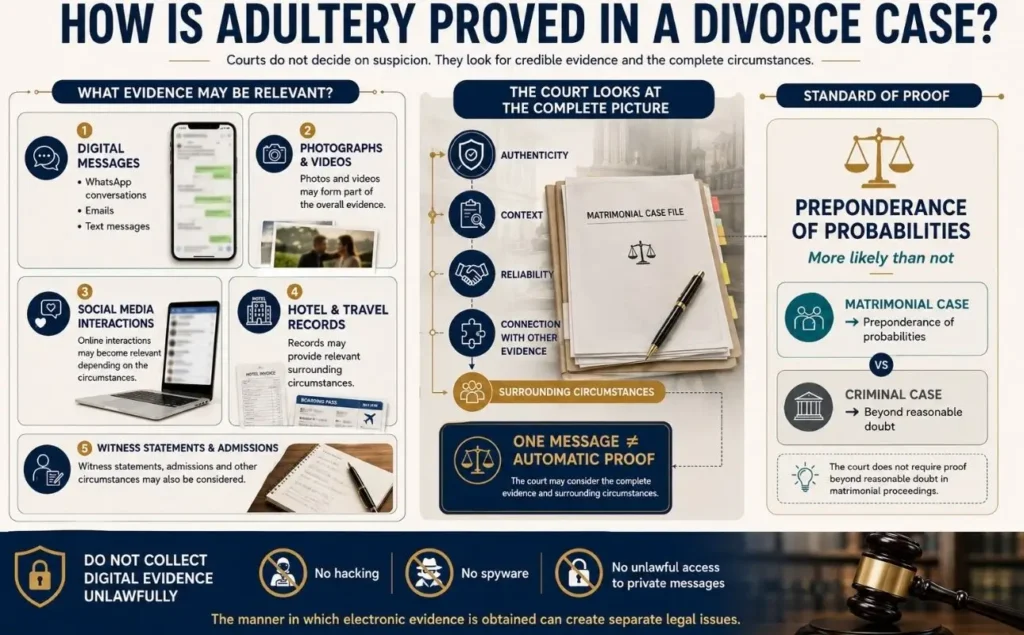
No single type of evidence automatically proves adultery. A photograph of two people together may show that they met, but it does not by itself prove a sexual relationship. Courts generally consider the complete evidence and circumstances before reaching a finding.
Can Digital Evidence Prove Adultery?
Digital evidence has become increasingly important in matrimonial disputes. WhatsApp messages, emails, photographs, videos, social media conversations and other electronic records may help show the nature of a relationship between two people.
However, a digital record does not automatically prove adultery. The court may consider its authenticity, context, reliability and connection with other evidence. A single message can sometimes be misunderstood when taken out of context.
A spouse should also avoid hacking another person’s account, installing spyware or unlawfully accessing private messages to collect evidence. The manner in which electronic evidence is obtained can create separate legal issues.
Impact of Adultery on Maintenance and Alimony
Adultery can become relevant when maintenance or permanent alimony is considered, but it is wrong to assume that a spouse automatically loses the right to maintenance because of an adultery allegation.
The outcome depends on the applicable law, financial circumstances and facts of the case. For example, Section 25 of the Hindu Marriage Act allows the court to consider factors including the income and property of the parties, their conduct and other circumstances while deciding permanent alimony and maintenance.
Therefore, adultery does not automatically mean no maintenance. The court considers the relevant legal provisions and overall circumstances rather than applying a fixed rule.
Impact of Adultery on Child Custody
Adultery may also be raised during a child custody dispute, but it does not automatically mean that a parent will lose custody or visitation rights. In custody matters, the welfare and best interests of the child remain the main concern before the court.
If the circumstances surrounding an extra-marital relationship have a direct effect on the child’s safety, care, stability or well-being, the court may consider them. However, adultery by itself does not make a parent automatically unfit to care for the child.
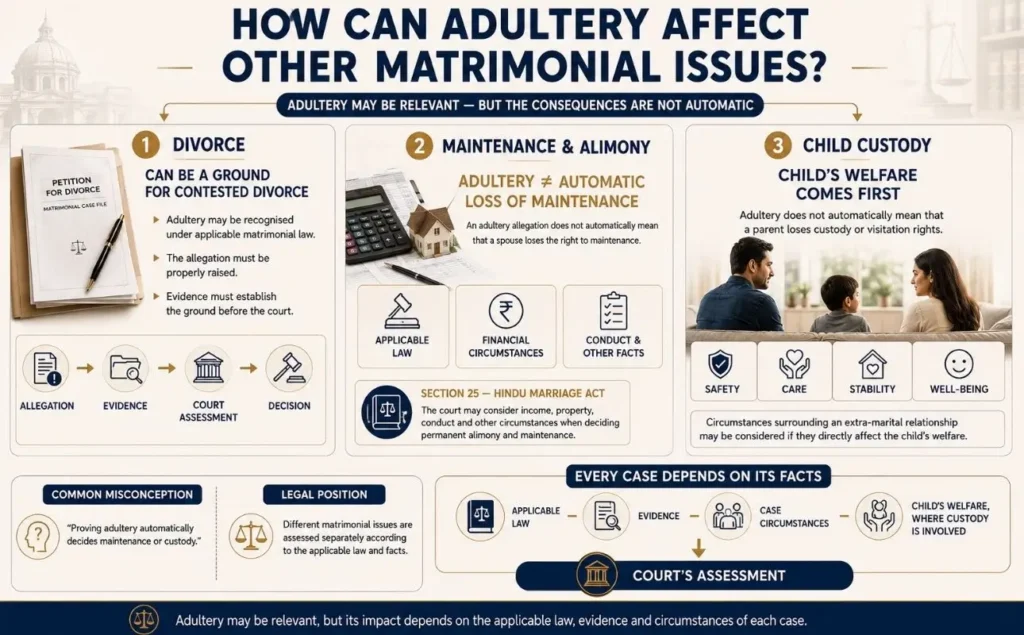
Therefore, a parent who commits adultery will not automatically lose custody. Each custody dispute is decided according to its facts, with the child’s welfare remaining central to the decision.
Social and Emotional Consequences of Adultery
The legal side is only one part of an adultery dispute. For many husbands and wives, discovering an extra-marital relationship means a sudden loss of trust. Arguments increase, communication breaks down and ordinary family matters can become stressful.
When children and other family members become involved, the situation can become even more painful. A divorce case may settle the legal relationship, but the emotional impact of betrayal can continue long after the case ends.
Conclusion
Adultery is no longer a criminal offence in India, but it continues to have legal importance in divorce proceedings under applicable matrimonial laws. A spouse relying on adultery as a ground for divorce generally needs to establish the allegation with reliable evidence. Courts may consider circumstantial evidence, digital records and other relevant facts while deciding whether adultery has been proved.
Adultery may also become relevant to maintenance, alimony and child custody, but these consequences are not automatic. The result depends on the applicable law, evidence and circumstances of each case. Anyone facing an adultery-related matrimonial dispute should understand the legal position before making allegations, collecting evidence or taking the matter to court.
Disclaimer: This article is for general educational purposes only and does not constitute legal advice or create an attorney-client relationship. Laws and their application may vary depending on the facts and applicable personal law.