


Ending a new marriage brings deep heartbreak and confusing legal questions. Many couples want to know if mutual divorce after 6 months is legally possible. You might wonder if can mutual divorce be filed after 6 months of wedding vows.
For marriages governed by the Hindu Marriage Act, mutual consent divorce generally requires the spouses to have lived separately for at least one year before filing. The first-year filing restriction is a separate requirement under Section 14.
Seeking mutual divorce before one year of marriage is ordinarily restricted. However, the court may permit an early petition in cases involving exceptional hardship or exceptional depravity. Waiver of the cooling-off period is a separate judicial issue. We understand your personal pain and explain the legal path clearly.
After How Many Months of Marriage Can Divorce Be Filed?
Heartbroken spouses often ask after how many months of marriage divorce can be filed legally. The real answer depends directly on whether you both agree to separate peacefully. A mutual consent separation requires you to live apart for twelve continuous months.
Contested cases may be based on cruelty, adultery, desertion, or other statutory grounds. However, the first-year filing restriction may still apply, and an early petition generally requires permission from the court.
Getting a mutual divorce within six months is ordinarily unavailable under the standard procedure. However, Section 14 may permit an early petition in cases involving exceptional hardship or exceptional depravity, depending on the evidence.
Can You Divorce Your Spouse Within 6 Months Of Marriage?
Heartbroken newlyweds often seek a divorce within 6 months of marriage in india. The painful truth is that a mutual divorce within 6 months remains impossible. Even with signed agreements, family judges cannot ignore mandatory statutory separation rules.
Living separately generally means that the spouses have stopped living as husband and wife and have ceased performing normal marital obligations. Separate residences are not always essential if the parties live apart in the legal sense.
Couples asking whether mutual divorce can be filed after six months will ordinarily need to wait, unless the court grants permission under the exceptional circumstances recognised by Section 14.
People often confuse wedding dates with the 6 month cooling off period mutual divorce. Seeking a divorce after 6 months of marriage requires finishing one full year.
- Mutual consent cannot override strict waiting timelines created by Indian family laws.
- Living separately means living apart without any marital cohabitation or physical relations.
- Being married for six months is entirely different from finishing a court cooling-off period.
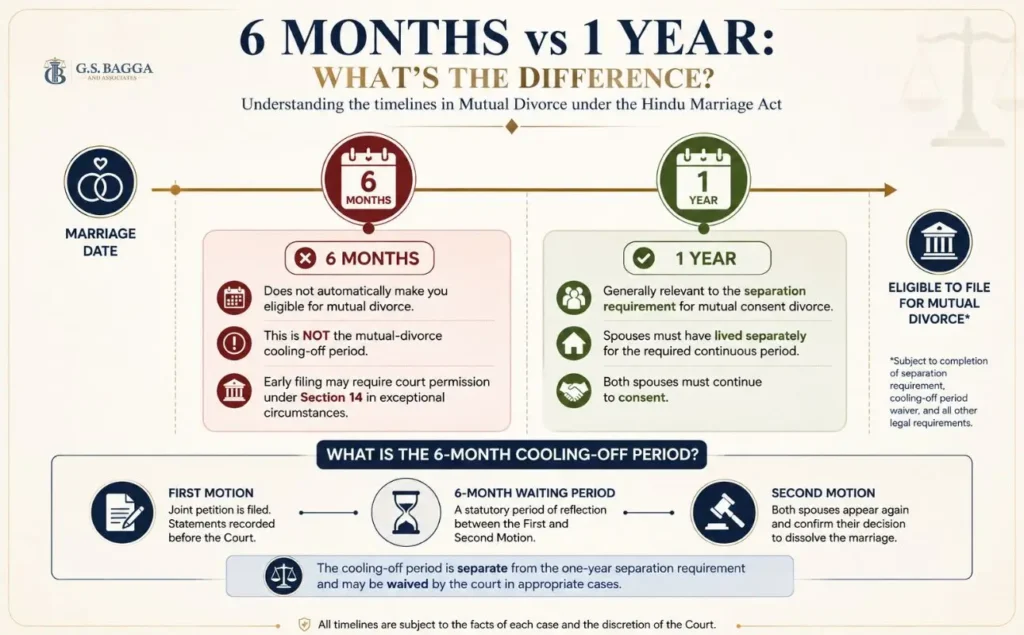
What Is the One-Year Requirement for Mutual Divorce?
The law creates strict rules before accepting a mutual divorce before one year of marriage. These rules protect couples from making hasty decisions during temporary anger.
Living Separately for the Required Period
You and your spouse must live completely apart for one full continuous year. This separation means ending your personal relationship and stopping all shared spousal duties.
Mutual Consent Must Continue
Both spouses must give honest, voluntary consent without any family pressure or threats. This genuine agreement must stay strong until the judge signs your decree.
No Reasonable Possibility of Reconciliation
The court must confirm that mediation sessions and counseling efforts have failed completely. Both partners must honestly state that staying together causes unbearable sadness.
Is There an Exception to the One-Year Rule?
Section 14 of the Hindu Marriage Act allows the court to consider an early divorce petition in exceptional cases. The applicant must establish exceptional hardship or exceptional depravity through facts and supporting evidence.
Judges do not grant this special permission easily to couples who argue. Daily domestic arguments or emotional differences never qualify as exceptional hardship under law. Couples seeking a divorce after 6 months of marriage must show undeniable proof.
What Is the 6-Month Cooling-Off Period in Mutual Divorce?
The court waiting gap causes confusion for people seeking a divorce after 6 months of marriage. This court delay often frustrates partners who want to rebuild their lives.
Section 13B(2) generally provides a six-month period between the first and second motions. This period allows the court to confirm that the decision is voluntary and that reconciliation is unlikely.
This statutory waiting period is completely different from your initial one-year separation timeline. Finishing six months of marriage does not satisfy the 6 month cooling off period mutual divorce.
- Six months of marriage simply measures the total time since your wedding ceremony.
- The cooling-off period is a mandatory court pause between your two motions.
- Being married for six months never skips your court waiting timeline automatically.
Can the Six-Month Cooling-Off Period Be Waived?
The court may waive the six-month cooling-off period in appropriate cases. The Supreme Court has held that this period is directory rather than mandatory, but waiver remains discretionary and depends on the facts.
The court may consider a waiver of the cooling-off period after examining factors such as:
- The spouses have completed the required separation period.
- Mediation and counselling efforts have failed, and reconciliation is unlikely.
- Both partners have settled issues involving alimony, property, children, and other claims.
- Further waiting would unnecessarily prolong the parties’ hardship and uncertainty.
Waiving the court’s six-month cooling-off period does not automatically remove the separate filing and separation requirements. The court must consider each legal requirement independently.

What Can You Do If You Have Been Married for Less Than One Year?
Desperate spouses facing early marital distress have three realistic legal options available.
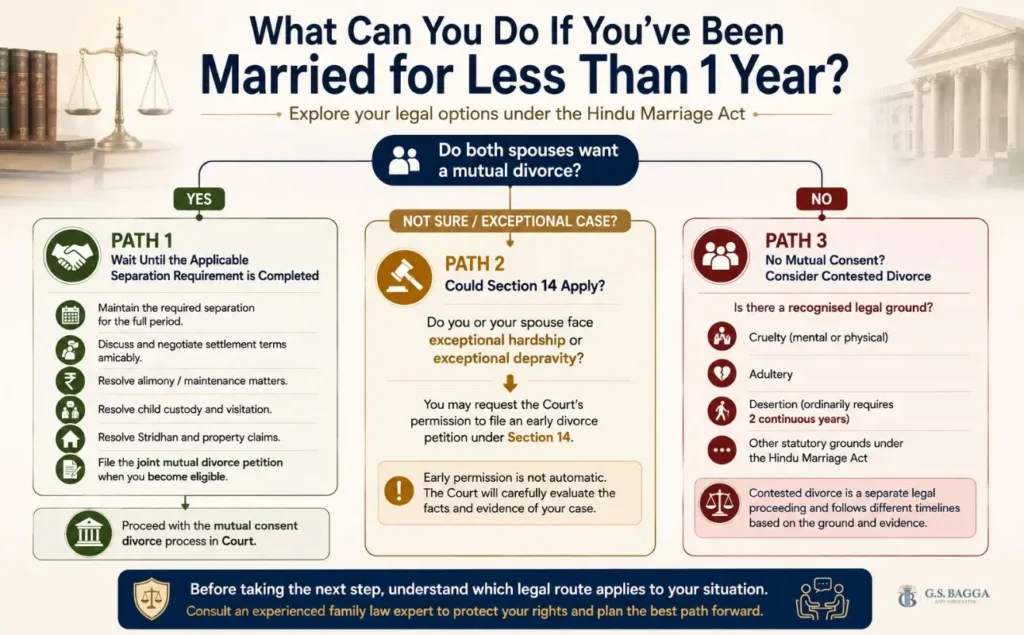
Wait Until the Applicable Period Is Completed
You can spend this separation time negotiating financial settlements and child custody terms. Once your one-year separation ends, you can file your joint mutual divorce petition.
Explore Whether an Exceptional Early Petition Is Available
If you suffer serious physical abuse or other exceptional hardship, your lawyer may request permission to file early. The court will evaluate the facts and evidence before deciding whether the statutory exception applies.
Consider Contested Divorce Where a Legal Ground Exists
When your partner refuses peaceful separation, you may file a contested divorce petition if a recognised legal ground, such as cruelty, is available. Desertion ordinarily requires two continuous years before filing.
How to Apply for Mutual Divorce in India
Filing an amicable joint divorce petition requires following six clear steps in court.
1. Finalise the Terms of Separation
Write down a complete settlement covering alimony, child custody, and Stridhan returns.
2. Prepare and File the Joint Petition
Draft your joint mutual divorce petition with attached marriage proofs and personal affidavits.
3. First Motion and Recording of Statements
Both partners generally appear before the court to record their statements, although the court may permit alternative arrangements, including video conferencing, where appropriate.
4. Cooling-Off Period or Waiver Application
Use this six-month reflection gap wisely or apply for a waiver of cooling off period.
5. Second Motion
Appear in court after six months to confirm your mutual decision to dissolve marriage.
6. Divorce Decree
The judge inspects your final settlement agreement and grants your official legal divorce decree.
What Happens If One Spouse Changes Their Mind?
Mutual consent must stay completely genuine throughout your court journey until final judgment. Under Indian law, either partner can withdraw their consent before the Second Motion ends.
If your spouse revokes consent, the family judge cannot pass a mutual divorce decree. Nobody can force an unwilling spouse to complete an amicable divorce against their wishes. When consent gets cancelled, you must resume mediation or file contested court litigation.
Frequently Asked Questions About Divorce Before One Year of Marriage
Can I File for Divorce After 3 Months of Marriage?
You ordinarily cannot file a mutual-consent petition after three months because the law requires the applicable separation period. In an exceptional case, you may request court permission to file early under Section 14.
Can I Get a Divorce After 3 Months of Marriage?
A divorce decree within three months of marriage is ordinarily unavailable under the standard procedure. An exceptional case may be considered only if the court grants the necessary permissions and waivers.
Can I Get a Divorce After 4 Months of Marriage?
A couple married for four months ordinarily cannot secure a mutual-consent divorce decree.
Can I Get a Divorce After 2 Months of Marriage?
Obtaining a divorce two months after marriage is impermissible under ordinary mutual consent provisions.
Can I Get a Divorce After 5 Months of Marriage?
Spouses married for five months ordinarily cannot finalise a mutual-consent divorce through the standard procedure.
Can I Get a Divorce After 6 Months of Marriage?
Couples married for six months ordinarily cannot file mutual divorce without satisfying the applicable statutory requirements or obtaining appropriate court permission.
Is the Six-Month Cooling-Off Period Compulsory?
The six-month waiting interval between motions is directory rather than strictly mandatory for couples.
Can the Six-Month Cooling-Off Period Be Waived?
Yes, family judges can waive this period when both partners settle all mutual claims.
How GS Bagga & Associates Can Help
If you are facing problems in your marriage, it is important to understand your legal options before taking the next step. Knowing after how many months of marriage divorce can be filed can help you make a clear decision.
GS Bagga & Associates can explain whether you are eligible for mutual divorce after 6 months, whether an early divorce petition may be possible in your situation, and what legal requirements you need to meet. Our team can also help with settlement terms related to alimony, child custody, Stridhan and property matters.
If you are considering divorce before completing one year of marriage, contact GS Bagga & Associates for a confidential consultation and proper legal guidance.