

Marriage in India is not only a personal relationship; it is also a legal relationship governed by different statutes and personal laws. But what happens when one spouse wants divorce and the other refuses?
If your spouse does not want divorce in India, this does not mean you are legally helpless. You may be able to file a contested divorce petition before the appropriate Family Court or District Court on a legally recognised ground.
In simple words, your spouse can oppose the divorce, but they cannot stop you from approaching the court. The court will hear both sides, examine the evidence, consider issues such as maintenance, child custody, residence, and settlement, and then decide whether a decree of divorce should be granted.
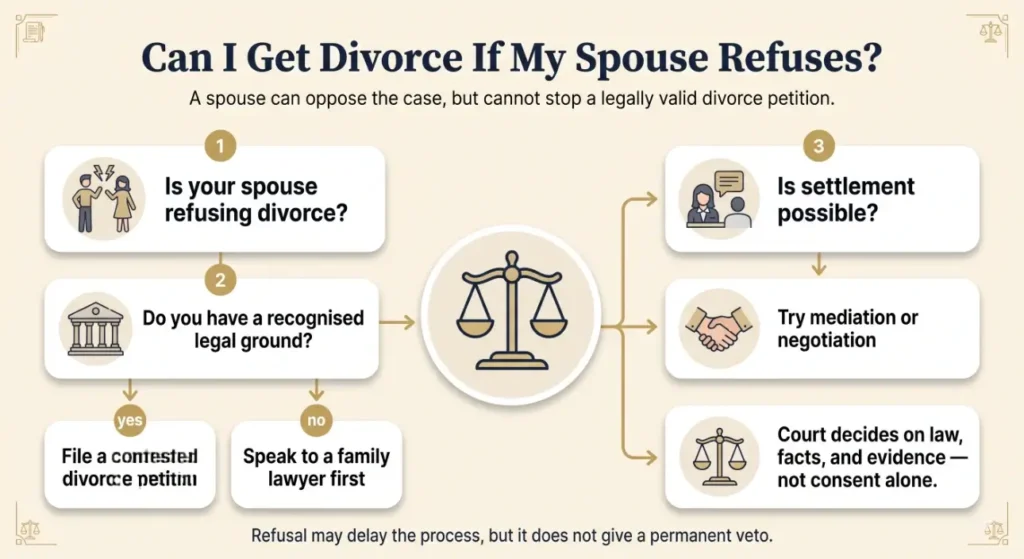
Can I Get Divorce If My Spouse Refuses?
Yes, it may be possible to get divorce even if your spouse refuses, but the matter will usually proceed as a contested divorce.
In a contested divorce, one spouse files a divorce petition and the other spouse gets an opportunity to oppose it. The spouse opposing the divorce may deny the allegations, file a written reply, raise counter-allegations, or seek relief such as maintenance, child custody, visitation rights, or litigation expenses.
The court does not grant divorce merely because one person says they no longer want to stay married. The person seeking divorce must prove a valid legal ground under the law applicable to the marriage. This is why the facts, documents, witnesses, and drafting of the petition become very important.
What Should I Do If My Spouse Does Not Wish to Divorce Me?
If your spouse does not wish to divorce you, do not try to pressure, threaten, or force them to agree. Speak to a family lawyer and check whether your facts support a contested divorce petition.
If your spouse is refusing to cooperate, you can apply for contested divorce, provided your case falls within a recognised legal ground. You do not need your spouse’s permission to start the process. Your spouse can reply and contest the case, but the court will decide the matter on law, facts, and evidence.
You should also preserve relevant documents, including proof of marriage, proof of separation, messages, emails, complaints, financial records, and any material connected with the reason for seeking divorce.

Which Divorce Law Applies in India?
India does not have one single divorce law for all marriages. The applicable law depends on the religion of the parties and the manner in which the marriage was solemnised or registered.
Common laws include:
- Hindu Marriage Act, 1955: generally applies to Hindus, Buddhists, Jains, and Sikhs.
- Special Marriage Act, 1954: applies to civil marriages registered under the Act, including many interfaith marriages.
- Indian Divorce Act, 1869: applies to many Christian matrimonial matters.
- Dissolution of Muslim Marriages Act, 1939 and Muslim personal law principles: may apply in Muslim matrimonial matters.
- Parsi Marriage and Divorce Act, 1936: applies to Parsi marriages.
Before filing any divorce petition, it is important to identify the correct law, the correct court, and the correct legal ground.
Common Grounds for Contested Divorce in India
The grounds for contested divorce depend on the statute applicable to the marriage. For many Hindu marriages, divorce may be sought on grounds such as cruelty, desertion, adultery, conversion, mental disorder as defined by law, renunciation, or not being heard of as alive for seven years.
- Cruelty may be physical or mental. It can include conduct that makes it difficult, unsafe, or unreasonable for one spouse to continue living with the other. The court looks at the overall conduct of both parties.
- Desertion generally means that one spouse has abandoned the other for the legally required period with an intention to end cohabitation. Mere physical separation may not be enough.
- Adultery refers to a voluntary sexual relationship outside marriage. It must be proved through legally admissible evidence and surrounding circumstances.
Other grounds, such as conversion, mental disorder, renunciation, or not being heard alive for seven years, depend on strict legal requirements. The correct ground should be chosen only after discussing the facts with a family lawyer. Filing on a weak or incorrect ground can delay the case and create avoidable complications.
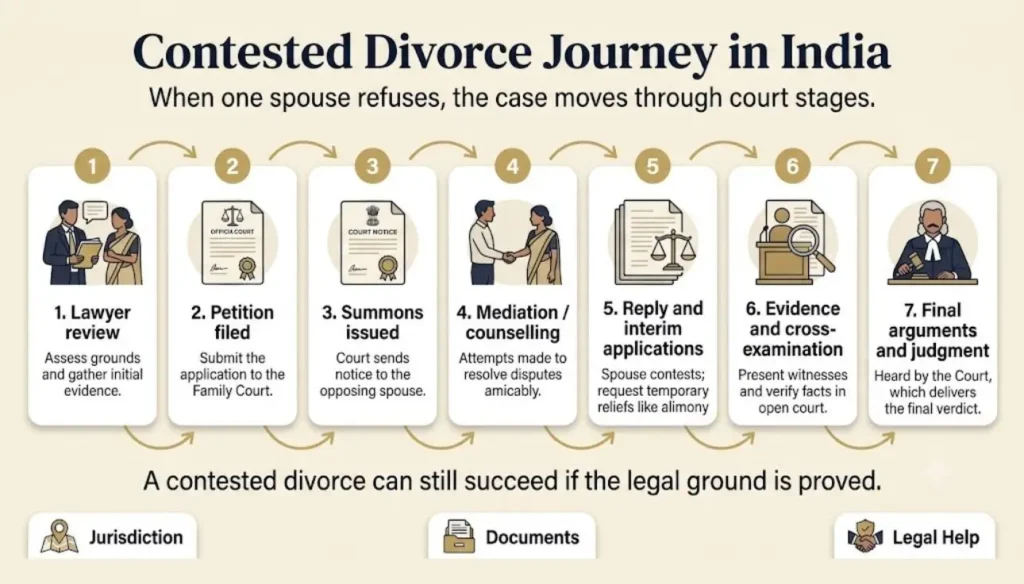
Procedure for Filing Contested Divorce in India
1. First Consult a Family Lawyer
The first step is to consult a lawyer who handles matrimonial and family court matters. Share the complete background, including the date and place of marriage, period of separation, details of children, previous complaints, financial position, and any pending cases. A lawyer can assess whether your facts support a contested divorce and where the petition should be filed.
2. Prepare the Divorce Petition
The divorce petition should clearly mention the facts, dates, incidents, legal ground, and reliefs sought. It should also include supporting documents wherever possible. A focused petition is usually stronger than a petition filled with vague allegations.
3. File the Petition Before the Appropriate Court
The petition is filed before the Family Court or competent District Court. Jurisdiction may depend on where the marriage took place, where the parties last lived together, where the respondent resides, or where the petitioner is legally permitted to file.
4. Court Issues Summons
After filing, the court issues summons to the other spouse. The respondent spouse is asked to appear before the court and file a reply.
5. Mediation or Reconciliation May Be Attempted
In many matrimonial cases, the court may refer the parties to mediation or counselling. This does not mean the court will force you to continue the marriage. The purpose is to see whether any settlement is possible. If mediation fails, the case returns to court.
6. Reply by the Respondent Spouse
The spouse opposing divorce may file a written statement or reply. They may deny the allegations, raise their own allegations, or seek interim relief. Specific denial is important and may affect the case depending on the pleadings.
7. Interim Applications
During the case, the court may hear applications for interim maintenance, child custody, visitation, residence, litigation expenses, or protection-related reliefs. These orders can have a major practical impact while the divorce case is pending.
8. Evidence and Cross-Examination
Both parties may file evidence and produce documents and witnesses. The opposite side may cross-examine the witnesses. This is one of the most important stages because the court examines whether the allegations are actually proved.
9. Final Arguments
After evidence is completed, both lawyers present final arguments. The court considers the law, facts, documents, and testimony before passing judgment.
10. Decree or Dismissal
The court may grant divorce, dismiss the petition, or pass related orders depending on the case. If a party is aggrieved by the decision, they may have a right to appeal within the prescribed time.
Documents and Evidence You Should Keep Ready
Your lawyer may ask you to collect:
- Marriage certificate, wedding photographs, invitation card, or proof of marriage.
- Identity proof and address proof.
- Proof of residence and last place of cohabitation.
- Birth certificates and school records of children, if any.
- Messages, emails, call records, photographs, medical documents, police complaints, legal notices, or other relevant material.
- Income proof such as salary slips, income-tax returns, bank statements, business records, asset details, liabilities, and monthly expenses.
- Any previous settlement discussions, mediation records, or written admissions, if legally usable.
Always use genuine and legally obtained evidence. False allegations, fabricated documents, or illegally collected material can seriously harm your case.
Can a Spouse Delay Divorce by Refusing?
Yes, a refusing spouse may delay the process by contesting the petition, seeking adjournments, filing interim applications, or disputing the allegations. However, refusal is not a permanent veto.
If the petitioner proves a valid legal ground and follows the required procedure, the court can still grant divorce. A well-drafted petition, organised documents, timely responses, and a clear legal strategy can help reduce unnecessary delay.
What You Should Not To Do
If your spouse is refusing divorce, avoid taking emotional or impulsive steps. Do not:
- Make false allegations only to create pressure.
- Threaten, harass, or defame your spouse.
- Hide income, assets, children-related information, or pending cases from your lawyer.
- Ignore court summons, notices, or hearing dates.
- Transfer property only to defeat possible maintenance or settlement claims.
- Assume that living separately automatically guarantees divorce.
- Depend only on online information instead of taking case-specific legal advice.
Divorce litigation can affect your family, finances, children, and future. It is better to act carefully from the beginning.
What About Irretrievable Breakdown of Marriage?
Many people believe that if a marriage has completely broken down, divorce will automatically be granted. In ordinary family court cases, this is not always correct. The Supreme Court of India has used its special powers under Article 142 of the Constitution in exceptional cases to dissolve marriages where the relationship had completely broken down.
However, ordinary Family Courts generally decide divorce petitions under the applicable statute and recognised legal grounds. This is why it is important to plead and prove a proper legal ground instead of relying only on the argument that the marriage has failed.
Frequently Asked Questions
Can I file for divorce if my spouse does not agree?
Yes. If your spouse does not agree, you may file a contested divorce petition on a legally recognised ground. Your spouse can oppose the case, but refusal alone does not stop you from approaching the court.
Can my spouse stop the divorce case by refusing?
No. Your spouse can oppose the divorce, but refusal alone does not stop the court from hearing the case. If you prove a recognised legal ground, the court can pass an order according to law.
What is the fastest way to get divorce if my spouse refuses?
There is no guaranteed fast route if your spouse refuses. The best approach is to file a properly drafted petition, collect strong evidence, follow court directions, and remain open to settlement or mediation where it protects your interests.
Can the matter be settled during a contested divorce?
Yes. Many contested divorce cases are settled during mediation or negotiation. Settlement may cover maintenance, child custody, visitation, return of articles, withdrawal of related cases, and other practical terms.
What if my spouse ignores court summons?
If summons are properly served and the respondent still does not appear, the court may proceed according to law, which can include ex parte proceedings. Proper service of summons is important.
Is separation enough to get divorce in India?
Separation alone may not always be enough. The petitioner must usually prove a recognised legal ground such as cruelty, desertion, or another ground available under the applicable law.
Conclusion
If your spouse does not want divorce in India, you still have legal options. A contested divorce can be filed if your case falls within a recognised legal ground.
The most important step is to understand the law applicable to your marriage, collect proper evidence, and take legal advice before filing. A contested divorce can be emotionally and legally challenging, but with the right guidance, you can approach the process with clarity and confidence.
How GS Bagga & Associates Can Help
Divorce becomes more stressful when one spouse wants to end the marriage and the other refuses. You may be facing family pressure, emotional stress, financial uncertainty, child-related concerns, or fear of a long court battle.
GS Bagga & Associates can help you understand whether your facts support a contested divorce, which law applies to your marriage, which court has jurisdiction, what evidence should be preserved, and how maintenance, child custody, residence, and settlement may affect the case.
If your spouse is not ready for divorce, speak to a family lawyer before taking any step. A clear strategy at the beginning can help you avoid mistakes later.