



Imagine living apart from your spouse for 79 months, more than six and a half years. Reconciliation efforts have failed, permanent alimony has been settled, and the Family Court has already allowed the First Motion. Yet a six-month waiting period still stands between you and the next stage of the divorce proceedings.
For couples whose marriage has ended in everything but name, further waiting can prolong emotional distress and delay important personal decisions. In appropriate cases, the court can waive this period on an application under Section 13B(2) of the Hindu Marriage Act, 1955, read with Section 151 of the Code of Civil Procedure (CPC), 1908.
In this article, we explain the Supreme Court judgement on waiver of the cooling period in divorce, the factors Family Courts consider, and an application format that can be adapted to your case.
Understanding the Cooling-Off Period in Mutual Consent Divorce
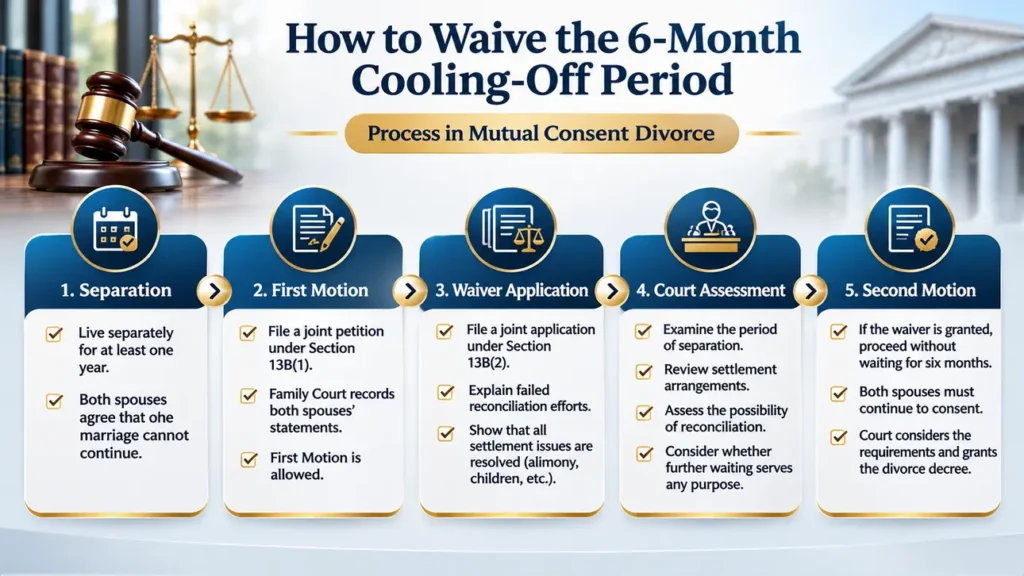
In India, mutual consent divorce under the Hindu Marriage Act, 1955, ordinarily involves two court stages:
- First Motion: Section 13B(1): Both spouses present a joint petition, ordinarily after living separately for at least one year. They state that they have been unable to live together and mutually agree that the marriage should be dissolved.
- Second Motion: Section 13B(2): Both spouses reaffirm their consent and request the final decree. The statute provides for this motion between six and eighteen months after presentation of the joint petition, subject to waiver of the six-month period. The court grants the decree after satisfying itself that the legal requirements are met.
The statutory timeline under Section 13B(2) runs from presentation of the joint petition. This date may differ from the date the court records the First Motion statements.
The six-month interval gives spouses an opportunity to reconsider their decision and explore reconciliation. However, where separation has continued for years and attempts to restore the relationship have failed, the court may conclude that further waiting would serve no useful purpose.
When Can a Family Court Consider Waiving Six Months?
To understand how a waiver request may arise before a Family Court in Delhi or elsewhere in India, consider the following illustrative example:
- Separation Timeline: The spouses have lived separately for 79 months before seeking relief.
- First Motion Status: The Family Court has allowed the First Motion under Section 13B(1).
- Exhausted Conciliation: Efforts to reconcile the parties, including mediation and counselling where undertaken, have failed.
- Complete Settlement: The parties have settled alimony, arrangements concerning children where applicable, and other matrimonial disputes.
- Urgency: The parties explain the specific personal circumstances supporting their request for an earlier Second Motion.
In these circumstances, a joint waiver application gives the court an opportunity to consider whether the six-month period should be dispensed with. The duration of separation is relevant, but it does not guarantee waiver or a decree within a particular number of days.
Supreme Court Judgement on Waiver of the Cooling Period in Divorce
Amardeep Singh v. Harveen Kaur: The Foundational Judgment
In Amardeep Singh v. Harveen Kaur, (2017) 8 SCC 746, the Supreme Court held that the six-month period under Section 13B(2) is directory rather than mandatory. This means the court may waive it after considering the circumstances of the case.
The ruling provides the foundation for seeking a six-month waiver in mutual divorce. It recognises that further waiting may be unnecessary where reconciliation has failed and the parties have settled the relevant issues.
Amit Kumar v. Suman Beniwal: Clarifying the Waiver Factors
The Supreme Court subsequently clarified in Amit Kumar v. Suman Beniwal, decided on 11 December 2021, that the factors identified in Amardeep Singh are illustrative, not exhaustive.
They should guide judicial discretion rather than operate as an inflexible checklist. In particular, eighteen months of separation should not be treated as an absolute prerequisite for granting waiver.
Factors the Court Considers Before Granting a Waiver
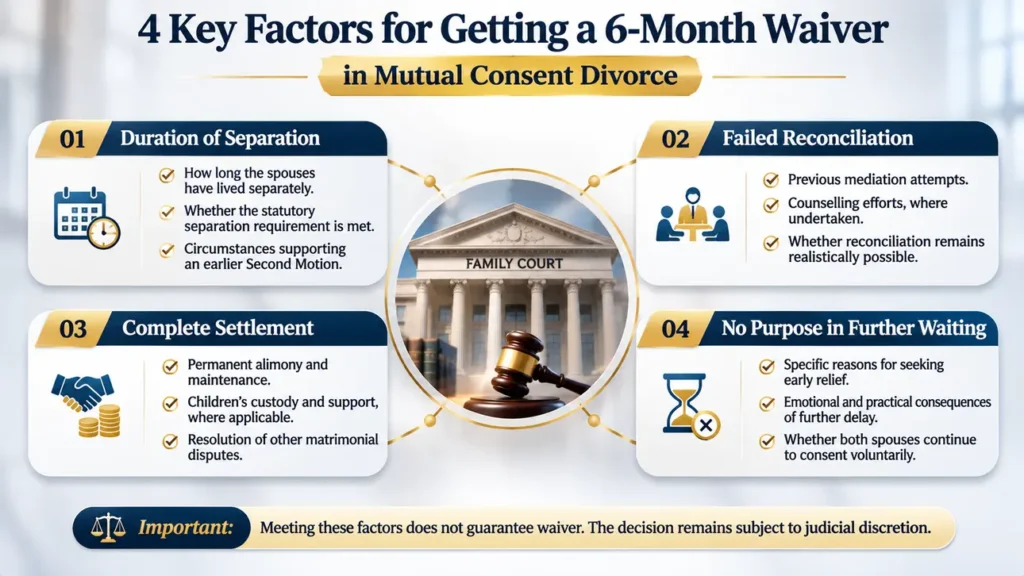
When considering a six-month waiver in mutual divorce, the court examines factors such as:
- Separation Period Before the First Motion: Amardeep Singh referred to one year of separation plus an additional six months already elapsed before the First Motion. Amit Kumar clarified that this should not become a rigid eighteen-month eligibility rule.
- Mediation and Reconciliation Efforts Have Failed: Attempts to restore the marriage have been unsuccessful, and there is no realistic prospect of reconciliation through further efforts.
- Complete Settlement of Alimony and Pending Issues: The parties have reached a voluntary settlement addressing alimony, maintenance, children’s custody and support where relevant, and other outstanding disputes.
- Further Waiting Would Prolong Distress: The application explains why another six months would serve no useful purpose in the circumstances of the marriage.
The settlement should clearly distinguish obligations already completed from those due at the Second Motion or later. Both spouses must also continue to consent freely to the divorce.
Application Format for Waiver of the Six-Month Cooling-Off Period
When seeking an earlier Second Motion, the parties can present a reasoned waiver application supported by the relevant court order, settlement documents and affidavits required by the court.
The following illustrative draft retains the usual structure of such an application. It assumes that the ordinary one-year separation requirement has been completed.
Joint Waiver Application
IN THE COURT OF PRINCIPAL JUDGE, FAMILY COURT:
[COURTS COMPLEX, CITY]
H.M.A. PETITION NO. [____] OF [YEAR]
IN THE MATTER OF:
[NAME OF PETITIONER NO. 1] …PETITIONER NO. 1
VERSUS
[NAME OF PETITIONER NO. 2] …PETITIONER NO. 2
JOINT APPLICATION UNDER SECTION 13B(2) OF THE HINDU MARRIAGE ACT, 1955, READ WITH SECTION 151 OF THE CODE OF CIVIL PROCEDURE, 1908, FOR WAIVER OF THE SIX-MONTH COOLING-OFF PERIOD
MOST RESPECTFULLY SHOWETH:
1. That the joint petition under Section 13B(1) was presented on [DD.MM.YYYY], and this Hon’ble Court was pleased to allow the First Motion in H.M.A. No. [NUMBER/YEAR], titled [PETITIONER NO. 1] versus [PETITIONER NO. 2], by order dated [DD.MM.YYYY].
2. That the parties have been living separately since [DD.MM.YYYY], for a period of [XX] months as of the date of this application.
3. That attempts to reconcile the parties have failed, and there is no prospect of their resuming the marital relationship.
4. That the period of one year of separation under Section 13B(1) had been completed before presentation of the joint petition.
5. That efforts at mediation and conciliation, including [ACCURATE DETAILS OF EFFORTS MADE], have failed. The parties submit that further attempts would not result in reconciliation.
6. That the parties have voluntarily settled their differences under the settlement dated [DATE], including alimony, arrangements concerning children, if any, and other pending issues. The settlement and details of completed and outstanding obligations are annexed as [ANNEXURE DETAILS].
7. That the parties seek waiver in accordance with Amardeep Singh v. Harveen Kaur, (2017) 8 SCC 746, and the clarification in Amit Kumar v. Suman Beniwal, decided on 11 December 2021. Further waiting would serve no useful purpose in the circumstances stated in this application.
8. That both parties continue to consent freely to dissolution of the marriage, without force, fraud or undue influence. An earlier Second Motion is sought for the following reasons: [SPECIFIC AND ACCURATE REASONS].
PRAYER:
It is most respectfully prayed that this Hon’ble Court may be pleased to waive the six-month period under Section 13B(2) of the Hindu Marriage Act, 1955, and permit the parties to move the Second Motion before expiry of that period, subject to the Court’s satisfaction.
It is further prayed that this Hon’ble Court
may pass any other order deemed appropriate in the interests of justice.
PETITIONER NO. 1 PETITIONER NO. 2
THROUGH COUNSEL
[ADVOCATE NAME & ENROLLMENT NO.]
[CHAMBER ADDRESS & EMAIL]
PLACE: [CITY]
DATED: [DD.MM.YYYY]
The application should be adapted to the court’s requirements, including its cause title, verification and annexures. Statements about separation, mediation and settlement must accurately reflect the parties’ circumstances.
Supporting Affidavit
Where individual supporting affidavits are required, each petitioner should confirm that they understand the application and that its factual statements are true. The following wording can be adapted for that purpose:
IN THE COURT OF PRINCIPAL JUDGE, FAMILY COURT:
[COURTS COMPLEX, CITY]
H.M.A. PETITION NO. [____] OF [YEAR]
IN THE MATTER OF:
[NAME OF PETITIONER NO. 1] …PETITIONER NO. 1
VERSUS
[NAME OF PETITIONER NO. 2] …PETITIONER NO. 2
AFFIDAVIT
I, [NAME OF PETITIONER], aged [XX] years, S/o or D/o [FATHER’S NAME], residing at [COMPLETE RESIDENTIAL ADDRESS], do hereby solemnly affirm and declare:
1. That I am Applicant/Petitioner No. [1/2] in the accompanying application and am acquainted with the facts and circumstances of the case.
2. That the accompanying application has been prepared under my instructions. I have read and understood its contents, or they have been read over and explained to me in [LANGUAGE]. Its factual statements are true to my knowledge.
3. That my consent to the divorce and settlement is free and voluntary, without force, fraud or undue influence.
DEPONENT
VERIFICATION:
Verified at [CITY] on [DAY] of [MONTH, YEAR] that the contents of this affidavit are true to my knowledge and no material fact has been concealed.
DEPONENT

Frequently Asked Questions
1. Can one spouse file the cooling-off waiver application alone?
Both spouses should support a consensual waiver request. The application does not remove the requirement for their continuing consent to divorce in ordinary Section 13B proceedings.
As explained in Hitesh Bhatnagar v. Deepa Bhatnagar, consent must continue until the decree. One spouse cannot use a waiver to obtain an ordinary mutual consent decree after the other has withdrawn consent. Confirm the filing and affidavit requirements with the court concerned.
2. Under which section is the cooling-off waiver filed?
The request seeks waiver of the period prescribed by Section 13B(2) of the Hindu Marriage Act, 1955. Applications commonly also refer to Section 151 CPC. The legal grounds should explain how the applicable Supreme Court judgments support waiver on the facts of the case.
3. When can couples submit the waiver application?
The Amardeep Singh judgment on the cooling-off waiver states that a reasoned application can be filed one week after the First Motion. The application should explain the grounds for waiver and identify the relevant settlement and reconciliation history. Filing and hearing arrangements remain subject to the court’s procedure.
4. Does the latest Supreme Court judgement on divorce by mutual consent mean there is no waiting period?
No. A relevant recent order is Misha Somani v. Rituraj Somani, dated 2 February 2026, in Civil Appeal No. 801/2026. The Supreme Court reiterated the flexible approach to waiver, set aside the High Court’s refusal and granted divorce using its Article 142 powers.
The order does not establish a universal rule of “no waiting in mutual consent divorce.” A Family Court must still consider the waiver request, and granting waiver does not itself dissolve the marriage.
5. Can a Supreme Court judgement on divorce within one year of marriage be used to waive the separation requirement?
A six-month waiver and permission to seek divorce within the first year involve different legal questions. Section 14 of the Hindu Marriage Act ordinarily restricts filing during the first year of marriage, with an exception for exceptional hardship or exceptional depravity.
In Shiksha Kumari v. Santosh Kumar, decided on 17 December 2025, the Delhi High Court Full Bench held that the one-year separation requirement under Section 13B(1) can also be waived through the proviso to Section 14(1) in exceptional circumstances. It requires separate consideration from the six-month waiver.
This is a Delhi High Court ruling, not a Supreme Court judgment granting every couple an automatic early divorce. Obtain advice on the binding law applicable to your court.
6. What documents should accompany a waiver application?
Depending on the court’s requirements and the circumstances, relevant documents may include:
- The First Motion order.
- The signed settlement agreement.
- Supporting affidavits.
- Available mediation or counselling records.
- Evidence of settlement payments already made.
- Details of arrangements concerning children, where applicable.
- Information about related proceedings and outstanding settlement obligations.
The application and supporting documents should give a consistent account of the separation, settlement and reasons for requesting waiver.
7. What happens if the court refuses to waive the cooling-off period?
Refusal of waiver is distinct from refusal of the divorce itself. The parties should follow the court’s directions and obtain advice on the remaining Second Motion timetable and any available remedy.
They should not assume that a waiver request suspends other procedural requirements.
Conclusion
The six-month cooling-off period need not prolong proceedings where reconciliation has failed and the circumstances justify an earlier Second Motion. A carefully prepared application allows the court to assess those circumstances against the applicable legal principles.
For couples who have lived apart for years, the strongest request explains the separation history, settlement terms and reasons further waiting would serve no useful purpose. Accurate documents and consistent statements are more persuasive than a general assertion of urgency.
Consult an experienced family law advocate to review your circumstances, adapt the application and affidavits, and address the requirements of the court hearing your petition.
Disclaimer: This article provides general legal information based on Indian statutory provisions and judicial decisions. Consult a qualified family law advocate for advice and pleadings tailored to your circumstances.