

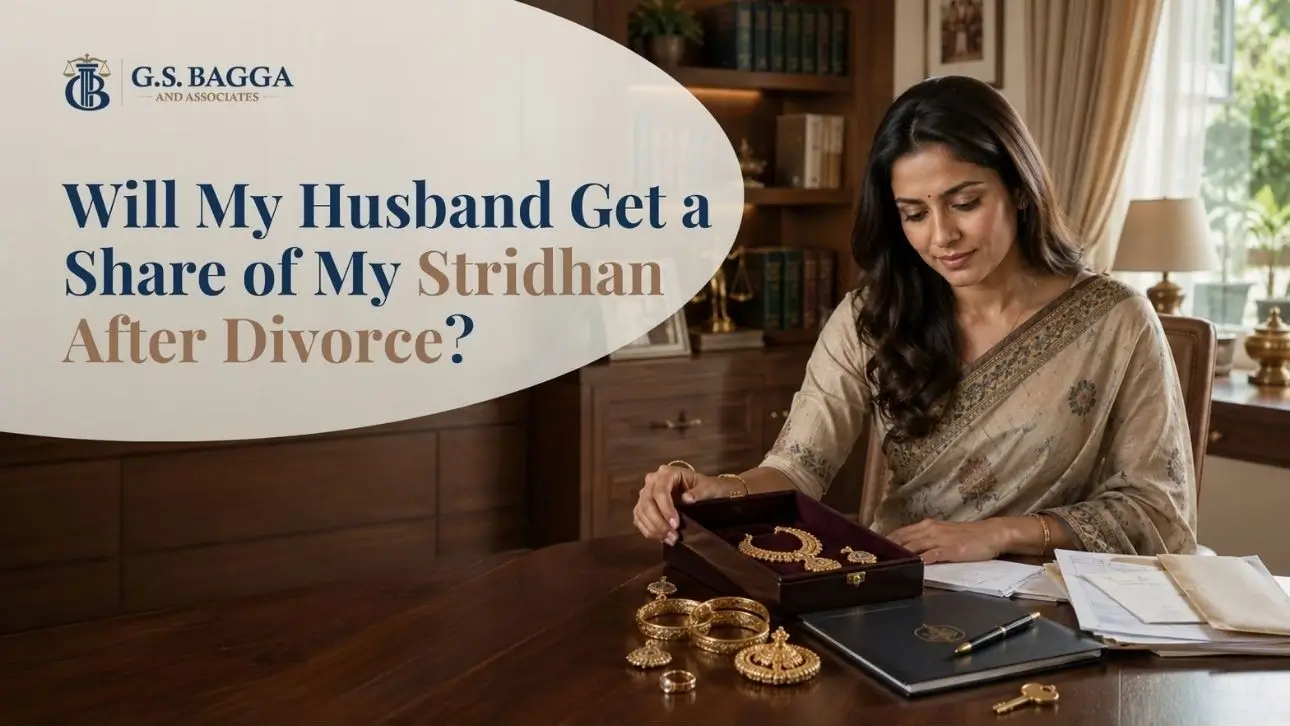
Going through a separation or divorce is emotionally draining, and worrying about your personal assets makes it even harder. Many women in India carry a deep worry about what will happen to their wedding jewellery, family gifts, cash, and belongings once a marriage ends. You might wonder whether your husband can legally claim any share in your Stridhan during or after the divorce.
As a general rule, marriage does not give a husband any ownership right in his wife’s Stridhan. Where property qualifies as the wife’s Stridhan, it remains her property, and divorce does not by itself transfer any ownership interest in it to the husband. It remains the exclusive and absolute property of the woman, before, during, and after the dissolution of marriage.
In this article, we discuss what qualifies as Stridhan, your legal rights under Indian law, and practical steps to protect and recover your rightful property.
What is Stridhan and How is it Acquired?
The word “Stridhan” is derived from classical Hindu jurisprudence, translating literally to “a woman’s property.” Modern Hindu law, particularly Section 14 of the Hindu Succession Act, 1956, recognises a Hindu woman’s full ownership over property covered by the provision.
Section 14(1) expressly includes property acquired by inheritance, partition, maintenance, gift, her own skill or exertion, purchase, prescription, and other recognised means, as well as property held by her as Stridhana.
Stridhan traditionally refers to property belonging to a woman, particularly property received through gifts and other recognised sources. Modern statutory law also gives a Hindu woman full ownership over a broad range of property under Section 14 of the Hindu Succession Act, 1956. Key forms of Stridhan include:
- Wedding Gifts and Jewellery: Gold, silver and diamond ornaments, cash, and other valuable articles specifically gifted to the bride for her personal ownership before, during, or around the time of marriage may form part of her Stridhan. The nature of the gift and the evidence establishing ownership can be important in a dispute.
- Pre-Marital and Post-Marital Presents: Assets gifted during courtship, engagement ceremonies, bridal send-off (Vidaai), or subsequent festive occasions.
- Childbirth Gifts: Valuables and financial gifts given to the woman upon the birth of her child.
- Inheritance and Partition Shares: Immovable or movable property inherited from her parents or received as her lawful share during family property partition.
- Self-Acquired Properties: Assets purchased using her personal income, investments, or profits derived from her existing Stridhan.
Gifts given exclusively to the husband or general household items intended for shared family use do not constitute Stridhan unless gifted specifically for the bride’s personal use.
Does a Woman Have Legal Ownership Rights Over Her Stridhan?
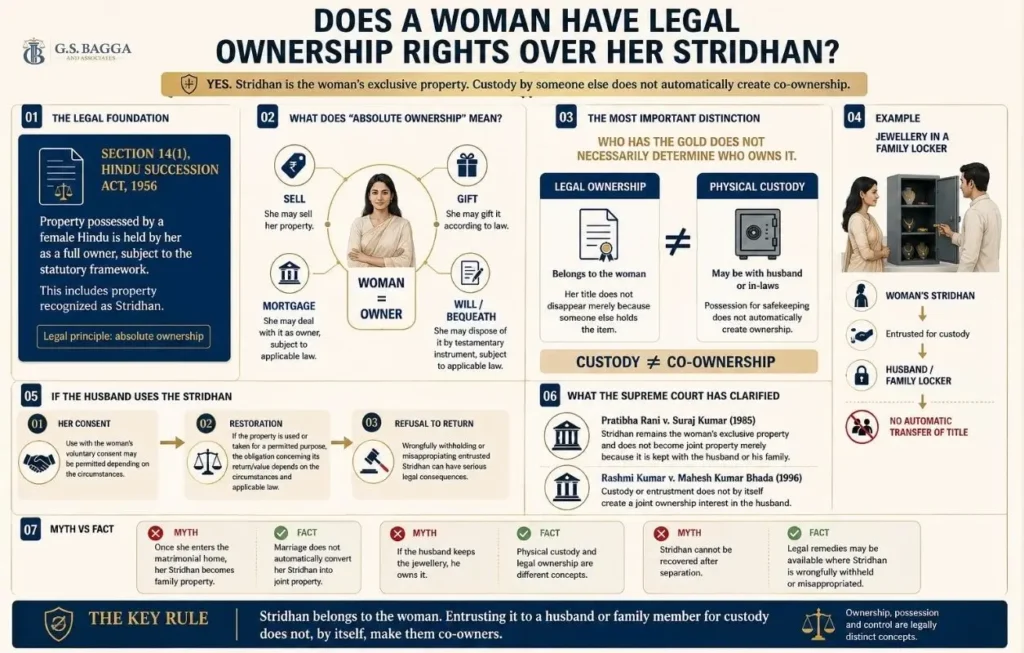
A woman holds complete, unassailable legal ownership over her Stridhan. Under Section 14(1) of the Hindu Succession Act, 1956, her ownership is absolute. This grants her the unrestricted right to sell, mortgage, lease, gift, or bequeath her assets at her sole discretion, without needing spousal permission.
During matrimonial cohabitation, a husband or his family may hold physical custody of Stridhan items, such as keeping gold ornaments in a joint family locker. However, this does not create co-ownership or confer any legal title. In the eyes of the law, the husband acts strictly as a trustee or custodian.
While a husband may, during severe financial distress, utilize his wife’s Stridhan with her voluntary consent, he has a strict legal obligation to restore it in full or reimburse its equivalent value. Withholding, selling, or refusing to return her Stridhan against her wishes constitutes an unlawful act.
What Happens to Stridhan After Divorce?
During divorce proceedings, matrimonial assets often become the focal point of disputes. However, Stridhan stands on a distinct legal footing. Because Stridhan is not joint matrimonial property, it cannot be divided, partitioned, or adjusted against financial claims made by the husband.
Upon separation or divorce, a woman is entitled to demand the immediate return of all her Stridhan articles. Under Section 27 of the Hindu Marriage Act, 1955, family courts have the power to make appropriate provisions regarding property presented at or around the time of marriage.
If the husband or in-laws retain her belongings after separation, their possession becomes unlawful detention, entitling the woman to initiate civil recovery and criminal proceedings.
What Happens to Stridhan in a Mutual Divorce?
In a mutual consent divorce under Section 13B of the Hindu Marriage Act, 1955, the return of Stridhan is settled amicably before the final decree is granted.
The settlement is documented through a formal Memorandum of Understanding (MOU):
- Itemized Inventory: Both spouses compile a comprehensive list of all jewellery, cash, and personal articles belonging to the wife.
- Physical Handover: Custody of all listed items is handed over to the wife prior to the First or Second Motion.
- Written Acknowledgment: The wife signs a receipt confirming the complete return of her belongings in good condition.
- No-Claim Clause: Both parties confirm in the petition that no Stridhan claims remain unresolved, preventing future litigation.
What Has the Supreme Court Said About Stridhan Rights?
The Supreme Court of India has consistently protected women’s proprietary rights over Stridhan through several landmark rulings:
- Pratibha Rani v. Suraj Kumar (1985): The Supreme Court held that Stridhan is the absolute property of the woman. The husband holds custody only as a trustee. If he or his family members refuse to return it upon demand, they are liable for Criminal Breach of Trust under Section 405/406 IPC (Section 316 BNS).
- Rashmi Kumar v. Mahesh Kumar Bhada (1997): The court reaffirmed that marriage does not create joint ownership over Stridhan. Misappropriating a wife’s bridal gifts attracts criminal prosecution.
- Krishna Bhattacharjee v. Sarathi Choudhury (2016): The apex court ruled that retaining Stridhan is a continuing offence under the Domestic Violence Act, 2005. Even after judicial separation, a woman remains an “aggrieved person” entitled to recover her property without limitation restrictions.
- Maya Gopinathan v. Anoop S.B. (2024): The Supreme Court reiterated that a husband has no control over his wife’s Stridhan. If the jewellery was sold or misappropriated, the wife is entitled to recover its current market value.
Stridhan vs. Maintenance, Alimony, and Joint Property
Stridhan is frequently confused with alimony, maintenance, or shared marital assets. Legally, they serve different purposes:
- Stridhan: A woman’s pre-existing, absolute property. It belongs exclusively to her and must be returned 100% in full upon divorce. It cannot be divided or negotiated away.
- Alimony and Maintenance: Financial support provided by the husband under Section 25 of the Hindu Marriage Act or Section 125 CrPC (Section 144 BNSS) for the wife’s living expenses. Claiming Stridhan does not waive her right to seek maintenance.
- Joint Property: Real estate, bank accounts, or vehicles acquired jointly during marriage using shared funds. These assets are divided between spouses based on proven financial contributions.
How Can a Woman Protect Her Stridhan?
To prevent evidentiary challenges during matrimonial disputes, women should take proactive steps to secure their Stridhan:
- Maintain an Itemized List: Record all jewellery, cash, and valuable gifts received during engagement, wedding, and festive occasions.
- Preserve Invoices and Certificates: Keep original purchase bills, hallmarking certificates, and valuation slips in a safe personal repository.
- Retain Visual Evidence: Keep wedding photographs and video recordings that clearly show the bride wearing specific jewellery pieces.
- Use Independent Bank Lockers: Store valuables in a bank locker operated solely in the woman’s name rather than a joint locker.
- Document Bank Statements: Maintain records of personal funds used to purchase gold, real estate, or financial investments.
Frequently Asked Questions About Stridhan After Divorce
Does a Husband Get a Share of His Wife’s Stridhan After Divorce?
No. A husband has no legal right to claim any share of his wife’s Stridhan after divorce. Indian law treats Stridhan as the exclusive property of the woman, completely exempt from marital property division.
Can a Husband Claim His Wife’s Gold Jewellery?
No. All gold jewellery given to a woman by her parents, relatives, or in-laws constitutes her Stridhan. Even if the in-laws purchased the jewellery as wedding gifts, absolute ownership vests entirely in the wife.
What Can a Woman Do If Her Husband Refuses to Return Her Stridhan?
If a husband refuses to return Stridhan, a woman can:
- File an FIR for Criminal Breach of Trust under Section 406 IPC (Section 316 BNS).
- Seek recovery orders under Section 12 and Section 19(8) of the Domestic Violence Act, 2005.
- File a petition in Family Court under Section 27 of the Hindu Marriage Act, 1955.
What Evidence Can Prove Ownership of Stridhan?
Ownership can be proved using jewellery purchase receipts, valuation cards, wedding photographs, and videos showing the bride wearing specific ornaments. Gift deeds, bank statements, witness testimonies, and signed inventory lists exchanged during marriage or separation also provide strong proof.
Is Stridhan Legally the Same as Alimony or Maintenance?
No. Stridhan is the return of a woman’s existing personal assets. Alimony and maintenance represent separate legal rights to ongoing financial support for her living expenses post-divorce.
How Can GS Bagga & Associates Help You?
Recovering Stridhan during a matrimonial dispute requires strategic legal planning and strong advocacy. At GS Bagga & Associates, our dedicated family law and divorce lawyers in Delhi assist women in safeguarding and retrieving their rightful assets.
Whether you are finalizing a mutual divorce settlement or pursuing criminal breach of trust proceedings for withheld jewellery, our legal team provides end-to-end guidance from drafting robust inventory agreements to representing you in Family Courts and the High Court. Visit our office today for a confidential legal consultation tailored to your matrimonial dispute.