

A divorce petition may be filed online in India where the relevant court has an e-filing facility. The process allows a petitioner or advocate to submit the divorce petition and supporting documents electronically.
However, filing for divorce online does not mean that the entire divorce case will necessarily be completed online. Court scrutiny, statements, hearings, mediation, evidence and other proceedings may still be required. The procedure also depends on the type of divorce, applicable marriage law, court jurisdiction and facts of the case.
If you want to apply for divorce online, understanding the filing process and the steps that follow can help you know what to expect.
Can I Apply for Divorce Online in India?
Yes, you can apply for divorce online where the relevant court has adopted an electronic filing facility for the proceeding. The e-Filing system allows legal pleadings and supporting documents to be submitted electronically before participating courts.
An online filing may involve creating an account, entering party and case details, uploading documents, completing verification, paying applicable court fees and submitting the petition for scrutiny.
However, an online divorce application is different from a completely online divorce. Filing the petition electronically does not automatically remove the need for court proceedings. Depending on the case, the parties may have to appear before the court, provide statements, attend mediation or participate in evidence and hearings.
Therefore, how can I file for divorce online should be understood as a question about the electronic filing process, not a guarantee that every stage of the divorce will take place online.
How to Apply for Divorce Online in India?
The exact process can vary depending on the court, applicable marriage law and type of divorce. The general steps for how to apply for divorce online are as follows.
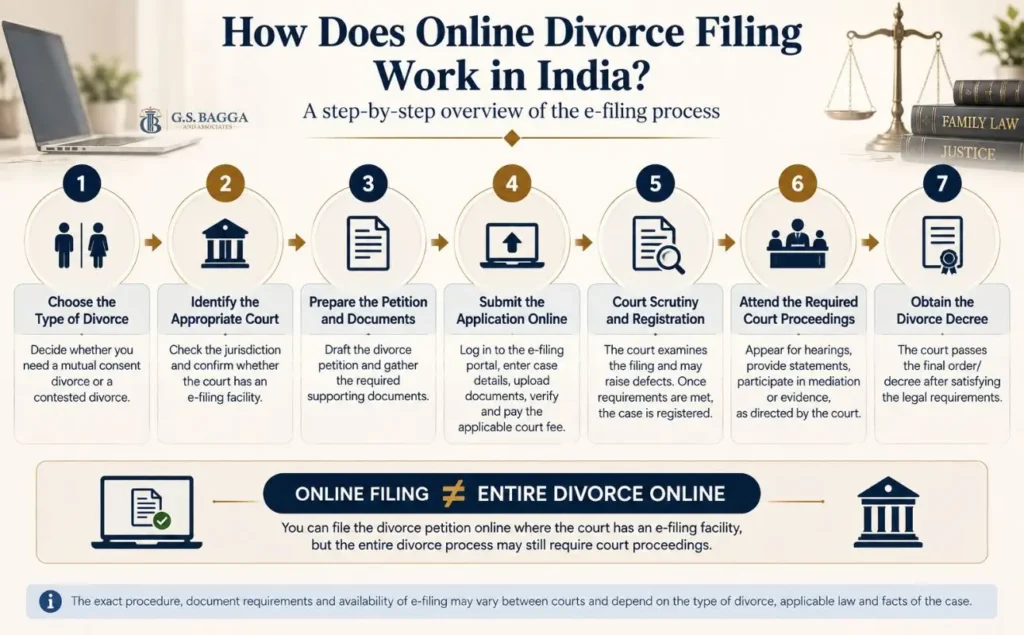
1. Determine the Type of Divorce
First, determine whether you need a mutual consent divorce or a contested divorce. Mutual divorce requires agreement between both spouses, while a contested divorce is filed when one spouse seeks divorce and the other may oppose the petition.
2. Identify the Appropriate Court
A divorce petition must be filed before a court with proper jurisdiction. The applicable jurisdiction depends on the governing law and facts such as where the marriage took place, where the respondent resides or where the spouses last lived together.
Depending on the location, the matter may be filed before a Family Court or competent District Court.
3. Prepare the Divorce Petition and Documents
Prepare the divorce petition according to the applicable law and court requirements. The petition should state the relevant facts and legal grounds for seeking divorce.
Supporting documents may include proof of marriage, identity and address documents, photographs and information about children. A contested matter may also require evidence supporting the allegations made in the petition.
4. Submit the Divorce Online Application
Where e-filing is available, the divorce online application can be submitted through the relevant electronic filing system.
The process may generally involve:
- Logging into the e-filing platform.
- Selecting the appropriate court and case category.
- Entering details of the parties and case.
- Uploading the petition and supporting documents.
- Completing verification or e-signing requirements.
- Paying the applicable court fee, where required.
- Submitting the filing for court scrutiny.
The exact filing requirements, document formats and available facilities can vary between courts.
5. Court Scrutiny and Registration
After submission, the court’s filing section examines the petition and documents. The court may raise defects relating to missing documents, incorrect information, formatting or other filing requirements.
If defects are raised, they must be corrected and the documents may need to be resubmitted. Once the filing satisfies the applicable requirements, the case can proceed to registration and further proceedings.
6. Attend the Required Court Proceedings
Electronic filing does not remove the need to participate in the case. Depending on the proceedings, the parties may need to attend hearings, provide statements, participate in mediation or comply with directions concerning evidence.
A court may permit virtual appearance in suitable circumstances, but this depends on the applicable procedure and specific court directions.
7. Obtain the Divorce Decree
Submitting an online petition does not itself dissolve the marriage. The court must consider the case and pass the appropriate final order or divorce decree.
The marriage is legally dissolved according to the final decree and applicable law. Therefore, online filing is only one stage of the divorce process.
How to Apply for Mutual Divorce Online?
A mutual consent divorce is based on the agreement of both spouses to dissolve their marriage. The spouses must satisfy the requirements of the applicable marriage law.
For marriages governed by the Hindu Marriage Act, Section 13B provides for divorce by mutual consent where the statutory requirements are satisfied, including the required period of living separately and mutual agreement to dissolve the marriage.
Where the relevant court provides e-filing, the joint petition may be submitted online. However, both spouses must still comply with court directions and participate in the required proceedings.
Steps for Applying for Mutual Divorce Online
The general process includes:
- Preparing the joint divorce petition.
- Filing the petition electronically where permitted.
- Appearing before the court as directed.
- Providing statements and completing the first motion.
- Observing the statutory waiting period where applicable.
- Filing or completing the second motion.
- Obtaining the divorce decree after the court is satisfied that the legal requirements have been met.
Under Section 13B(2) of the Hindu Marriage Act, the second motion is ordinarily made after six months and within eighteen months from presentation of the petition. The waiting period may be waived by the court in appropriate cases where legally permissible.
Thus, online divorce apply refers to the filing method. It does not mean that mutual divorce takes place without court involvement.
How to Apply for Contested Divorce Online?
A contested divorce is generally started by one spouse filing a petition based on a legally recognised ground for divorce. For example, the Hindu Marriage Act includes grounds such as cruelty and desertion, subject to statutory requirements.
Where e-filing is available, the petition can be submitted electronically. The respondent is then served with notice or summons and receives an opportunity to file a reply.
Depending on the case, the proceedings may involve reconciliation or mediation, evidence, examination and cross-examination of witnesses, final arguments and judgment. If the court grants divorce, a decree is issued. An appeal may also be available under applicable law.
Therefore, how to file for divorce online mainly concerns the method of submitting the petition. The subsequent contested proceedings continue according to the applicable law and court procedure.
What Documents Are Required for an Online Divorce Application?
The documents required for a divorce online application depend on the applicable law, court and circumstances of the case. There is no universal document list for every divorce matter.
Common Documents
Common documents may include:
- Marriage certificate or other proof of marriage
- Identity and address proof
- Photographs, where required
- Details of children, where applicable
- Basic information about the marriage and separation
Additional Documents Depending on the Case
Depending on the dispute, additional documents may include income and financial records, property documents, children’s records, medical documents, correspondence and evidence supporting allegations in a contested case.
The documents should be consistent with the facts stated in the petition. Missing or incorrect documents can result in filing objections and may delay registration.
Do I Have to Go to Court After Applying for Divorce Online?
In many cases, yes. E-filing changes the method of submitting the petition, but it does not automatically eliminate court proceedings. In a mutual consent divorce, both spouses may need to appear and provide statements as directed by the court. A contested case may require hearings, evidence and other appearances.
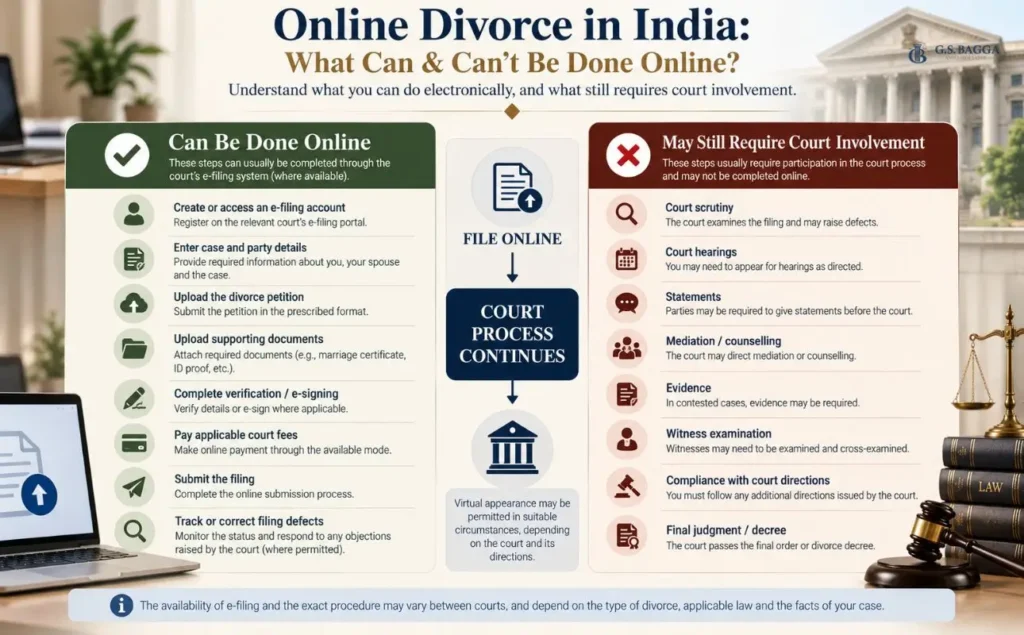
Virtual appearance may be permitted in appropriate circumstances, depending on the court’s directions and applicable procedure. Therefore, filing online should not be treated as a promise that the entire divorce process can be completed without appearing before a court.
How Long Does an Online Divorce Application Take?
The time required to submit an online divorce application depends on the completeness of the petition and documents and the requirements of the relevant court.
Obtaining the final divorce decree takes longer and depends on factors such as the type of divorce, court scrutiny, hearing dates, procedural requirements and, in contested cases, evidence and arguments.
The time required to file should therefore be distinguished from the time required to complete the divorce case.
How Can GS Bagga & Associates Help With an Online Divorce Application?
GS Bagga & Associates can assist with the legal and procedural aspects of an online divorce application based on the facts of the case and applicable court procedure.
Our assistance may include understanding the appropriate divorce procedure, preparing the petition, reviewing documents, assisting with online filing, representing clients before the court and providing guidance in mutual and contested divorce matters. A consultation can help you understand the appropriate process before filing.
Frequently Asked Questions About Applying for Divorce Online
How can I file for divorce online in India?
You can file electronically where the relevant court provides an e-filing facility. The process generally involves preparing the petition, selecting the appropriate court, uploading documents, completing verification and paying applicable fees.
Can I apply for divorce online without a lawyer?
In some courts, litigants may use the e-filing system themselves. However, preparing the petition, establishing jurisdiction and meeting procedural requirements can require legal knowledge. A lawyer is not automatically required simply because the filing is electronic.
Can mutual divorce be applied for online?
Yes, where the relevant court permits electronic filing. Both spouses must still comply with the legal requirements and court directions for mutual consent divorce.
Can contested divorce be filed online?
Yes, where the court’s e-filing facility covers the proceeding. The case will then continue through the required judicial proceedings.
Can I complete my divorce entirely online?
Not necessarily. Online filing does not mean that every stage of the divorce will take place online. Court appearances, statements, mediation, evidence or hearings may still be required.
What documents are required for an online divorce application?
The required documents vary by court, applicable law and circumstances. Common documents include proof of marriage, identity and address documents and basic case information. Additional financial, property or evidentiary documents may be required.
Conclusion
You may be able to apply for divorce online in India where the relevant court has an e-filing facility. Electronic filing can make the initial submission of the petition and documents easier, but it does not necessarily mean that the entire divorce case will be completed online.
The procedure differs between mutual consent and contested divorce. The applicable marriage law, court jurisdiction, documents and individual facts determine the exact process. If you are unsure how to file for divorce online, a legal consultation can help you understand the appropriate procedure before filing.
Disclaimer: This article provides general legal information and does not constitute legal advice. Divorce procedures and e-filing requirements may vary based on the facts and applicable law.