

Many couples in India are trapped in unhappy marriages because they believe divorce will take years and involve endless court visits. A nationwide justice survey found that 32% of people hesitate to approach a lawyer for legal issues.
At the same time, family courts have over 11 lakh pending divorce, child custody, and maintenance cases, which often adds to people’s concerns. It’s also a worry that after divorce many parents might not get child custody or get to spend very little time with their children.
Understanding the process to file a mutual divorce petition can ease these worries. In this blog, we will explain the process, cost, documents, and expected timeline in simple words.
When Can A Person File For Mutual Divorce?
Despite all the efforts, a husband and wife still feel they cannot live together and decide to part ways peacefully; that’s called mutual divorce. There are some common situations when you can file a mutual consent divorce petition:
- Spouses live away from each other for at least one year.
- They no longer wish to continue the marriage.
- There is no pressure or force from either side.
- Both are willing to settle matters like maintenance, child custody, and property.
- They feel there is no practical chance of getting back together as husband and wife.
Laws For Mutual Divorce In India
When a couple decides to part ways peacefully, the law provides a simple route through mutual divorce. Different personal laws govern the process, depending on the couple’s religion and marriage registration. The laws that have provisions related to mutual divorce are;
Hindu Marriage Act, 1955
Section 13B is the provision for mutual divorce under the Act. It’s only for Hindus, Buddhists, Jains, and Sikhs. The conditions to obtain a mutual divorce under this act are;
- Spouses should have lived separately for at least one year.
- Both of them should feel that the marriage cannot continue.
- The divorce petition is filed jointly before the family court.
Special Marriage Act, 1954
Mutual divorce is explained under Section 28 of the Act. A couple married under the act can file a mutual divorce petition. There are certain conditions to file for mutual divorce, which are;
- Both spouses agree to end the marriage.
- The petition is filed by both partners before the court.

Divorce Act, 1869
Section 10A gives an explanation for mutual divorce and it applies to Christians. The conditions that need to be met are;
- Husband and wife must be living separately for the period required under law.
- Both partners should opt for divorce without any force.
Before filing, it is important to keep the documents required for mutual divorce ready. The documents are identity proofs, marriage records, income details, and other divorce documents India courts commonly ask for.
In Sureshta Devi v. Om Prakash (1991), the Supreme Court said that mutual divorce needs consent from both spouses till the trial ends. If even one spouse withdraws consent before the decree, divorce stops.
Where Should The Petition For Divorce Be Filed?
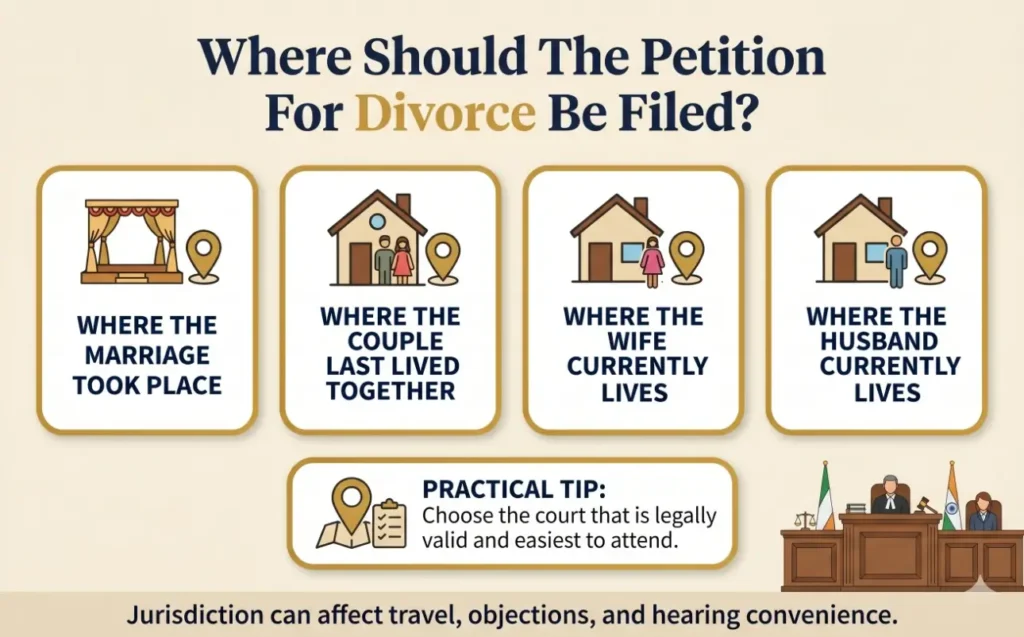
Spouses often carry doubts about which court should they go to file for divorce. Before you file the mutual divorce papers or a mutual consent divorce petition, you must know which family court can take up your case, which is listed below;
- The area where the marriage took place.
- The family court where the couple last lived together.
- The family court where the wife is currently living.
- Place where the husband is currently living.
Documents Needed For A Mutual Divorce Petition
One of the first questions a couple going for a mutual divorce usually has is about the paperwork. The exact documents required for mutual divorce can differ for each case; some papers are common in most mutual consent divorce matters.
- A marriage certificate to show that the marriage was legally registered.
- Identity and address proof of both husband and wife.
- Recent passport-size photographs of the spouses.
- Documents of income, such as salary slips or income tax returns.
- Details of any property, investments, or assets owned by either spouse.
- Papers for child custody or child support, if children are involved.
- A written settlement having maintenance, alimony, or property-related matters.
- Proof of living separately, if available.
- The signed mutual divorce papers will be submitted before the court.
These are some of the commonly accepted documents required for divorce. Depending on the facts of the case, the court may ask for additional records as well.
Steps Involved In A Mutual Consent Divorce
The process for mutual divorce moves through a few simple legal stages before the court grants divorce.
- File a mutual divorce petition jointly before the Family Court.
- Submit the required divorce documents india along with the petition.
- Appear before the court for recording of statements.
- Complete the First Motion proceedings.
- The court gives time for reconciliation, if needed.
- Need to be present in the court again for the Second Motion.
- Submit the final mutual divorce papers and settlement terms.
- The court sees child custody, maintenance, and property arrangements.
- If everything is fine, the court grants a Decree of Divorce.
Your mutual divorce case can be done within 18 to 24 months. Sometimes it takes only 6 months, if your case facts are short and the court’s schedule.
How Much Will A Mutual Divorce Cost You?
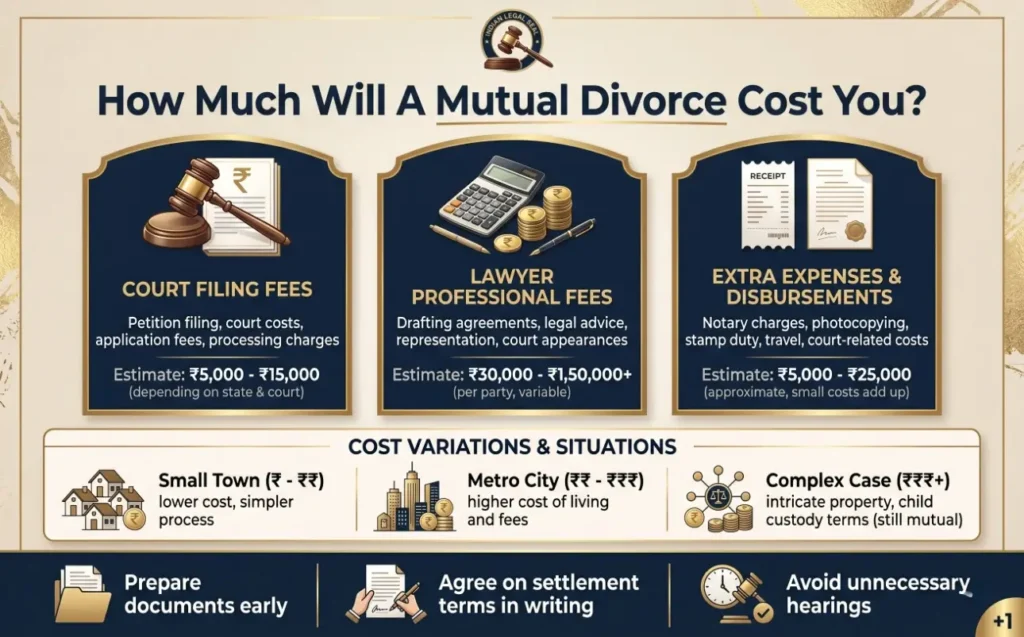
It’s a common question to first ask about the cost of a mutual divorce. However, the total expense changes with where you live, the lawyer you choose, and the nature of your mutual divorce petition.
- Court filing fees will be only a few hundred rupees.
- You can expect lawyer fees in a small town to be from ₹ 10,000 to ₹ 30,000 for the complete case.
- Couples from cities like Delhi, Mumbai, Bengaluru, and Kolkata get a little higher rate from ₹25,000 to ₹1,00,000 or more.
- The cost can increase if there are additional hearings or settlement issues.
Can A Mutual Divorce Be Withdrawn?
If you wish to give your marriage a second chance after filing the mutual divorce petition, you can go ahead.
Yes, a mutual divorce can usually be withdrawn if:
- The husband or wife changes their mind before the second motion.
- Both of them decide to stay together and work on the marriage.
- One party is doesn’t want to continue with the mutual divorce papers.
- Partners don’t agree on child custody, maintenance, or property settlement.
- A spouse feels they agreed to the divorce under pressure.
- If one spouse skips the court trial for the next stage of the case.
Planning a Mutual Divorce? Go For The Right Legal Support.
You can feel less stressed with the mutual divorce process, timeline, and documents required for mutual divorce. If you have the necessary papers ready and understand each step, you can avoid delays.
Looking for help with a mutual consent divorce petition or want to understand the documents required for divorce? G.S. Bagga & Associates is here to help at every stage. Our team works on divorce matters, child custody, maintenance, and settlement discussions. We make you understand the paperwork and the legal process in a simple and clear manner. Reach out to G.S. Bagga & Associates for trusted legal support.