

While adoption was once viewed with traditional hesitation in certain parts of society, modern India is rapidly changing, evolving, and celebrating the choice to welcome a child into a secure, nurturing home.
Prospective parents across the country choose to explore legal adoption in India for two primary reasons: fulfilling the profound desire for parenthood when navigating biological hurdles, and providing a bright, secure future for a child who lacks parental care.
If you are exploring how to adopt a child, understanding the baseline legal frameworks is critical to ensure that your journey is protected, transparent, and completely binding.
India’s adoption framework mainly rests on the secular Juvenile Justice (Care and Protection of Children) Act, 2015 and the Adoption Regulations, 2022 framed by CARA, together with the Hindu Adoptions and Maintenance Act, 1956 (HAMA) for Hindus.
This comprehensive legal guide details the current eligibility conditions, statutory pathways, paperwork checklist, and nationwide structural steps required to successfully adopt a child in India.
Legal Eligibility Criteria For Adoptive Parents In India
Verifying your legal eligibility to adopt a child in india is the primary step of this journey. The Central Adoption Resource Authority (CARA), a statutory body operating under the Ministry of Women and Child Development, sets strict baseline regulations to prioritize the safety and permanent welfare of the child.
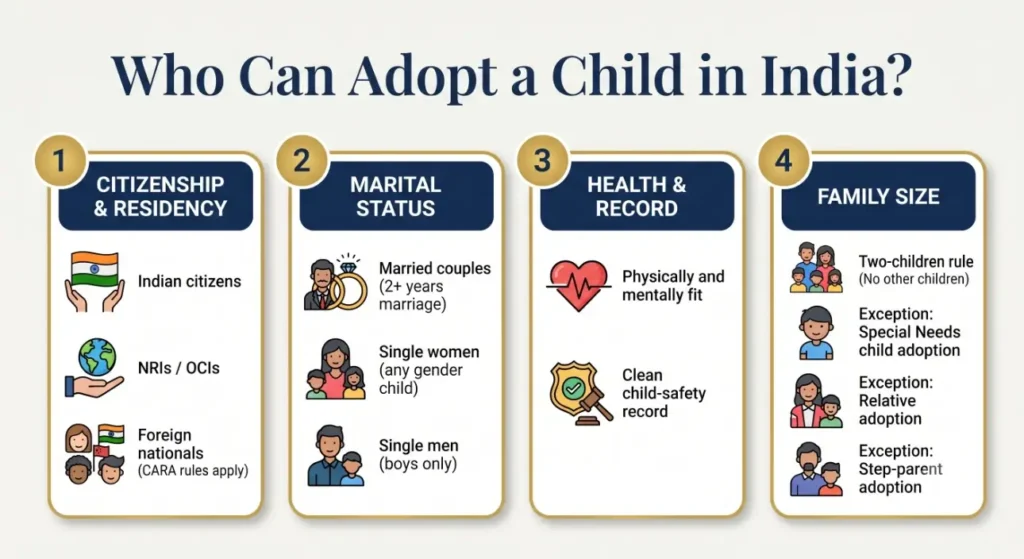
When analyzing child adoption eligibility in india, the nodal authorities review the physical, mental, emotional, and economic capabilities of the applicants. The foundational criteria for adopting a child in india require prospective adoptive parents (PAPs) to fulfill these key adoption rules:
- Citizenship and Residency: Indian citizens, Non-Resident Indians (NRIs), and foreign nationals are fully eligible, though matching sequences and verification protocols vary by category.
- Marital Stability & Consent: Married couples must have completed at least 2 years of a stable marital relationship, and both partners must provide their explicit written consent to adopting a child.
- Health & Medical Status: Applicants must be physically, mentally, and emotionally sound, with no life-threatening or debilitating medical conditions.
- Judicial Record: Applicants must not have been convicted of any offence that endangers children or involves serious moral turpitude, and any criminal record will be carefully reviewed to ensure that adoption is in the child’s best interests.
- Existing Family Size: Under current rules, couples who already have two or more living children (whether biological or adopted) are generally not considered for adopting a non‑special‑needs child, but they remain fully eligible to adopt children with special needs or hard‑to‑place children, and for immediate placement, relative, or step‑parent adoptions.

Maximum Age Limit For Adopting A Child In India
CARA regulates the permissible age of prospective parents based directly on the age group of the child they wish to bring home. For institutional adoptions under CARA, the age difference between the child and at least one adoptive parent must generally be a minimum of 25 years, but this age rule does not apply in relative or step‑parent adoptions. Under the official Adoption Regulations, 2022, the composite age limit for adoption in india is categorized into distinct brackets:
| Age of the Child | Maximum Composite Age (Married Couple) | Maximum Age (Single Parent) |
| Upto 2 years | 85 years | 40 years |
| Above 2 and upto 4 years | 90 years | 45 years |
| Above 4 and upto 8 years | 100 years | 50 years |
| Above 8 and upto 18 years | 110 years | 55 years |
Adoption Rules in India for Single Parents
The contemporary statutory framework offers progressive and highly inclusive adoption rules in India for single parents. If you are an individual aiming to build a family independently, the core adoption rules specify that:
- A single female applicant is legally eligible to adopt a child of any gender.
- A single male applicant is completely restricted from adopting a female child.
- All other age and eligibility criteria apply to single parents in the same way as to couples.
Authoritative Legal Guidance for Solo Applicants
Can a divorced woman adopt a child in india?
Yes. Under the secular guidelines of the Juvenile Justice Act and central CARA frameworks, a divorced woman is fully eligible to adopt as a single parent. Once a final, valid divorce decree is obtained from a competent Family Court, she can independently initiate the application process without requiring any consent, validation, or paperwork from her former spouse.
Statutory Laws To Adopt A Child In India
In India, legal adoption is primarily governed by the Juvenile Justice (Care and Protection of Children) Act, 2015 (as amended in 2021) and the Adoption Regulations, 2022 framed by CARA, along with the Hindu Adoptions and Maintenance Act, 1956 for Hindus.
- The Hindu Adoptions and Maintenance Act, 1956 (HAMA): Monitored under the Ministry of Law and Justice, this statute applies to individuals practicing Hinduism, Buddhism, Jainism, or Sikhism. It primarily governs direct adoptions between known relatives, family members, or step-children.
- The Juvenile Justice (Care and Protection of Children) Act, 2015 (JJ Act): Supervised under the Ministry of Women and Child Development, this is a completely secular act open to all Indian citizens regardless of faith. It strictly regulates institutional adoptions of unrelated or vulnerable children.
Key Differences Between CARA And HAMA Adoption Process
Choosing the accurate legal track is essential to protect your family from future claims or legal challenges. Evaluating the adoption criteria in india across both frameworks reveals distinct structural variations:
| Parameter | HAMA Pathway | CARA (JJ Act) Pathway |
| Nature of the System | Direct adoption between known families or relatives. | Institutional adoption of children through recognized care registries. |
| Religious Scope | Restricted to Hindus, Buddhists, Jains, and Sikhs. | Secular framework available to all religious beliefs. |
| Age Limit of the Minor | Children up to the age of 15 years. | Children and minors up to 18 years of age. |
| Final Legal Instrument | Finalized via a registered, physical Adoption Deed. | Finalized via an administrative order from a District Magistrate (DM). |
| Post-Adoption Tracking | No statutory post-adoption checks are mandated. | Mandatory periodic follow-up visits for 2 years post-placement. |
| Inter-Country Validity | Requires an explicit CARA No-Objection Certificate (NOC) to move a child abroad. | Fully integrated with international Hague Convention standards. |
Which Children Are Legally Eligible For Adoption In India?
An infant or minor is only deemed legally free and available for adoption after undergoing comprehensive background checks and being formally categorized into one of these three distinct legal classifications:
- Orphan: A child who has lost both biological parents, or whose legal guardians are legally declared missing or deceased.
- Abandoned: A child deserted by their biological parents or guardians, where institutional efforts by local police and child welfare authorities have failed to trace the family.
- Surrendered: A child relinquished by their biological parents to the Child Welfare Committee (CWC) due to severe physical, social, or emotional constraints, following which the child is declared “legally free for adoption.”
Essential Paperwork And Legal Documents Required For Adoption
Ensuring your documentation is meticulously organized prevents processing hurdles or administrative rejections. The primary child adoption documents required for the centralized institutional portal include:
- A formal application along with recent postcard-sized family photographs.
- Valid age proof and identity credentials (Aadhaar Card, PAN Card, Passport).
- Proof of residence (Utility bills, sale deeds, or registered lease agreements).
- Income certificates, Form 16, or Income Tax Returns (ITR) to prove financial sustainability.
- A comprehensive medical fitness certificate signed by a government-registered physician (minimum MBBS) proving the absence of life-threatening health issues.
- Three separate reference letters from responsible societal members testifying to the family’s character and stability.
Documents Required for Adoption Deed (HAMA Track)
When pursuing an intra-family or relative adoption directly under HAMA, you do not apply through the standard centralized institutional registry. Instead, the adoption is recorded through a registered Adoption Deed at a local Sub-Registrar’s office, provided that all mandatory conditions under sections 6 to 11 of HAMA (who can adopt, who can give, who can be adopted, age-gap and gender rules) are fully satisfied. The essential documents required for adoption deed registration include:
- A formally drafted physical Adoption Deed executing the unconditional transfer of the minor.
- Proof of religious identity for both participating sides.
- Written, signed affidavits or absolute consent forms from the biological parents and the adoptive parents.
- Identification documents and signatures from at least two independent, adult witnesses.
Can Adoptive Parents Choose Or Request A Specific Child In India?
No, prospective adoptive parents cannot pick or demand a specific child from an institutional registry. To prevent trafficking and ensure child rights protection, the centralized CARINGS system matches profiles automatically based on seniority.
However, parents can outline broad structural preferences during their initial setup, including:
- Desired age group brackets.
- Gender preference (if any).
- Health categories (stating their willingness to open their home to a child with special medical needs).
Step-By-Step Procedure To Adopt A Child In India
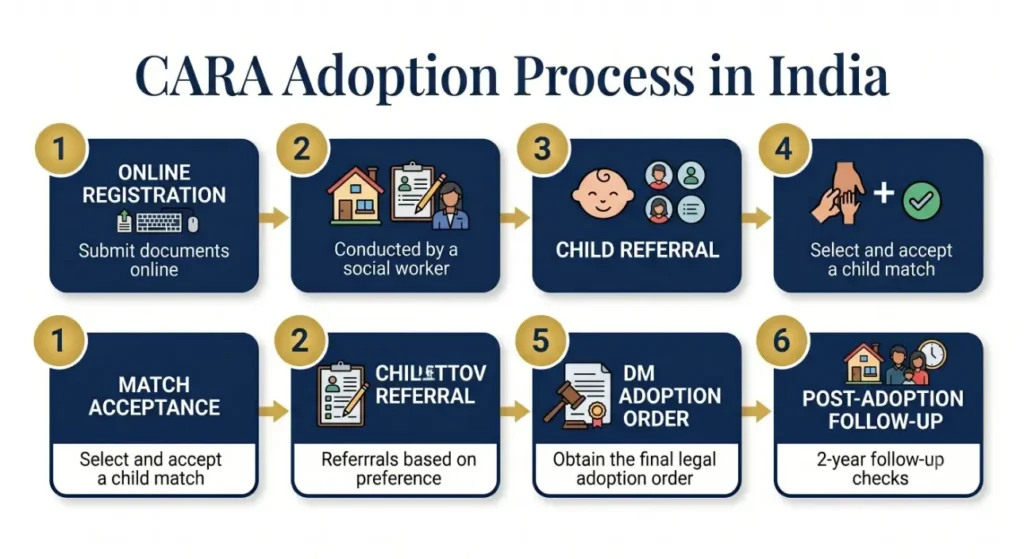
The modern adoption process in india relies on a clear, electronic timeline managed via the central CARINGS portal to maximize transparency and rule out middlemen. Knowing exactly how to adopt a child in india involves navigating these distinct operational phases:
- Online Registry Setup: PAPs submit their primary registration on the official CARA web application, securely uploading all required identity, residency, and financial proofs.
- Home Study Report (HSR): An authorized social worker from a registered Specialised Adoption Agency (SAA) visits your home to conduct a detailed Home Study Report within 60 days of your registration. They assess household safety, environment, and parent motivation.
- Child Referral Cycle: Based on the parents’ seniority on the national waiting list, automated child profiles, complete with medical and social histories, are securely shared. Parents have a strict 48-hour window to review and reserve a profile.
- Pre-Adoption Foster Care: Once a referral match is confirmed, parents assume physical custody under a temporary foster care agreement while formal legal papers are prepared.
- Filing the Application: A specialized child law advocate compiles the administrative application alongside all statutory home studies and child welfare clearances.
- The District Magistrate Order: To avoid long court backlogs and prioritize the child’s adjustment, the latest amendments to the Juvenile Justice Act mandate that final, binding adoption orders are reviewed and issued directly by the District Magistrate (DM) or Additional District Magistrate rather than traditional civil courts.
- Post-Adoption Follow-Up: Following the DM’s final order, the designated adoption agency schedules quarterly follow-up visits over a period of 2 years to ensure the child integrates smoothly into their new life.
Secure Your Family’s Legal Journey
Navigating the complexities of central child registration portals, cross-state tracking, or registering an adoption deed under HAMA requires precise legal insight to protect your family from future disputes. Minor administrative or procedural oversights can delay your dream of parenthood or risk legal invalidation.
At the Law Office of G.S. Bagga & Associates, our experienced family and child law advocates provide compassionate, highly specialized guidance throughout the entire statutory framework. We handle the heavy legal and administrative burdens, allowing you to focus completely on preparing your home for your child.