

Family law Specialists
Divorce Lawyer in Saket Court, Delhi
People may consider divorce when cruelty, prolonged separation, or serious marital disputes make continuing the marriage difficult. Divorce can also affect finances, children, and future plans. Understanding your rights and the available legal options helps you prepare for the next step.
At G.S. Bagga & Associates, we assist with mutual consent divorce, contested divorce, child custody, maintenance, and related matrimonial matters. If you need a divorce lawyer in Saket Court, we can review your circumstances, prepare legal documents, and assist with proceedings before the appropriate Family Court.
- 20+ Years of Combined Legal Experience
- Divorce and Family Law Assistance
- Clear Legal Guidance
Prefer WhatsApp? Use the chat option on our website for a brief enquiry.
Request a Private & Confidential Consultation
Your privacy is our priority. All discussions are strictly protected under advocate-client confidentiality.

Understand Jurisdiction
Who Can File for Divorce at Saket Family Court?
Saket Courts Complex houses Family Courts serving the South and South-East judicial districts of Delhi. If your marriage or relevant residence connects with Saket, Hauz Khas, Greater Kailash, Malviya Nagar, Defence Colony, Kalkaji, Lajpat Nagar, Gulmohar Park, or CR Park, you may be able to file here. Your locality alone does not establish jurisdiction.
Under Section 19 of the Hindu Marriage Act, 1955, the legal connection to the court matters:
- Wife Filing a Petition: A wife may file where she resides on the filing date, provided that address falls within the court’s territorial jurisdiction.
- Husband Filing a Petition: A husband may file where the marriage was solemnised, the respondent resides, or the spouses last lived together. Specific statutory exceptions may also apply.
- Mutual Consent Filing: Both spouses may jointly petition before a competent court after satisfying Section 13B requirements and the applicable jurisdiction rules.
- Interstate or Overseas (NRI) Spouses: Living outside Delhi does not necessarily prevent filing at Saket. A qualifying marriage or residence connection must still exist.
We check the applicable matrimonial law, relevant addresses, and territorial court allocation before preparing a petition. This can help identify jurisdictional problems early.
How We Assist: We review marriage records, residential details, and legal grounds to assess whether Saket Family Court is the appropriate forum.
Our Practise Areas
Matrimonial and Divorce Matters We Handle at Saket Court
Divorce may involve financial support, arrangements for children, and disputes about personal belongings. We assist with case preparation, related applications, and representation before the appropriate court.

Mutual Consent Divorce
When both spouses agree to end their marriage, they may present a joint petition under Section 13B of the Hindu Marriage Act. They generally must have lived separately for at least one year and meet the other statutory conditions. We assist with joint petitions, settlement terms, and first- and second-motion formalities. Read our mutual consent divorce guide.
Contested Divorce Proceedings
When one spouse does not agree, the other may seek divorce on recognised legal grounds. Section 13 of the Hindu Marriage Act includes cruelty, adultery, and desertion for the required period. We review relevant facts, prepare petitions or replies, organise evidence, and assist with hearings and arguments. Learn about divorce without mutual consent.
Child Custody & Visitation
Worried about where your child will live or how often you can meet them? Courts consider the child’s welfare when deciding custody and visitation. We assist with interim custody applications, visitation requests, and documents concerning the child’s care and needs. Learn more about child custody in India.
Maintenance and Alimony
Financial support may be needed during or after matrimonial proceedings. Eligible spouses can seek interim maintenance, litigation expenses, or permanent alimony under Sections 24 and 25 of the Hindu Marriage Act. We assist with financial disclosures, applications, and responses to disputed maintenance claims. Read more about maintenance and alimony.
Interim Relief and Connected Matrimonial Disputes
Some issues need attention before a divorce petition is finally decided. Depending on the facts, separate applications or proceedings may be available.
Our assistance may include:
- Interim Maintenance: Applications under Section 24 of the Hindu Marriage Act or Section 144 BNSS, where applicable.
- Domestic Violence Protection: Applications for protection, residence, or monetary relief under the Protection of Women from Domestic Violence Act, 2005.
- Child Access and Custody: Interim visitation or custody applications, including appropriate directions concerning relocation.
- Connected Complaints: Assistance with matrimonial cruelty complaints under Section 85 BNS or older Section 498A IPC matters, and related police or CAW Cell proceedings where relevant.
These matters may be heard by different courts or authorities. We help identify the appropriate legal procedure and forum.

Questions About Divorce, Child Custody or Maintenance at Saket Court?
Going through divorce, domestic concerns, child custody, maintenance, or NRI matters will surely confuse you with a lot of questions. So, if you’re not sure of your legal rights, you can talk to a lawyer and understand how things work.
We’re available if you’d like to talk to us or ask us your doubts. We ensure you receive the right legal guidance to better understand your situation.
Step By Step
How Does the Divorce Filing Process Work at Saket Court?
The process differs between mutual consent and contested divorce. These five stages explain the usual steps and how we assist with case preparation.
Understanding the main stages can help you prepare before filing your petition. It also gives you a clearer idea of what may happen after the case begins. The following steps explain how divorce proceedings generally move through the Family Court.
Case Review and Jurisdiction Check
We review your marriage documents, relevant addresses, and concerns to identify the applicable law and assess whether Saket Family Court has jurisdiction.
Drafting Petitions and Applications
We prepare the relevant divorce petition and supporting documents. Where appropriate, we also assist with settlement agreements and applications relating to maintenance or child custody.
Filing at the Saket Filing Counter
The petition is submitted through the court’s applicable filing procedure. Any scrutiny objections may need correction before registration and listing. In contested cases, the respondent is ordinarily served with notice or summons.
Court Hearings and Saket Mediation Centre
The court may explore settlement where appropriate under Section 9 of the Family Courts Act. Parties may be referred to mediation, while contested proceedings can also involve replies and evidence. The exact sequence depends on the case.
Evidence, Arguments, and Final Order
In mutual consent cases, the court checks the statutory requirements and continuing consent. In contested cases, it evaluates the evidence and arguments before deciding whether to grant a decree. We assist with the necessary submissions; the decision rests with the court.
Duration
What Happens During Mediation at Saket Court?
Mediation allows spouses to discuss disputed issues with the help of a neutral mediator. It may assist with arrangements for financial support, belongings, or children, but it does not guarantee agreement.
The Saket Mediation Centre is on the first floor of the Utility Block at Saket Courts Complex. The mediator supports discussions but cannot grant a divorce decree. The number of sessions depends on the issues and progress made by the parties.
We assist with reviewing proposed settlement terms and preparing documents if an agreement is reached.
How Long Does a Divorce Case Take at Saket Court?
Divorce timelines depend on the type and complexity of the case, cooperation between spouses, supporting evidence, and court scheduling. The following estimates are provided for general planning and do not represent fixed completion periods at Saket Family Court.
Timeline for Mutual Consent Divorce
- Expected Duration: Approximately 6–12 months in a straightforward case; potentially 2–4 months if the cooling-off period is waived and formalities proceed smoothly.
- Process Overview: Both spouses file jointly and complete the first and second motions. Their continuing consent is required when the court considers the decree.
- Key Stages Affecting Time:
- Standard Procedure: Section 13B ordinarily provides a six-month interval before the second motion. Filing and hearing dates may extend the total duration.
- Waived Waiting Period: The court may waive that interval under Amardeep Singh v. Harveen Kaur in suitable cases. Approval is discretionary.
Timeline for Contested Divorce
- Expected Duration: Approximately 2–5 years in many cases; complex disputes or appeals may take longer.
- Process Overview: The court considers the petition, reply, relevant applications, evidence, and arguments before deciding the case.
- Key Stages Affecting Time:
- Notice and Preliminary Proceedings: Serving summons, obtaining replies, mediation, and interim applications can affect progress.
- Evidence and Trial: Witnesses, cross-examination, multiple hearings, and adjournments add time. The court may proceed ex parte after proper service and non-appearance, but proof remains necessary.
Documents You May Need for Filing Divorce at Saket Court
Required documents depend on the matrimonial law, type of divorce, and any connected applications.
Commonly relevant records include:
- Marriage Proof: Marriage certificate, wedding photographs, or other evidence.
- Identity and Address Proof: Aadhaar, passport, voter ID, and relevant residence records.
- Financial Documents: Salary slips, tax returns, bank statements, assets, liabilities, and expenses where applicable.
- Children’s Records: Birth certificates and information about education, care, or financial needs.
- Supporting Evidence: Relevant messages, medical records, correspondence, or previous court orders.
- Settlement Documents: Agreed terms concerning maintenance, belongings, custody, or visitation.
Not every document is required in every case. We assist with identifying and preparing records relevant to the petition.
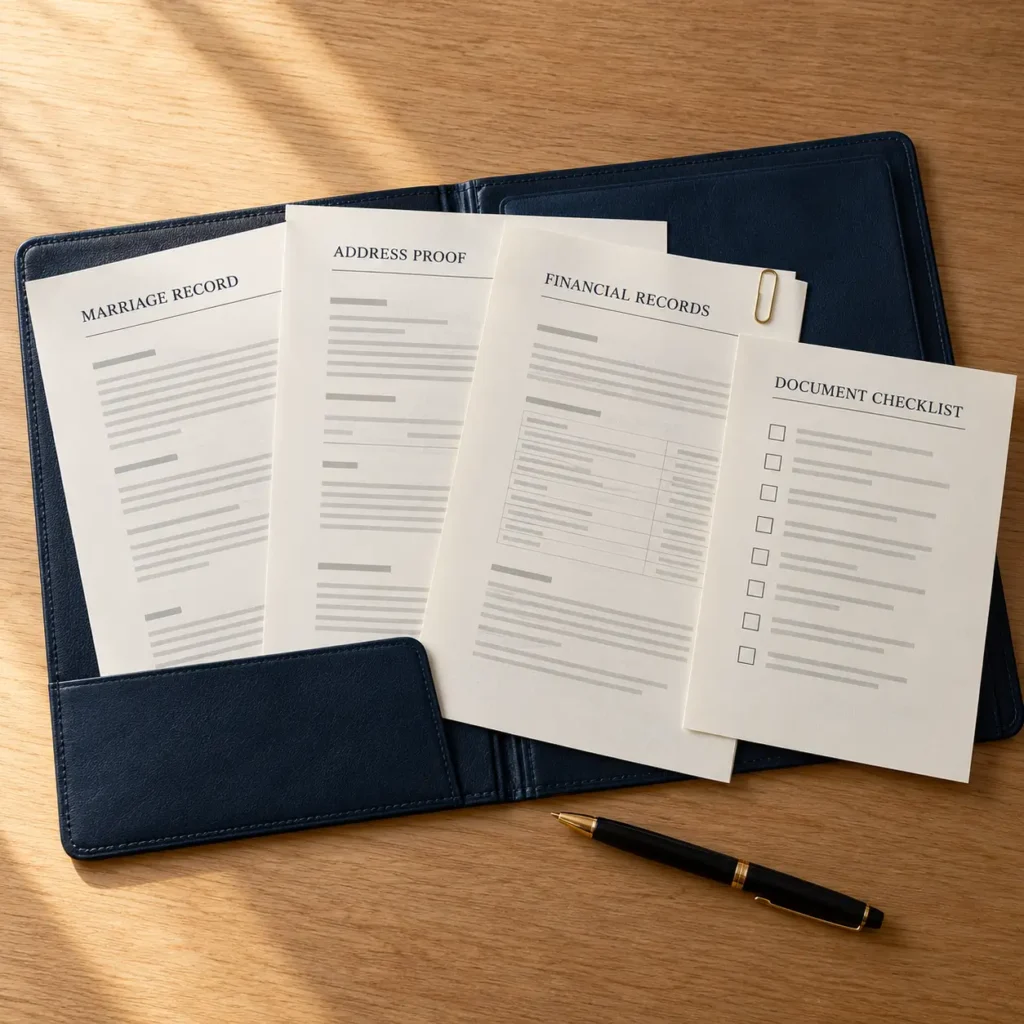
What to Prepare Before Discussing Your Divorce Case
You do not need to have every document ready before making an enquiry. However, a few basic details can help you understand which legal procedure may apply.
1. Keep Your Marriage Details Ready
Note the date and place of marriage. Keep your marriage certificate or other available marriage records accessible.
2. Check Your Residential Details
Identify your current address, your spouse’s address, and where you last lived together. These details may be important for determining jurisdiction.
3. Preserve Relevant Financial Documents
Keep available salary slips, bank statements, income tax returns, and information about assets or liabilities, especially when maintenance is disputed.
4. Choose a Suitable Contact Method
You can call our office or use the website’s WhatsApp chat option for a brief enquiry. Avoid including detailed allegations or sensitive documents in your first message.
How Are Maintenance Claims and Financial Disclosures Handled?
Maintenance proceedings may require disclosure of income, expenses, assets, and liabilities. In Rajnesh v. Neha (2020), the Supreme Court directed parties in maintenance proceedings to file the applicable Affidavit of Disclosure of Assets and Liabilities.
These records help the court assess financial circumstances before deciding relief. We assist with organising financial information, maintenance applications, and responses to claims. Any award depends on the law and evidence.

How G.S. Bagga & Associates Can Assist With Your Divorce Matter
At G.S. Bagga & Associates, we bring over 20 years of combined experience in divorce and family-law matters.
Our practice is led by Advocate Gagandeep Singh Bagga, the firm’s founder. We assist with matrimonial matters before the appropriate Delhi courts, including Saket Court where jurisdiction exists.
Our legal assistance includes:
- Jurisdiction and Case Review: Reviewing marriage details, legal grounds, and available remedies.
- Petition Preparation: Drafting divorce petitions, replies, and connected applications.
- Settlement Documentation: Preparing or reviewing financial and child-related arrangements.
- Evidence Preparation: Organising relevant records and financial disclosures.
- Court Representation: Assisting with hearings, submissions, and procedural requirements.
We focus on clear explanations, careful preparation, and representation appropriate to each case. Court decisions depend on the applicable law and evidence.
Frequently Asked Questions About Divorce at Saket Court
Can a wife file for divorce at Saket Court based on her current address?
Yes. Section 19(iii-a) of the Hindu Marriage Act allows a wife to file where she resides on the filing date, provided the address falls within the court’s territorial jurisdiction.
Can a husband file for divorce based only on his current residence?
Generally, no. Under Section 19, other qualifying connections include the place of marriage, the respondent’s residence, and the last shared matrimonial home. A statutory exception may allow filing based on his residence.
Can I file at Saket Court if my spouse lives in another city or abroad?
Possibly. Saket Family Court may have jurisdiction if the marriage, last shared residence, or another qualifying connection falls within its territorial limits. Living in another city or abroad does not, by itself, settle the jurisdiction question.
Can the six-month waiting period in mutual consent divorce be waived?
Yes. Under Amardeep Singh v. Harveen Kaur, the court may waive the interval between motions in suitable cases. It considers the circumstances and whether further waiting would serve a useful purpose.
Can I seek financial maintenance while the divorce is pending?
Yes. Under Section 24 of the Hindu Marriage Act, an eligible spouse with insufficient independent income may seek interim maintenance and litigation expenses. The court assesses the relevant financial information.
Is a mutual divorce agreement on stamp paper legally valid?
A settlement may record agreed terms, but it does not itself dissolve a marriage governed by the Hindu Marriage Act. A valid divorce decree is required.
Read more about divorce on stamp paper.
Where is the Saket Family Court located?
The Family Courts operate at Saket Courts Complex, Press Enclave Road, near Pushp Vihar, New Delhi 110017. Check your assigned courtroom before visiting.
Understand Your Divorce Options With G.S. Bagga & Associates
Whether you are considering mutual consent divorce or facing contested proceedings, understanding the available legal options and correct court is an important first step.
At G.S. Bagga & Associates, we assist with divorce petitions, maintenance applications, child custody matters, and connected proceedings.
Prefer WhatsApp? Use the chat option to message us directly
