


Divorce proceedings in India are not only emotionally stressful, but can also create significant financial uncertainty. Most couples worry about money and their financial security after separation. When people hear about alimony, they usually assume that only wives can claim financial support after divorce.
But that is not always true under Indian divorce alimony rules. In certain situations, a husband can also seek maintenance from his wife. Such cases are still uncommon, with only 1-2% husbands claiming maintenance in India.
However, globally, women now make up around 10% of alimony payers in progressive countries. Although this figure might be considered low, it indicates an increase in men seeking alimony over time.
If you are considering divorce and you seek spousal support, then knowing the ins and outs of alimony will greatly benefit you as you go through your legal proceedings. In this blog, we discuss in detail the husband’s right to claim alimony in divorce.
What is Alimony in Divorce?
Before understanding how husbands can get alimony, let’s understand what is alimony in simple terms, alimony is the monetary contribution from one spouse to another in case of divorce. Maintenance and alimony are often used synonymously.
However, there is a subtle difference between the two as per Indian laws. While maintenance means the monetary help needed during the divorce process, alimony refers to the amount required after the divorce is granted.
In most cases, at least one spouse in an Indian family would have taken a career break, dependent on the other spouse, or been earning less than the other. This leads to the need for alimony post-divorce due to financial difficulties faced by one of them. This ensures that divorce doesn’t leave one person poor overnight.
This divorce money is called alimony. It is not a punishment. It is to create a final balance and end a marriage with dignity.
What are the Different Types of Alimony?
In India, alimony is divided into different types based on the purpose, duration, and payment method. Your divorce lawyer will guide you to file for the best type according to your specific situation.
1. Interim Maintenance
Temporary financial support given while the divorce case is still pending in court. This will cover your daily expenses and legal costs.
2. Permanent Alimony
Amount of money granted after the divorce is finalised. You may be paid in monthly instalments or as a one-time payment.
3. Lump-Sum Alimony
A single one-time payment is made instead of monthly payments. This helps you and your ex-partner avoid future financial disputes.
4. Rehabilitative Alimony
A short-term monetary support is given to help a spouse become financially stable through education, skill training, or employment opportunities.
5. Compensatory Alimony
This is granted when one spouse makes sacrifices for the other’s sake. If you sacrificed your career or education to support your spouse’s professional growth, you can claim compensation for it.

When Can a Husband Claim Alimony From Wife?
For many years, alimony in India was mostly seen as financial support given by a husband to his wife after divorce. But with changing lifestyles, dual-income couples, and shifting family roles, Indian courts today also recognise that husbands may also need financial support. Various legal provisions provide gender-neutral divorce alimony rules, discussed later in the blog.
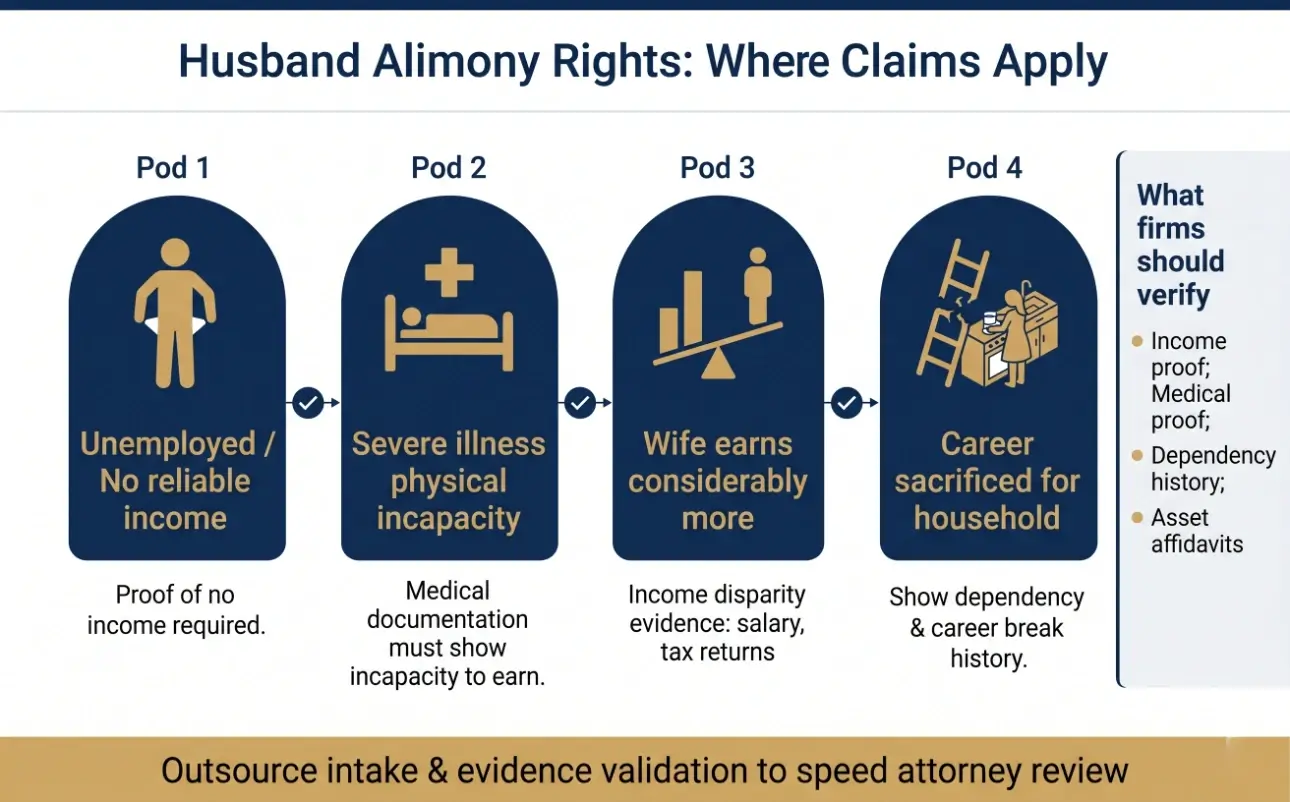
An eligible husband can apply for alimony from his wife when:
- The husband is unemployed and without any reliable means of income.
- The husband is severely ill or physically incapacitated.
- The wife earns considerably higher wages than the husband.
- He was financially dependent on his wife during the marriage
- He sacrificed his career to manage family responsibilities
- He is unable to meet basic living or legal expenses due to the divorce
An order for alimony is based on an analysis of certain considerations such as occupation, earning capacity, and health conditions. In Rani Sethi vs. Sunil Sethi, the husband was awarded alimony since he was financially weaker compared to his wife.
In situations where the husband can work but does not do so deliberately, the case will definitely be dismissed. Therefore, consult with an advocate to make sure that you present yourself adequately.
Important Divorce Alimony Rules for Husbands
The divorce alimony rules in India balance the statutory gender neutrality with strict filters to prevent abuse of the law.
Relevant Legal Frameworks
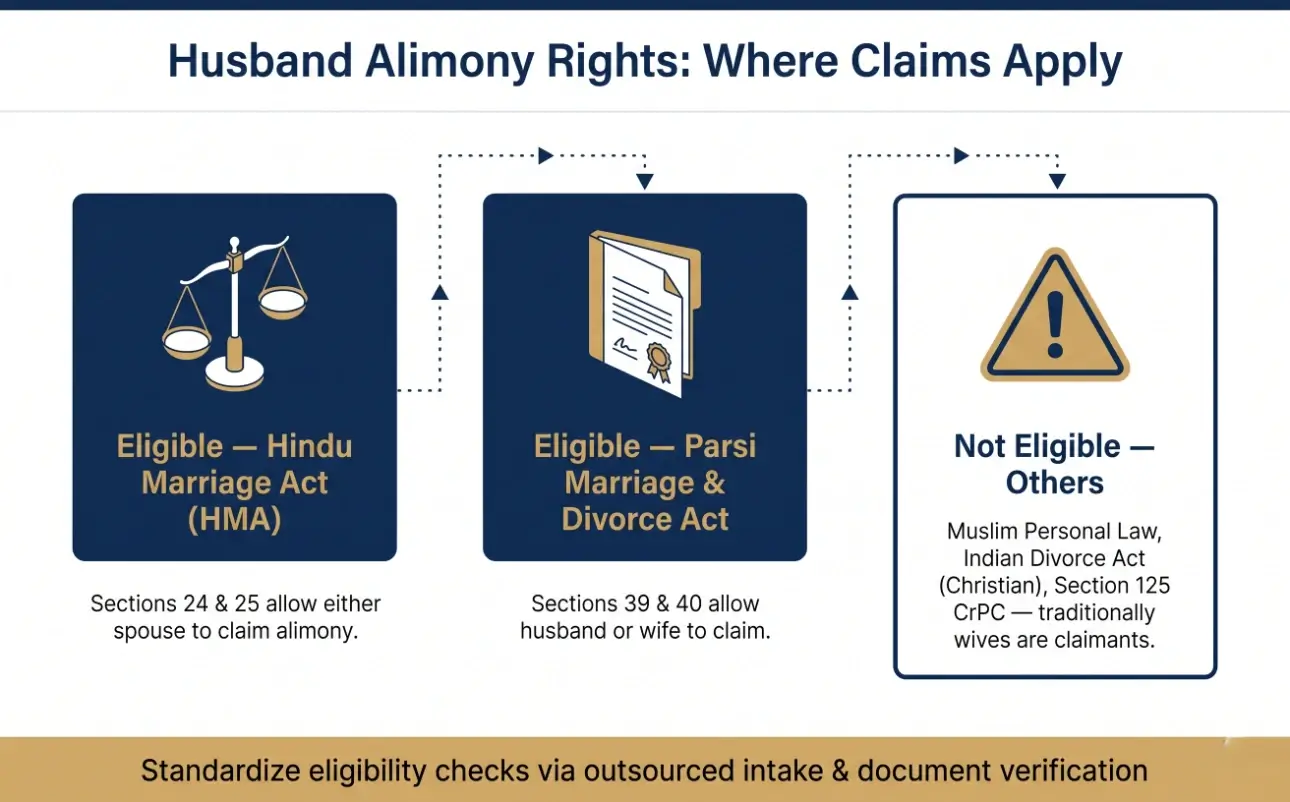
Under Indian divorce alimony rules, a husband’s right to claim alimony depends on the law under which the marriage was registered.
1. The Hindu Marriage Act, 1995
Section 24 covers temporary financial relief and legal costs while the case is pending. Section 25 covers permanent alimony granted after the divorce is finalised. Both sections state that “either the wife or the husband” can claim alimony. Thus, husbands have equal right to claim alimony in Hindu marriages.
2. Parsi Marriage and Divorce Act, 1936
Parsi personal law also allows husbands to claim temporary and permanent alimony under sections 39 and 40 of the Act. Both husband and wife have equal rights to claim alimony in a Parsi divorce.
3. Prohibitions
A husband cannot claim maintenance under Muslim Personal Law, Christian Law (Indian Divorce Act, 1869), or Section 144 of the BNSS/125 CrPC. These laws specify wives as claimants and husbands as alimony payers.
Eligibility Rules
These are the standards that make husbands eligible for alimony in India.
1. “No-Idleness” Standard
An able-bodied, educated, and physically fit man cannot claim alimony. Choosing not to work or deliberately quitting a job to force your wife to pay alimony will result in the dismissal of your application.
2. Incapacity Rule
To legally qualify, a husband must prove a permanent physical or mental disability or medical issue that stops him from earning. This also must not be a deliberate attempt to claim alimony.
3. Career Sacrifice
A husband may claim maintenance if he can show that he has voluntarily sacrificed his professional growth to take up the household responsibilities and support his wife’s career.
In Bhagyashri w/o. Jagdish Jaiswal vs. Jagdish Jaiswal, the Bombay HC ordered the wife, a teacher, to pay alimony to the husband. He claimed poor health, no independent income, and stated that he has sacrificed his career to manage the household and support his wife’s education and career.
Rules to Stop Alimony
A husband’s right to receive alimony or maintenance terminates immediately if:
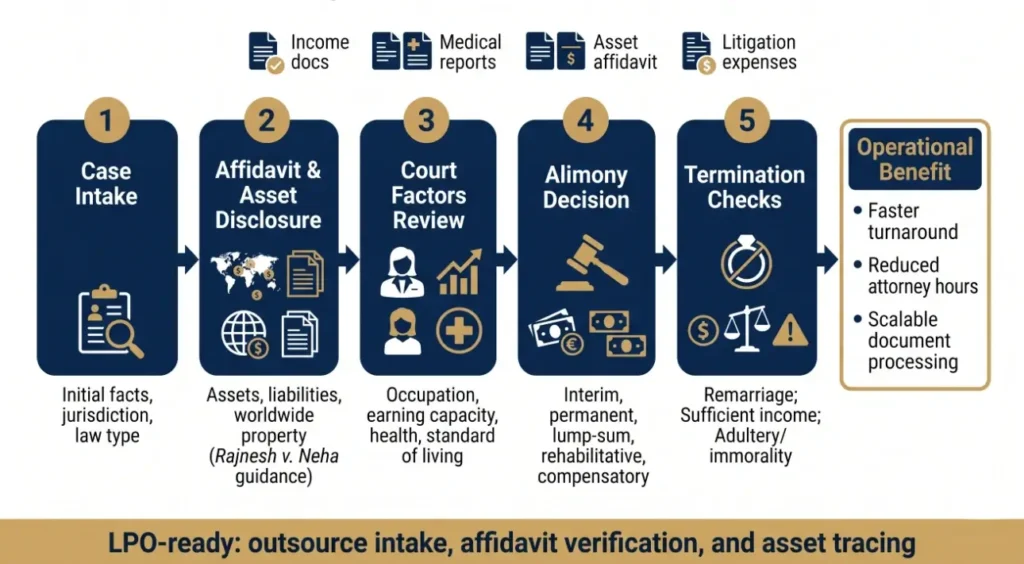
1. Remarriage: The husband gets remarried.
2. Sufficient Income: He recovers from an illness, gets a job, or becomes rich enough to support himself without any external help.
3. Adultery/Immorality: It is established that he lives with another person out of wedlock in a conjugal relationship.
How Do Indian Courts Calculate Alimony?
There are no set rules for determining alimony payments in India. The courts take into consideration several aspects when deciding how much alimony should be paid.
1. No Legal Formula: There is no set calculation method discussed within any statute concerning India. The decisions are made on a case-by-case basis.
2. The Assets & Liabilities Principle: As per the guidelines laid down by Rajnesh vs. Neha, both parties need to provide a statutory affidavit that includes information about their assets and liabilities around the world.
3. The “Standard of Living” Rule: The ultimate benchmark for a successful claim is to ensure the dependent spouse’s lifestyle matches the comfort level experienced during the marriage.
4. Inflation Rules: In active, continuous maintenance decrees, courts increasingly apply a 5% automatic escalation clause every two years to protect the value of the support against inflation.
Important Financial Considerations
Do not forget to consult an attorney specializing in divorce to know what financial issues can occur during your divorce proceedings. There are various financial considerations before you apply for alimony.
Hidden Assets
Under the Supreme Court’s Rajnesh v. Neha ruling, both spouses must file comprehensive asset affidavits. Husbands must trace a wife’s digital investments, business turnovers, and properties held in relatives’ names.
Legal Fees
Court litigation is an expensive process. Apart from lawyers’ fees, there are various expenses you must consider. Various Indian laws we discussed before allow a dependent husband to claim immediate litigation expenses from a wealthy wife to balance legal fighting power.
Child Support
Custody alters payouts. If the husband raises the children, his maintenance claim increases significantly. If the wife has custody, his alimony is heavily reduced to offset child support duties.
Tax Impact
One-time lump-sum alimony is a tax-free capital receipt for the husband. However, monthly maintenance is fully taxable as income. The paying wife gets no tax deductions.
Conclusion
Although husbands claiming alimony in India is still rare, our courts do recognise such rights in genuine cases of financial dependency, illness, disability, or major career sacrifices. Since divorce alimony rules in India vary depending on applicable laws, financial records, and overall situations, proper legal guidance becomes extremely important.
If you are seeking alimony or fighting against an unfair alimony case, then an expert divorce advocate can assist you. G.S. Bagga & Associates is an expert legal consultancy firm in Delhi that offers legal advice in divorce, alimony, and child custody in India.